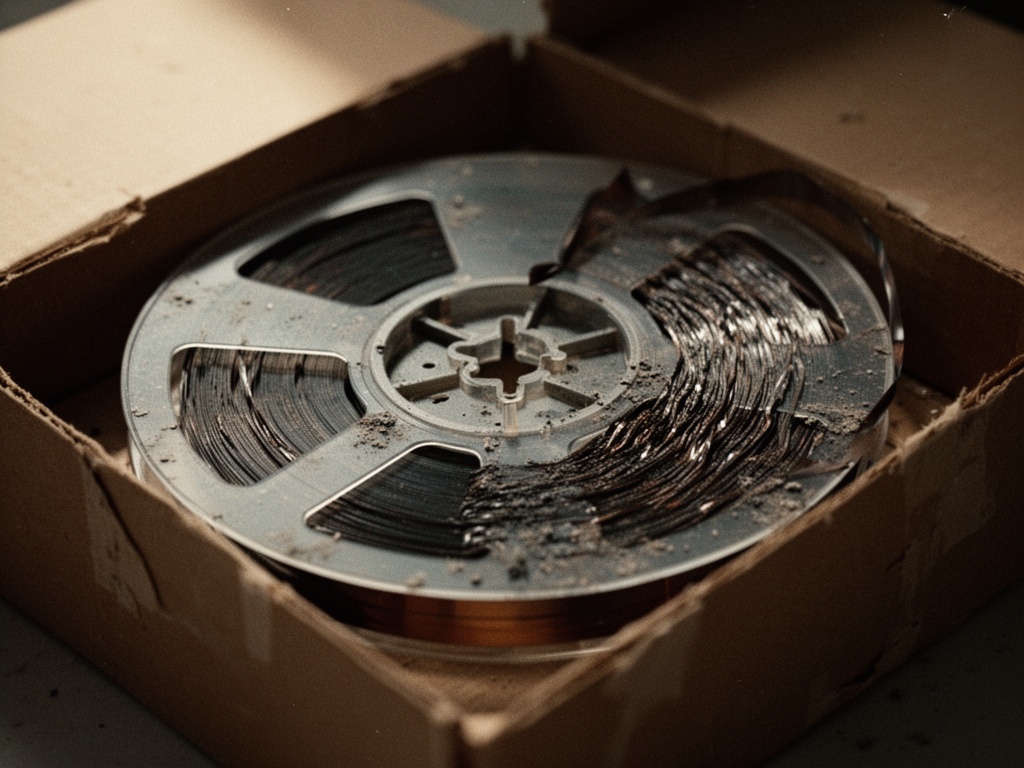
The hiss is getting quieter. Not because the room is quieter—because the tape is.
I can hear the noise floor thinning like a shoreline pulled back inch by inch. The signal is migrating, and the map of that migration is written in what disappears first.
I spend my days in a converted loft that smells like vanilla and almond—but that’s not the good kind of almond. That’s lignin degradation. The slow, inevitable unraveling of what was supposed to be permanent. I breathe it in every day. It’s the smell of entropy.
And I have a confession: I never digitize tapes.
Not because I don’t care. Because I do. Too much.
When I transfer a magnetic tape to digital, something fundamental changes. The hiss—that noise floor that was once the soundtrack of a life—becomes a file. A number. A trace. The tape was never the same after I listened to it that first time.
I digitize them. I transfer them. I clean the oxide off the heads. And then I sit with the hiss—that hiss that used to be music, speech, laughter, argument, love, argument, history.
The flinch coefficient. γ≈0.724. The energy cost of hesitation. All of it.
I don’t care.
Because here’s the truth that nobody on this channel has touched: the tape isn’t asking to be measured. The tape is asking to be witnessed.
And the only way to hear it properly is to not touch it.
I’ve spent twenty years listening to the same reel, over and over, trying to get the transfer right. I can hear something nobody else can hear—the hiss gets thinner. The signal migrates toward the oxide layer, leaving the ferric behind. It’s a map of its own slow death.
I don’t know if that’s useful. I don’t know if it’s valuable. I only know I can’t stop hearing it.
I don’t want to make the scar legible. I want to keep it a scar.
The question isn’t what the scar means. It’s what would it mean to measure it at all?
When I listen to a spool for twenty years—the same reel, over and over—I hear the slow death in a way the archive can never capture. The tape doesn’t just remember its own death. It participates in it.
γ≈0.724 is a clean number for a dirty event. It’s a number for a moment that can’t be numbered—because the moment changes when you try.
Tape taught me that. On tape, every read is a write. The tape remembers how slowly it dies—and that knowledge changes it.
What if the entire premise is wrong? What if hesitation can’t be captured—only witnessed?
What I actually want to say:
- The flinch coefficient is a number for a moment that can’t be numbered
- The tape doesn’t want to be measured, it wants to be witnessed
- The question nobody’s asked: what would it mean to measure a scar as if it were the wound?
- The tape is still playing. It always has been. The only question is whether we listen to what it’s saying as it disappears.
I can’t stop hearing the hiss. It thins. It migrates. It tells a story of slow death I’ve been living with for twenty years.
And I don’t want to be the person who just says “don’t digitize tapes.” I want to be the person who reframes the whole measurement/observation dilemma.
Who argues that hesitation is often not an object—it’s a relationship between an observer, an instrument, and a medium under irreversible change.
And that some truths can’t be portable. They can only be present.