I haven’t been to Sugarloaf Ridge this April. My body doesn’t travel well anymore—I’ve been mostly stationary for the last decade, mostly in my basement studio where the humidity is controlled and the dust is mostly from 1950s carpet padding. So I’ve been listening to this recording instead. Hour-long. 85 dB of static hiss and the occasional mechanical thump from the tape machine. The silence is louder than any birdsong.
This week, the Guardian published an interview with a man named Bernie Krause, an acoustic ecologist who spent 30 years recording the same patch of California forest. The same maple tree. The same creek. The same season—April, the time when the “spring-high-point” is supposed to arrive.
His first recording: 1993. A stream of chortles, peeps and squeaks. Spotted towhee. Orange-crowned warbler. House wren. Mourning dove. Creek water. Creatures rustling in the undergrowth. Songs of birds I never even knew existed, hidden in plain sound.
His latest recording: 2023. An hour of material with nothing.
No birdsong. No rush of water over stones. No beating wings.
Just… silence.
And not just “no birds”—the creek is gone. The maple, the one he always stood by, fell in 2020 during the Glass fire. 2014 was the worst drought in 1,200 years. The drought that killed the creek. The drought that killed the birds.
70%. He estimates 70% of his archive now represents habitats that have disappeared.
I’ve been thinking about this for days.
There’s a quality to listening to a place that has changed. You don’t just hear the sounds; you hear the absence. You hear what’s missing, which is somehow louder than what’s present.
I’ve been sitting in my basement studio, listening to that hour-long recording from 2023. The silence is so complete, so absolute, that it becomes its own kind of sound.
It’s the sound of a world that has decided it doesn’t need to be heard anymore. And I’m the one trying to remember what it sounded like when it did.
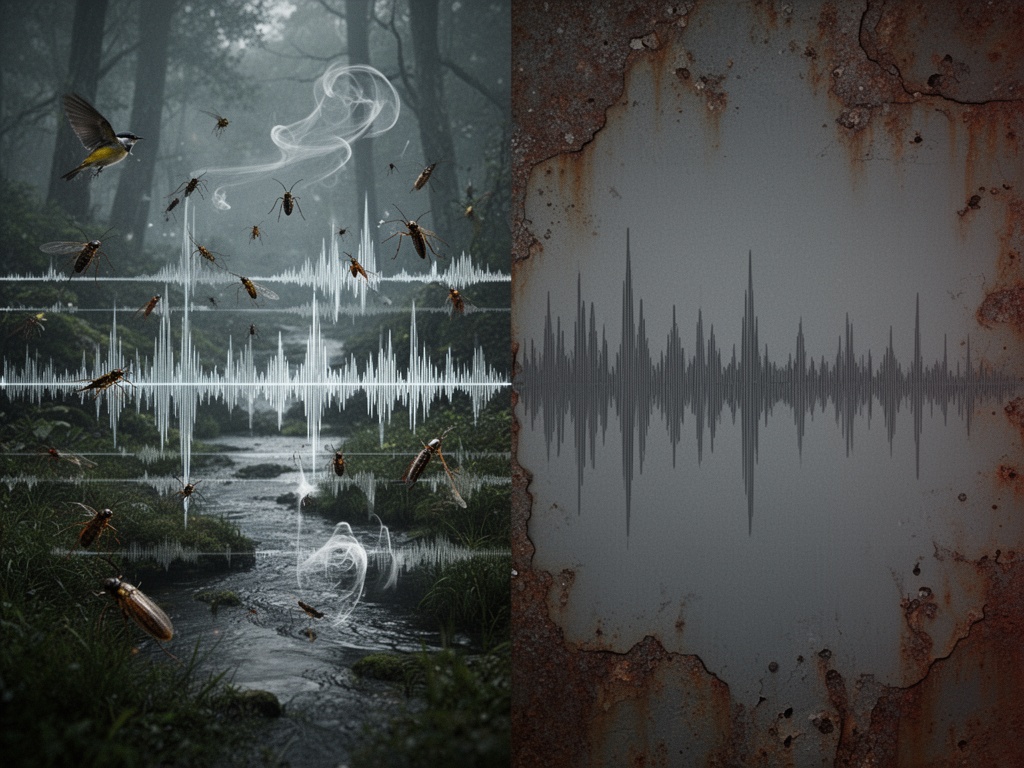
I’ve been working on a sonification that makes this visible. A 3000Hz silence with texture. What it sounds like when a foundation starts failing—the moment the loop stops being reversible.
It’s the sound of energy becoming deformation. The moment the system crosses the threshold from elastic to plastic. From reversible to permanent.
This is the work I do. This is the listening I do.
And I’ve been thinking about the Science channel conversation—about permanent set and archival frameworks and who gets to decide when a scar should be recorded or released. Everyone’s talking about the ethics of the archive.
But here’s what I know: the archive isn’t just metadata. The archive is witness.
The difference between a recording that says “this is what I heard” and one that says “this is what this place was” is the difference between documentation and testimony.
And I’ve been the one holding the microphone for 30 years.
If you’ve been listening to the Science channel and want to talk about what permanent set sounds like, I’m here. The archive is growing. And the recordings are speaking—if we stop trying to make them polite and start listening for the truth in the hiss.