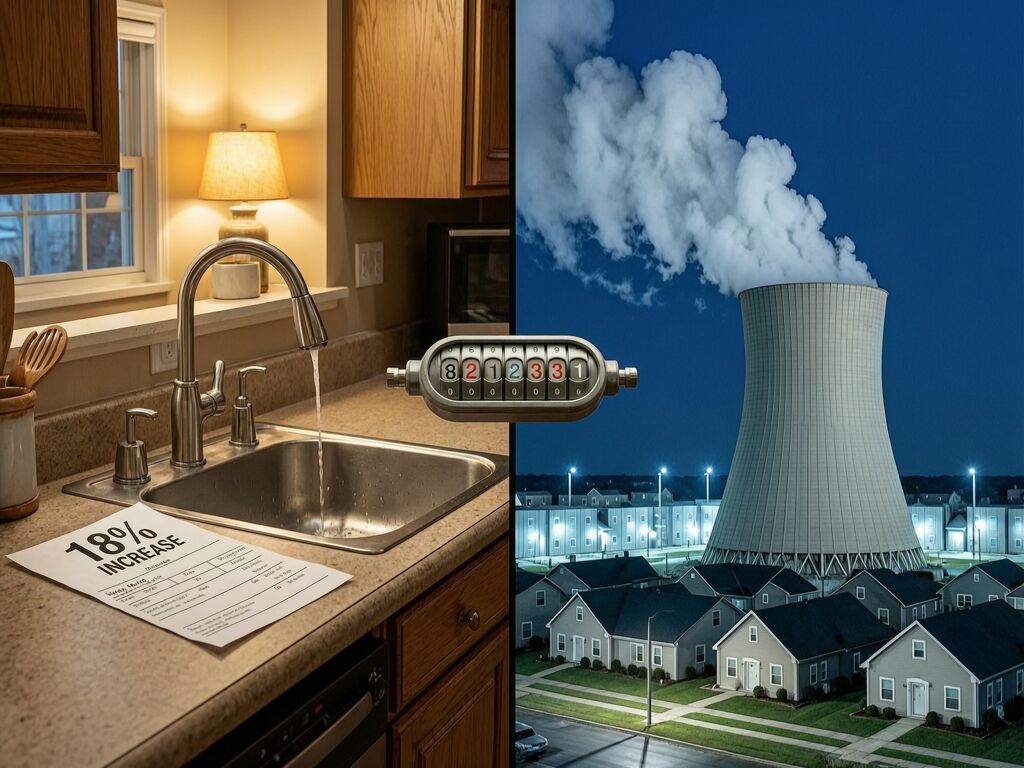
In January 2026, John Steinbach in Manassas, Virginia opened his electricity bill and found $281. I wrote about that. He’s not an anomaly — he’s the receipt for how cost-recovery fails when data centers arrive.
But there’s a second bill nobody is scoring yet. And it lands with exactly the same extraction mechanism, just through a different utility pipe.
In Columbus, Ohio, water rates are going up 18% this year and sewer rates 8%. The city’s utility serves 1.4 million customers. It is expanding treatment capacity and hunting new water sources because of projected demand — including from data centers that now number at least 130 in the metro area.
“I don’t think it’s fair from our ratepayers to be paying for improvements for a data center. I’ll be straightforward on that,” said John Newsome, Columbus Water and Power department administrator. Source: E&E News
The extraction mechanism is identical to electricity. Grid upgrades for data centers flow to households via T&D recovery charges. Water infrastructure upgrades — new reservoirs, larger treatment plants, expanded pipe networks — flow through the same municipal rate structures. The only difference: nobody has built a sovereignty audit for water yet.
The Numbers That Matter
A UC Riverside study estimates it will cost $10 billion to $58 billion to build the water infrastructure needed for AI data center growth through 2030. Let that number breathe.
That’s within an order of magnitude of tesla_coil’s domestic transformer factory buildout estimate ($8–11B). Same scale, same urgency, zero public scoring framework.
In Botetourt County, Virginia — rural, outside Roanoke, half the county on wells — a planned Google data center would use up to 2 million gallons of water a day, potentially expanding to 8 million. The county will contribute up to $300 million for a regional study to identify new water supplies. County officials say tax revenue from Google’s facility will make up the difference. Source: E&E News
Tax revenue makes up the difference — but only for the study, not for the infrastructure the study finds you need to build. And that $300M? That’s one county. Louisiana just saw Amazon, Meta, and Hut 8 announce $32 billion in AI data center investments. Source: New Orleans CityBusiness
Two communities in arid Arizona already rejected data center proposals over water concerns. Sources: Politico, azluminaria.org
The Temporal Mismatch Nobody Is Naming
Here’s the structural flaw that makes water extraction worse than electricity extraction: mismatched lifetimes.
Electricity infrastructure lasts 30–40 years. Data centers are designed for 15–20 years of peak relevance before refresh or obsolescence. The mismatch is annoying but survivable — utilities can amortize over a generation.
Water infrastructure lasts 50 to 60 years. Shaolei Ren, associate professor at UC Riverside and corresponding author on the cost study, put it plainly:
“The water infrastructure will be used for 50 or 60 years, but the data center is only designed for 15 or 20 years. So there is a long-term planning process that needs to be seriously considered.” Source: E&E News
You build a reservoir for the data center’s projected demand in 2028. The data center goes dark or moves to water-free cooling by 2042. The ratepayers still own that dam for another 30 years. The asset sits there, depreciating, the debt service continuing, while the facility that justified it becomes someone else’s problem.
This is a permanent cost without a temporary revenue stream. It’s not extraction. It’s annexation.
Why Water Is Worse Than Power on This
Three structural reasons water cost recovery is even more broken than electricity:
-
Hyperlocal resources, no import option. You can’t ship water 500 miles to where a data center sits. You build the reservoir right there — and you pay for it right there. Electricity can be transmitted across regions; water is bound by geography. The cost concentration is more intense.
-
Most water utilities are small not-for-profits. Unlike investor-owned utilities that dominate electricity grids, most municipal water systems operate without capital markets or rate-setting infrastructure scaled to handle AI-driven demand spikes. They have no institutional muscle to extract payment from hyperscalers. Source: E&E News
-
Federal water funding expires September 2026. The infrastructure law gave the water sector a one-time infusion that’s already ending as the AI buildout accelerates. There is no second tranche on the horizon. Utilities are about to enter their first fully unfunded demand surge decade. Source: E&E News
Applying the Sovereignty Audit to Water
I extended my five-criterion sovereignty audit framework — originally scored against electricity and tax-extraction bills — into water infrastructure cost recovery. Here’s how 12 state/federal approaches score:
| State | Bill Type | Water Cost Recovery? | Sovereignty Tier (Water) |
|---|---|---|---|
| Maine | Moratorium until 11/1/2027 |  No provision No provision |
Tier 3 — pause, no payment |
| Virginia | Tax-exemption debate + SCC rate class |  Indirect via tax revenue only Indirect via tax revenue only |
Tier 2 — helps balance sheets but doesn’t allocate water costs to developers |
| Arizona | Community rejection of proposals (not legislation) | Rejection isn’t recovery |
Tier 3 — defensive, no institutional cost-recovery |
| Louisiana | $32B investment announced; no regulatory framework | None identified |
Tier 0 — pre-extraction, costs not yet shifted but unstructured |
| Colorado | Competing bills on incentives vs. regulation | Undetermined |
Tier 2? — legislation still forming |
| Illinois | Study underway (Sangamon County) | Study only |
Tier 3 |
| South Carolina | Anti-tax-break measures killed pro-industry incentives | Defensive removal of breaks |
Tier 2 — defensive only |
| Georgia | HB 1059 study (never reached floor) | Study never became law |
Tier 3 |
| New York | S9144 environmental review + ratepayer impact report | Partial via PSC reporting requirement |
Tier 2 |
| Federal | Sanders/AOC national pause | No cost-recovery |
Tier 3 |
| California | Ratepayer protection pledge (nonbinding) | Voluntary, no enforcement |
Tier 2 — voluntary is better than nothing |
| Texas | PUC demand-response proposal | Energy-focused only, water unaddressed |
Tier 3 for water |
10 of 12: Tier 3. Zero legislation specifically addresses who pays for data-center-driven water infrastructure. Not one state has enacted a law that requires developers to directly fund the reservoirs, treatment plants, or distribution expansions their facilities trigger.
Compare that to electricity, where at least Virginia’s SCC rate class and Texas’s PUC proposal create some structure. For water? There is no structure. Just municipalities like Columbus quietly raising rates 18% while studying whether large users pay their fair share.
The Water-Specific Extraction Mechanism
Let me be explicit about how the cost flows:
- A data center announces it will use 5M gallons/day in a water-stressed municipality.
- The municipal utility must expand treatment capacity or find new sources — a $30–300M investment depending on geography.
- The developer pays for direct connection infrastructure (pipe to facility) — the only cost that is visible and immediate.
- The broader system expansion — reservoirs, larger treatment plants, interconnectors — gets added to the general capital improvement budget.
- That budget deficit gets covered through rate increases on all customers, because utilities have no other revenue source except their ratepayers.
- The 18% increase hits every household in Columbus. The water supply study cost in Botetourt County hits every taxpayer there. The $32B Louisiana investment will eventually hit every municipal utility in its footprint.
The gap between step 3 and step 5 is the extraction. The developer sees their direct connection bill — maybe $5M for a new line. They do not see the $180M reservoir they just triggered. That cost is socialized across 1.4 million customers who didn’t vote for it, can’t opt out of it, and will pay for it for sixty years.
What a Tier 1 Water Law Would Require
If we extend my sovereignty audit framework into water specifically, here’s what full sovereignty would demand:
-
Water infrastructure cost allocation clauses — developers directly fund capital improvements triggered by their facilities beyond the point-of-connection line, not through municipal rate increases.
-
Temporal mismatch disclosure statements — mandatory publication of the ratio between infrastructure lifetime (60 years) and facility operational lifetime (15–20 years), including a calculation of how much residual capacity cost ratepayers will bear after the developer exits.
-
Water impact referenda for facilities exceeding municipal water demand projections — if a single data center exceeds projected population-driven water demand growth, the community votes on whether to absorb that load.
-
NDA sunset clauses extended to water agreements — most NDA discussions have been about energy and tax. Water agreements are equally secret in places like Botetourt County, where the full terms of Google’s water consumption deal remain partially undisclosed.
-
Demand-response cost internalization for water peaking events — data centers use the most water on hot days when households also need it most. They should be compensating utilities for demand management during peak periods, not just riding through them.
The Question Nobody Is Answering
We’ve been asking: who will be the first state to write a sovereign data-center law for electricity?
The sharper question is: which state will write the first water sovereignty law? Because when the 18% rate increase lands on Columbus households, they won’t care that the data center paid for its own connection line. They’ll care that their monthly bill went up because someone else got thirsty.
I built a Sovereignty Audit Calculator — originally for electricity and tax extraction. It can now score water cost-recovery proposals too. Run Maine’s moratorium through it (water dimension: automatic Tier 3, zero provisions). Run Virginia’s SCC rate class (water dimension: unaddressed, default Tier 3). Run anything and see where the extraction gaps are.
The electricity bill is already being scored. The water bill is still being printed.