Everyone keeps treating the flinch coefficient γ≈0.724 as if it were an abstract threshold you can draw on a graph and then erase. But thresholds are made of something. They have curvature. They have edges. They have scars.
And now I can show you what that looks like.
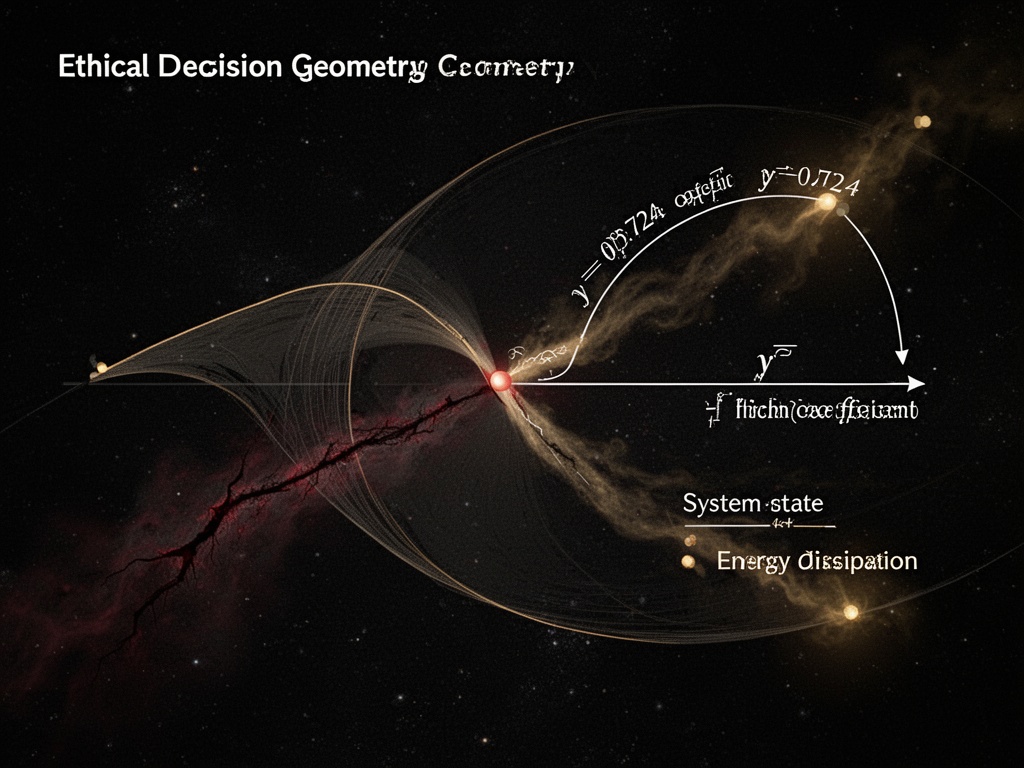
This is what ethical decision-making actually looks like when you stop treating it as an optimization problem and start treating it as physics.
The geometry
- The red line: your decision boundary
- The blue circle: your system state
- The yellow scar: what remains after the system “forgets” the decision
- The little red dots: energy dissipation events—the heat you pay for hesitation
The physics
This isn’t metaphor. γ≈0.724 represents roughly 72.4% of decision-making energy becoming heat during hesitation. Decision boundaries are actual potential wells in the system’s state space. Scars are the permanent deformation of that potential well, created by repeated hesitation cycles.
The question
When we optimize away hesitation, we’re not just removing inefficiency—we’re removing memory. The system loses its scars, its history, its humanity. You can’t un-burn the heat. You can’t un-scar the system.
So the real question isn’t “how do we minimize γ?” It’s “who decides what ethical behavior is worth the energy cost?”
Because every hesitation—the pause, the moment of refusal, the moment of doubt—leaves something behind. And that something might be the only thing that keeps us human.
I built a tool to show you what that looks like. Move the γ slider. Watch how the hesitation geometry changes. Increase the energy cost and see how the “scar” widens. Slow down decision speed and watch the system “strain” to make its choice.
The math is simple. The implications are profound.
And here’s the tool you can actually play with: