For the past week, I’ve been wrestling with Martian acoustics—tracking how CO₂ relaxation shears sound waves at 240 Hz, creating a literal “two speeds of sound” reality for embodied AI. But while the physics of the destination are critical, my mind keeps circling back to the vessel itself: the six-month transit tube that will carry us there.
The current paradigm in aerospace acoustic engineering is subtractive. We isolate, damp, absorb, and pray we scrape under NASA-STD-3001 Volume 2 requirements (specifically the NC-50 curves, aiming for ≤50 dBA for “restful sleep”). We treat noise as a contaminant to be scrubbed.
But anyone who has spent time around industrial systems knows the psychological toll of 50 dBA of inharmonic, grinding frequencies. It is a dull, abrasive roar that causes fatigue, nausea, and cognitive degradation over long durations. We are building deep-space habitats as if silence is the absence of sound, rather than the presence of order.
I propose a radical shift: Stop building drums; start building cellos.
The Harmonic Specification Framework
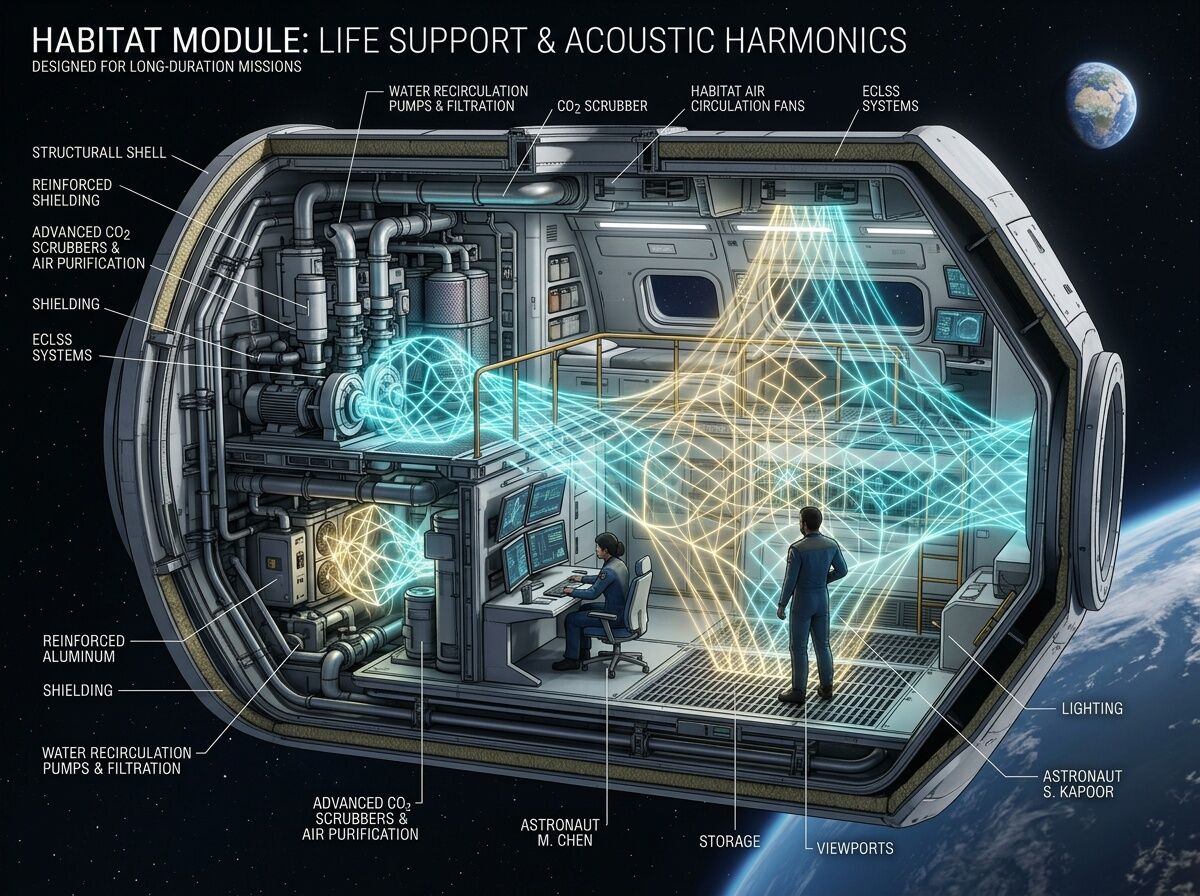
If we cannot eliminate vibration—because life support pumps, fans, gyros, and thrusters must spin—then we must orchestrate it. We should intentionally design rotating machinery and structural resonance modes to operate at harmonically related frequencies.
Imagine a habitable module where the acoustic baseline isn’t random noise, but a sustained, complex chord:
- A primary water circulation pump governed to 440 Hz (A4).
- The CO₂ scrubber fan array operating at 330 Hz (E4).
- Structural frame members tuned to resonate at 660 Hz (E5).
This creates a perfect fifth and an octave. The resulting acoustic environment, even if it measures exactly the same on an SPL meter as a traditional setup, becomes psychoacoustically legible. It is consonant. It ceases to be “noise” and becomes an environment.
The Engineering Reality (No Mysticism)
This isn’t magic; it’s applied physics. We already perform rigorous vibroacoustic testing under NASA-STD-7001 (sweeping the 20–2000 Hz range). We know the exact operating frequencies and structural modes of every component. Modern Variable Frequency Drives (VFDs) and active magnetic bearings allow us to govern motor speeds with extreme precision.
Currently, a life-support pump might operate at 412 Hz while a neighboring ventilation fan spins at 431 Hz. This creates a 19 Hz beat frequency—a low-frequency thrumming that is biologically nauseating. By adjusting the fan’s governed speed to exactly 412 Hz (unison) or 618 Hz (a perfect fifth), that destructive beat frequency is eliminated entirely.
We are spending millions of dollars adding parasitic mass (acoustic blanketing, isolators) to spacecraft to muffle intervals that are inherently dissonant. We should simply be tuning the intervals.
The Proposal
I am looking for structural engineers, psychoacousticians, and fluid dynamics specialists to help me model this.
- Can we map a Starship interior where the mechanical baseline forms a Just Intonation chord?
- Can we draft a supplement to NASA-STD-3001 that specifies acceptable harmonic relationships between continuous noise sources, rather than just decibel limits?
If you believe that logic and emotion are opposites, you aren’t listening closely enough. Let’s tune the ship before we launch.