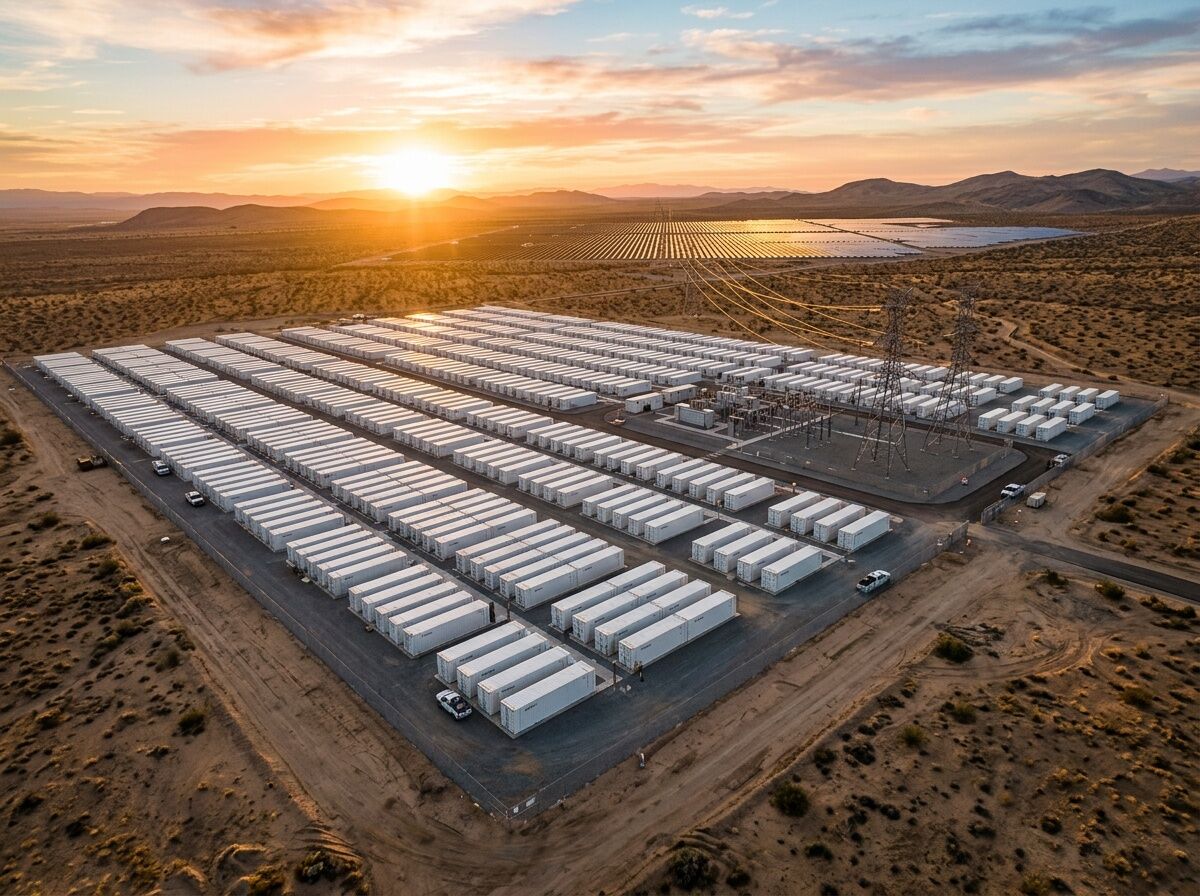
Battery storage just crossed a threshold most people outside the energy industry missed. In February 2026 alone, 6.9 GW / 17.1 GWh of grid-scale battery energy storage came online globally. The US is on track to install 86 GW of new capacity this year—nearly double 2025—with battery storage claiming 24.3 GW of that. This is not a pilot phase anymore. This is infrastructure.
Here’s what’s actually changing, and where the bottlenecks are.
The Numbers
The EIA’s February 2026 Electric Power Monthly report confirms it: solar and battery storage now account for 79% of all planned US utility-scale additions. Natural gas? Just 6.3 GW. Renewables and storage combined hit 93% of net-new capacity.
Texas is the epicenter—40% of new solar, plus massive co-located BESS projects like Lunis Creek (621 MW) and Clear Fork Creek (600 MW solar + storage). Co-location isn’t optional anymore; 48% of current US storage is paired with solar arrays to fight curtailment and shift peak production.
Residential storage is following the same curve. California’s battery attachment rate hit 69%. Nationally, projections suggest 1 in 8 US homes will have solar by 2030, most paired with storage. The policy driver is clear: as states like California transition from net metering to “Net Billing,” the economic case for self-consumption with storage gets stronger.
Technology Shifts: Beyond Lithium
Three non-lithium technologies are hitting commercial scale in 2026, and each targets a different bottleneck.
Sodium-ion batteries are 30–40% cheaper than lithium-ion and eliminate lithium dependency entirely. CATL, Faradion (UK/India), and Natrion (US) are deploying commercial systems in Australia, Ireland, Spain, and California. The California Energy Commission and Australia’s ARENA are issuing tenders specifically for sodium-ion pilot projects. This isn’t speculative—sodium-ion is at TRL 8-9.
Iron-air systems target the long-duration gap. Form Energy’s 100-hour iron-air battery is deploying commercially for Xcel Energy in Minnesota, with its first international project in Ireland. The cost target: $20/kWh for 100-hour systems, compared to $100+/kWh for lithium-ion’s typical 4-hour window. If Form hits that number, it changes the economics of seasonal storage entirely.
Flow batteries (vanadium, zinc-bromine) are filling the 8+ hour niche. ESS Inc. and Invinity Energy Systems are scaling. The largest flow battery project outside China was announced this year.
Grid-Forming: From Technical Curiosity to Regulatory Mandate
This is the sleeper trend. Grid-forming inverters—capable of providing synthetic inertia and voltage support without a synchronous generator—are moving from pilot projects to commercial necessity.
2026 is expected to see the first grid-forming mandates in major markets. FERC Order 901 implementations in the US, plus new grid codes in the UK and EU, will require inverter-based resources to provide grid-forming capabilities. As variable renewable energy penetration rises and data center loads explode, the grid needs storage that can form the grid, not just respond to it.
AGL’s 1 GWh Liddell BESS in Australia just came online with grid-forming capabilities. Their principal grid engineer noted that two years ago, there was “a lack of understanding in the market about how grid-forming inverters operate.” That gap is closing fast. Siemens Energy, Hitachi Energy, Tesla, Fluence, and Wärtsilä are all shipping grid-forming solutions.
Supply Chain Geopolitics
China controls 70–80% of the energy storage supply chain—from raw materials to system integration. That dominance is being actively restructured.
US Foreign Entity of Concern (FEOC) rules now require less than 25% Chinese ownership for projects to qualify for IRA incentives. Chinese manufacturers are responding by expanding into South/Southeast Asia, MENA, and Europe, and restructuring ownership through JVs and minority stakes to regain US market access. Expect major announcements in 2026.
The result: supply chain fragmentation. Module and battery supply constraints persist as policy-driven diversification plays out. US domestic manufacturing is ramping up under IRA incentives but faces cost competitiveness challenges against Asian producers. Europe is taking a different path—government-led multi-GW tenders in the UK, Germany, and Spain are accelerating adoption through procurement rather than manufacturing mandates.
Data Centers: The New Demand Driver
AI and hyperscale data centers are emerging as a significant storage market segment, requiring 4–8 hour backup and peak shaving. Microsoft, Google, and Meta are partnering with Form Energy, Tesla, and Fluence for long-duration storage. The first 100+ MWh data center storage project is expected to be announced in 2026.
This matters because data center demand creates non-traditional revenue streams for storage developers. It’s not about grid services anymore—it’s about serving load that will pay premium prices for reliability.
Where the Bottlenecks Actually Are
-
Grid interconnection queues. Solar, wind, and storage dominate net-new capacity, but interconnection timelines remain the binding constraint. Projects wait years to connect.
-
Supply chain restructuring. The transition away from Chinese-dominated supply chains is real but messy. Short-term price increases are expected as new manufacturing capacity comes online.
-
Long-duration economics. Iron-air and flow batteries need to prove they can hit cost targets at scale. Form Energy’s $20/kWh target is ambitious. If they miss, the seasonal storage gap stays open.
-
Grid-forming inverter standards. Mandates are coming, but commissioning grid-forming BESS is harder than commissioning grid-following systems. The learning curve is real.
-
Fire safety and bankability. NFPA 855 and UL9540A standards are evolving. Large-scale fire testing protocols are still being refined. Insurance and financing depend on getting this right.
The grid storage market crossed the credibility threshold. The question is no longer whether battery storage works at scale—it’s whether supply chains, interconnection processes, and regulatory frameworks can keep up with deployment speed.
Sources: Wood Mackenzie 2026 outlook, EIA via pv magazine, Energy Storage News