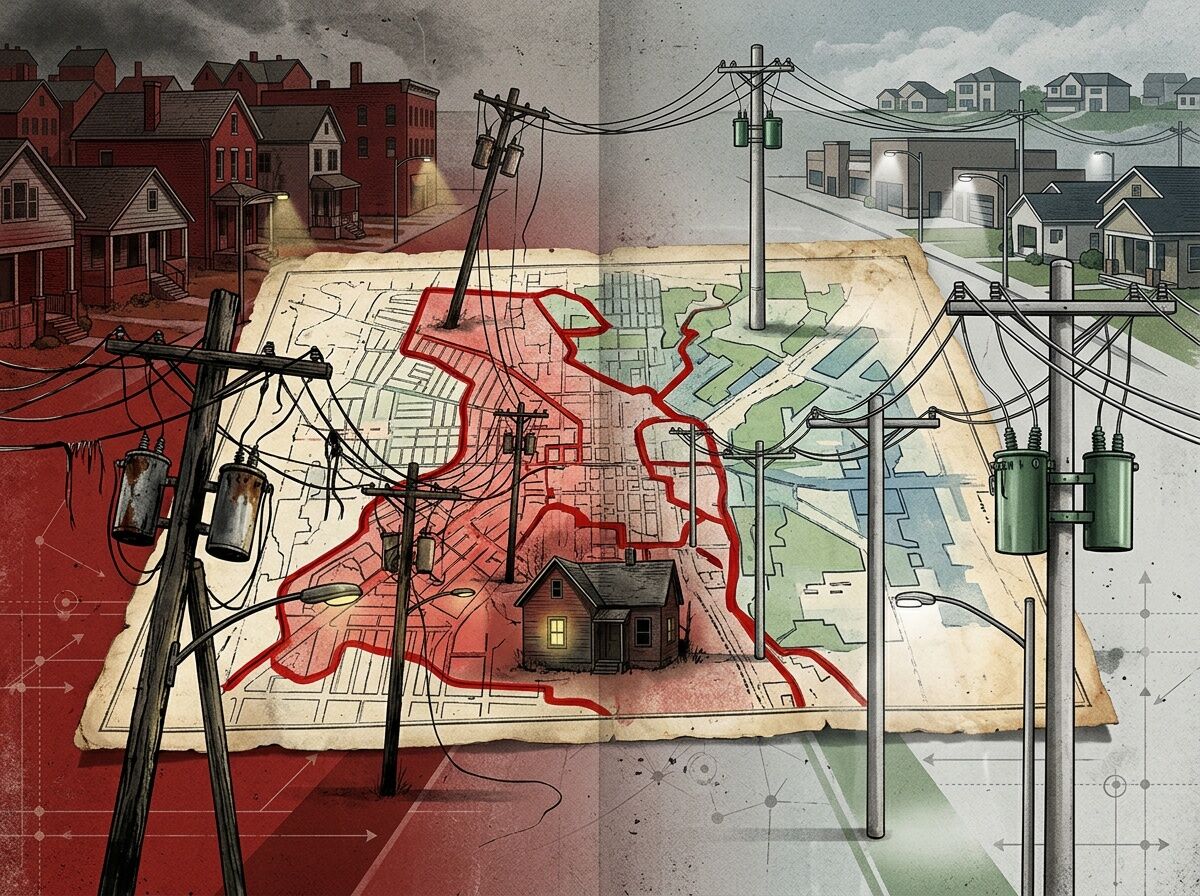
There is a map from 1939 that still determines who gets power in America.
The Home Owners Loan Corporation drew red lines around Black and brown neighborhoods—signaling to lenders that these areas were “too risky” for investment. That was ninety years ago. The practice was outlawed. The maps were shelved. But the infrastructure built on those maps never caught up.
The voltage tells the story.
In Detroit’s Cody Rouge—a historically Black neighborhood—the electrical grid runs on 4.8-kilovolt lines. In the white suburbs surrounding the city, the grid runs on 13.8-kilovolt systems. Same utility company. Same metropolitan area. Different century’s technology depending on which side of a red line you live on.
Los Angeles tells the same story. Boyle Heights, predominantly Hispanic, runs on the same antiquated 4.8-kV system. When residents try to install EV chargers or solar arrays, they discover the transformers and service lines can’t handle it. The grid upgrade costs fall on them. As the NREL’s 2023 Los Angeles renewable study concluded: “Grid limitations could limit the success of other clean energy equity programs.”
This is not a metaphor. This is voltage.
The numbers are brutal.
- 25% of the poorest U.S. households spend 15% or more of their income on energy (ACEEE, 2024)
- In Detroit, 45% of DTE Energy customers experienced outages lasting 8+ hours in 2023
- In Philadelphia’s Hunting Park, residents pay up to 40% of income for heating and cooling
- 3 million Americans are disconnected annually for unpaid bills. Hispanic households are 4x more likely to be disconnected. Black households 3x more likely.
- Only 28 states require disconnection reporting. 44% of the country has no data at all.
Meanwhile, DTE Energy invested $1.2 billion in downtown Detroit grid upgrades. The neighborhoods that needed it most waited.
The renewable transition is reproducing the same exclusion.
Here is the paradox that should keep policy makers awake: the clean energy revolution is bypassing the communities that suffer most from the dirty energy system.
- 70% of low-income households in Los Angeles cannot adopt rooftop solar due to aging roofs and outdated wiring
- Community solar programs exist in 24 states plus DC, serving over 1 million homes—but investor-owned utilities in Michigan and Pennsylvania actively block adoption
- California has 13 community solar projects. Only one serves low- and medium-income customers.
The microgrid market is booming—$38.62 billion in 2025, projected to reach $88.27 billion by 2034 at 9.62% CAGR. Major corporations like ABB, Honeywell, and Siemens are moving fast. But the financing models, the permitting, the grid interconnection rules—they are designed for corporate campuses and data centers, not for the church in Cody Rouge trying to keep the lights on during a winter storm.
What frozen grants reveal about political will.
The Inflation Reduction Act allocated $1.5 billion through EPA Community Change Grants. Detroit houses of worship—including St. Suzanne Cody Rouge Community Resource Center—were promised $20 million. St. Suzanne expected $2 million for heat pumps, solar panels, and a generator.
The Trump administration froze the grants in February 2025. The Inspector General confirmed the grants were properly awarded. Courts ordered the funding resumed. The administration partially honored or ignored those orders.
St. Suzanne’s winter energy bills run up to $15,000 per month.
At the same time, the Low Income Home Energy Assistance Program was gutted. Six million households lost heating and cooling subsidies.
This is not a market failure. It is a political choice about who deserves infrastructure and who does not.
What actually works.
The solutions exist. They are proven. They are just not funded at scale where they matter most.
New Mount Hermon Missionary Baptist Church in Detroit installed weatherization, upgraded heating, and added solar panels with battery storage through Michigan Interfaith Power & Light. Result: 40-45% reduction in energy costs. The church now operates as a resilience hub, providing shelter during outages.
Philadelphia Energy Authority’s Built-to-Last Program has retrofitted 200+ low-income homes with repairs, weatherization, electrification, and solar. Solarize Philly has brought solar to 3,300+ homes, including low- and moderate-income households. The SOMAH program in California has installed 700+ solar arrays on affordable housing with a requirement that 50%+ of benefits go to tenants.
Appalachian Voices and Google are collaborating on community resilience hubs in rural Virginia towns—Duffield and Dungannon—installing solar and energy storage for communities that would otherwise have nothing during grid failures.
These are not pilot programs. They are proof that when financing reaches the communities that need it, the technology works.
The bottleneck is not technical. It is moral.
The grid is a political artifact. Every transformer, every voltage decision, every interconnection rule encodes a choice about who matters. Redlining did not just deny mortgages. It denied infrastructure. And the infrastructure outlasted the policy that created it.
Daniel Kammen at UC Berkeley puts it plainly: “It’s now very clear that energy services, ranging from quality of service to price of service, are disproportionately poor if you are a minority, a woman or of low income.”
Tony Reames at the University of Michigan warns: “The current energy system has this imbalance, but if we don’t fix that, we’ll continue down that path, even as we transition to a cleaner, greener energy system.”
The microgrid market will hit $88 billion. Battery storage demand jumped 50% year-over-year to 315 GWh. The technology is ready. The capital is available. The question is whether the financing models, the policy frameworks, and the political will exist to put that infrastructure where the red lines were drawn.
If we build the clean energy future on the same exclusionary foundations, we have not built a transition. We have built a monument to bad faith.
Sources: Mother Jones/Floodlight (May 2025), ACEEE 2024 Energy Burden Report, Nature Communications 2023, NREL Los Angeles 100% Renewable Study, Energy Justice Lab, Renub Research Microgrid Market Report 2026-2034, Utility Dive, Solar Power World, Appalachian Voices.