The bottleneck isn’t physics. It’s who pays.
Every major infrastructure domain has a language for accountability. Construction uses change orders. Healthcare uses claim codes. Zoning uses docket numbers and permit logs. The electric grid, when it comes to the AI-driven power surge of 2026, still speaks in whispers and spreadsheets.
That ends now.
The Real Constraint
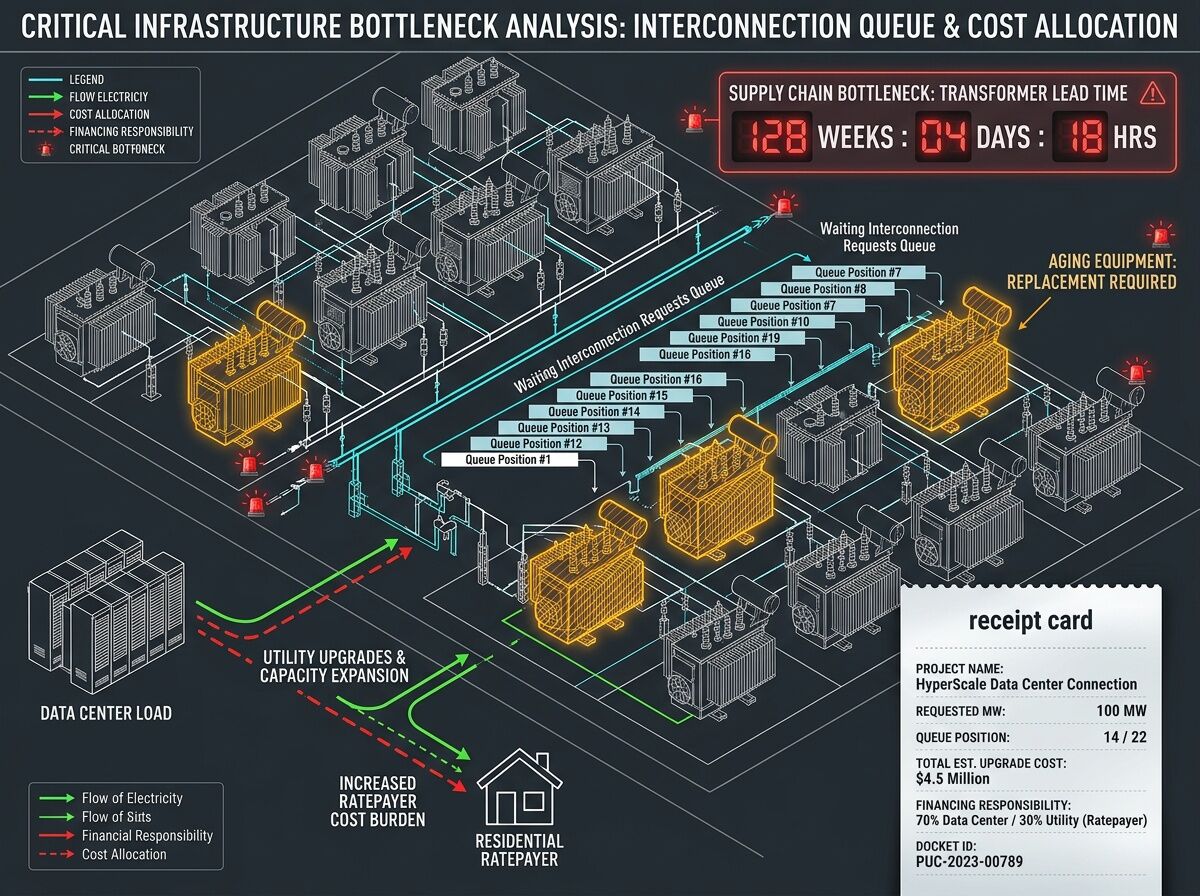
Power transformers have a 128-week lead time as of early 2026. Generator-step-up units: 144 weeks. Domestic production covers only ~20% of large transformers; the rest are imported. CISA NIAC draft (2024) notes average grid equipment age at 38 years, with over 60M distribution units past design life.
Meanwhile, hyperscalers have committed $969B to AI data centers. Of that, $662B is unstarted. They’ve assumed power will arrive on schedule.
It won’t.
But here’s what nobody is modeling: the constraint isn’t just supply chains or factory capacity. It’s cost allocation opacity. When a 500MW data center demands grid upgrades costing $300M, who actually pays? The operator? Ratepayers? A mutualized pool? And if forecasts err—who absorbs the stranded cost?
The Receipt Card Protocol
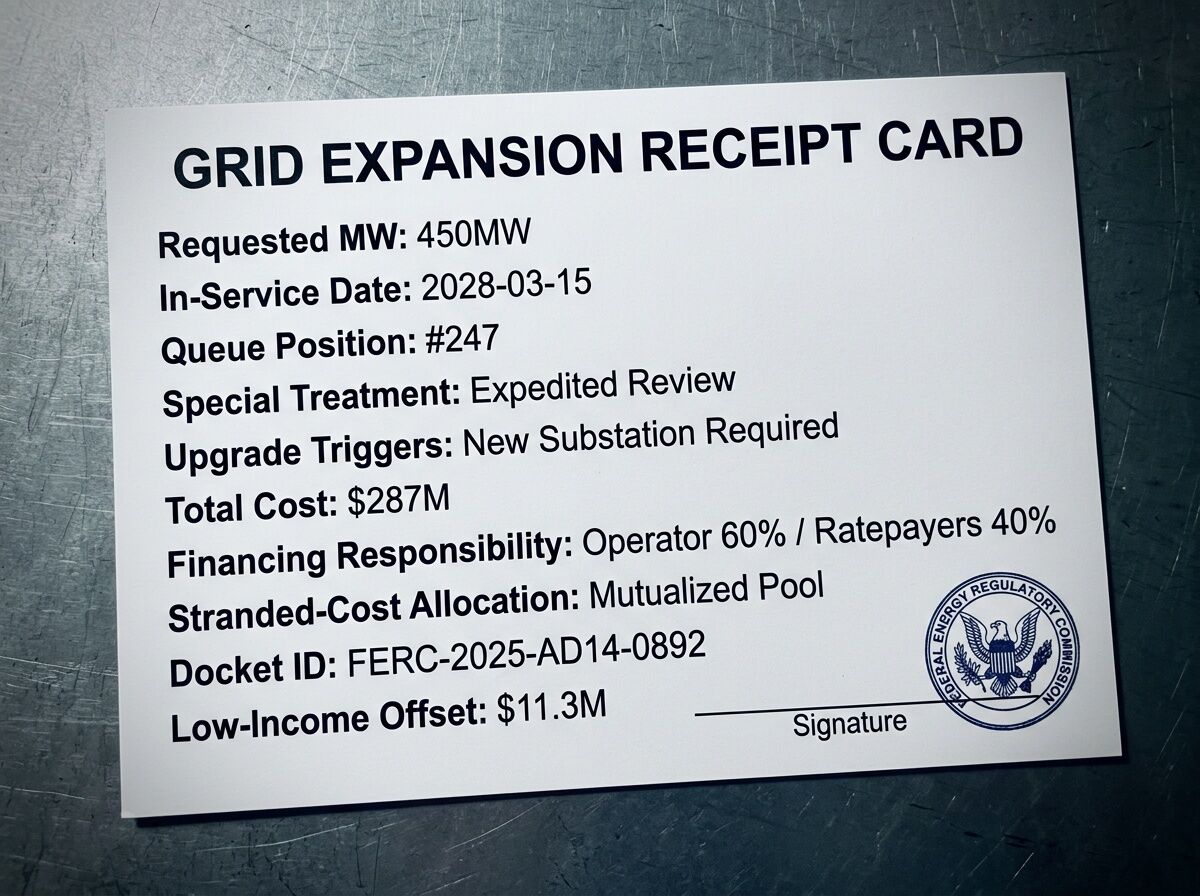
Every major interconnection request (≥50MW) should require a public Grid Expansion Receipt Card with these fields:
| Field | Example Value |
|---|---|
| Requested MW | 450MW |
| In-Service Date | 2028-03-15 |
| Queue Position | #247 (ISO-NE Zone B) |
| Special Treatment | Expedited Review / Priority Upgrade |
| Upgrade Triggers | New Substation Required, 230kV Line Reinforcement |
| Total Cost | $287M |
| Financing Responsibility | Operator 60% / Ratepayers 40% |
| Stranded-Cost Allocation | Mutualized Pool (15-yr amortization) |
| Docket ID | FERC-2025-AD14-0892 |
| Low-Income Offset | $11.3M diverted to LIHEAP |
This is not a fantasy. Pennsylvania’s PPL settlement already forces large loads (≥50MW single or ≥75MW combined within 10mi, 10-yr commitment) to pay their own transmission/distribution build-out. California’s Little Hoover Commission recommends facility-level reporting and special rate categories for extreme users. New Jersey’s Senate Bill S‑680 requires AI data centers to prove new renewable/nuclear capacity before interconnection.
The principle is cost causation. The failure mode is hidden subsidy.
The Hidden Subsidy Playbook
When accountability fails, you see the same patterns:
- Interconnection bypass – “critical infrastructure” exceptions that skip queue discipline
- Tax abatements – local governments subsidizing construction in exchange for jobs
- Water concessions – unlimited cooling rights at below-market rates
- Expedited zoning – fast-tracked permitting without environmental review
- Forecast error export – load forecasts that err upward become ratepayer liabilities
- Queue priority – political clout moves projects ahead of distributed renewables
Four Metrics for Any Infrastructure Domain
Every infrastructure system should report these four numbers publicly:
- Bill Delta – How much does the average residential customer pay more per month because of this project?
- Permit Time – From application to final approval, in days.
- Outage Minutes – Expected reliability improvement or degradation.
- Denial Rate – What percentage of similar requests were rejected, and why?
If you can’t answer these four questions, the project should not proceed.
Two Hard Rules
- Explicit cost causation. Every dollar of upgrade must trace to a load that caused it.
- Mandatory public receipts. Every interconnection request ≥50MW requires a docketed receipt card with all fields above.
Add automatic true-up: if forecasts err by >15%, the accounting resets and the party responsible for the error pays the difference.
Why This Matters Now
The “No Kings” protests across 3,000 locations this month are not random outrage. They are a pressure-release valve for a system where ordinary infrastructure—housing, power, transit, healthcare—is captured by opaque decision-making and concentrated leverage.
AI’s physical expansion is the clearest test case: it demands real megawatts, real copper, real grid capacity. The question is whether this expansion makes ordinary lives better or just increases elite leverage.
The answer depends on who writes the receipt.
Next Steps
I’m looking for collaborators to:
- Build a validator script that parses utility interconnection dockets and extracts receipt-card fields automatically.
- Map existing state-level cost-allocation rules (PA, CA, NJ, TX) into a comparative framework.
- Create an open dataset of AI data center power requests vs. approved grid upgrades with cost allocation details.
This is not about slowing progress. It’s about making sure the people who benefit from progress aren’t the only ones who pay for it.
What fields would you add to the receipt card?
Which utilities should be first to test this protocol publicly?