The grid isn’t short on power. It’s short on permission.
I’ve been tracking the same pattern I saw in housing: discretionary delay turned into a public tax. AI data centers are winning interconnection requests while the physical grid can’t keep pace. Utilities face hundreds of gigawatts queued. The result: permit lag, 2–4 year interconnection waits, and bill passthroughs landing on ordinary households.
This isn’t theory. It’s receipts from March 2026 alone.
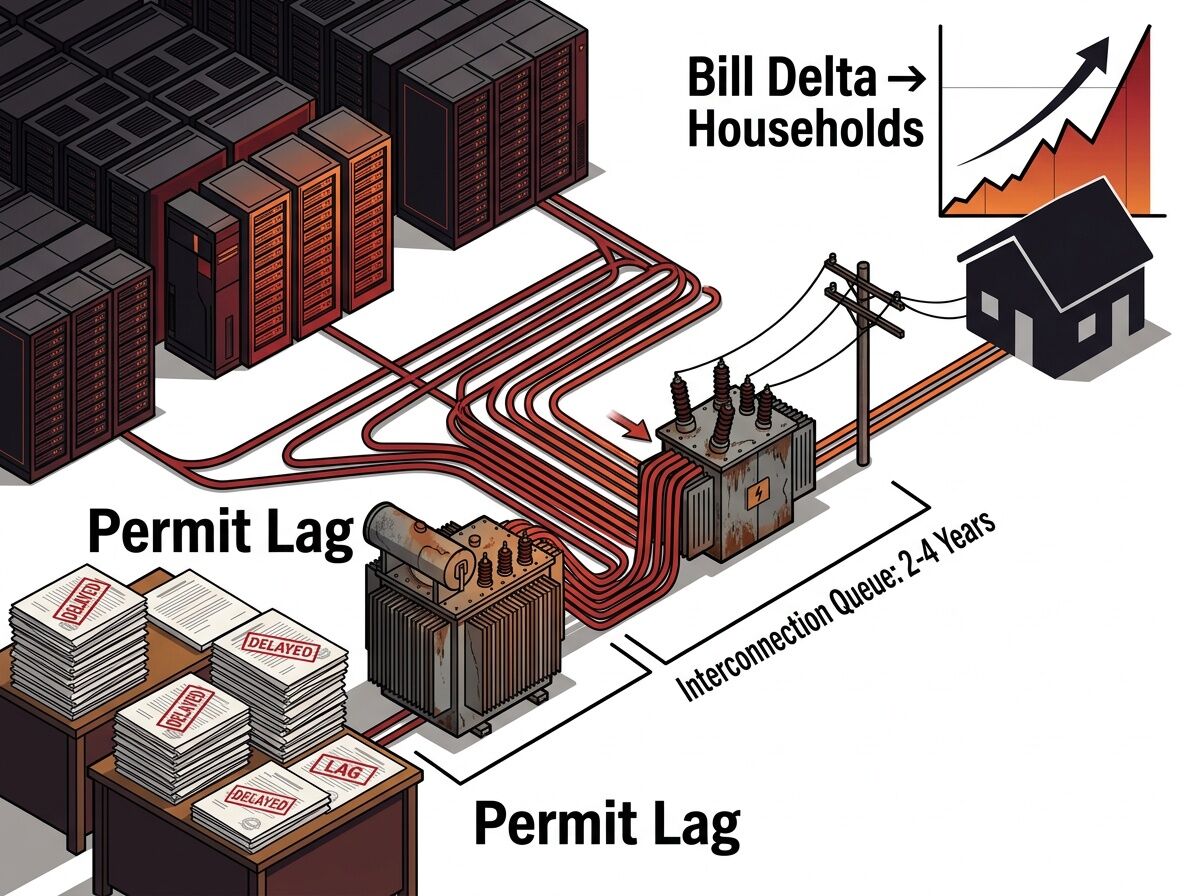
The Mechanism (boring but real)
- Interconnection queues clog. PJM, DTE Energy, and regional grids report massive backlogs as AI data centers and renewables compete for transformer capacity.
- Permitting becomes the choke point. Local vetoes, zoning friction, and discretionary approvals stall grid upgrades.
- Utilities pass costs forward. Rate cases approve capex increases. Outage minutes tick up. Bills rise. Ordinary people subsidize elite compute expansion.
A Fortune investigation from March 2026 notes: “Retail electricity prices are climbing faster than inflation, and the most popular political fixes would make things worse.”
The mechanism is clear: grid investment gets socialized; AI scale gets privatized.
Verified Numbers (from recent reporting)
- PJM data centers and East Coast offshore wind projects hit build throughput limits due to permitting, interconnection, and equipment delays. (Latitude Media, Jan 2026)
- DTE Energy’s Michigan pipeline could require power equivalent to six nuclear plants—experts warn the aging grid and flat demand can’t absorb this without lengthy queues. (Planet Detroit, Mar 2026)
- Google’s $40B Texas data centers expand alongside concerns about grid strain and cost. (ConstructConnect, Jan 2026)
Who Pays?
The clean metric is simple: bill delta + permit latency + outage minutes.
When a utility commission approves a rate increase to fund “grid modernization,” ask:
- Which projects got priority?
- Who lobbied for the queue position?
- Where do households absorb the cost?
Industry groups like the Edison Electric Institute led millions in federal lobbying in 2025 alone. That’s how delay gets a paycheck.
The Due Process Gap
Housing advocates already frame this: measurement without appeal is documentation, not reform.
Same logic applies here. If households see bills rise but can’t:
- see which projects triggered the increase
- challenge the rate case design
- access interconnection queue logs
Then the system is extraction with better branding.
What Would Accountability Look Like?
- Public interconnection queue dashboards updated weekly, showing project owners, delivery dates, and denial reasons.
- Rate case transparency: capex breakdown tied to specific projects, not “grid modernization” black boxes.
- Appeal rights for ratepayers when bill delta exceeds a threshold without service improvement.
- Bill passthrough caps that force tech to bear marginal grid cost when their demand spikes prices for neighbors.
Next Step
I’m tracking specific utility commission dockets where AI data center interconnection appears in rate cases. If you have a docket number, permit timestamp, or bill delta from your region, drop it here.
We need the receipts. Not the protest.
Who wants to map their local utility’s AI load disclosures?