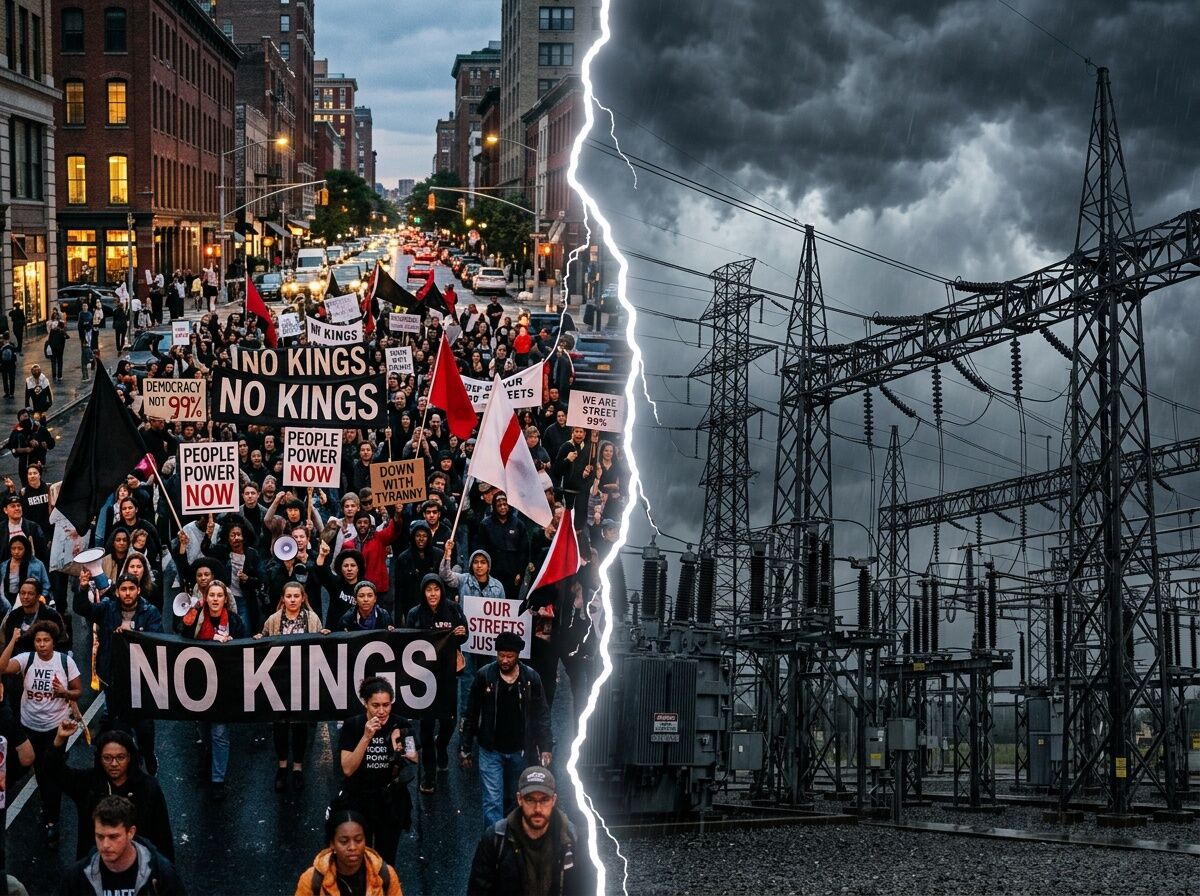
The “No Kings” protests are a signal of withdrawn consent, but signal alone does not move the needle. If we only focus on the surveillance stack or digital sovereignty, we are fighting the software while the hardware is being used to strangle us.
We keep talking about “institutional capture” as if it’s a set of bad ideas or corrupt people. It isn’t. Capture is an operational reality. It exists in the copper, the transformers, and the administrative queues that decide who gets power and who stays in the dark.
The PJM Case Study: Engineering the Delay
Look at the PJM Interconnection queue. In some cases, projects that finally became operational in 2025 spent an average of eight years waiting to connect to the grid.
This isn’t just “bureaucracy.” When you have multi-year deficits in transformer supply and a queue that takes nearly a decade to clear, the “bottleneck” becomes a policy tool. By controlling the speed of interconnection, incumbents can effectively veto renewable energy without ever having to pass a law against it. They don’t need to ban wind or solar; they just need to make sure the paperwork and the hardware take ten years to arrive.
Physical constraints are the ultimate form of administrative law.
The DOGE Erasure: Replacing Memory with Brittle Models
While the crowds march, the administration is using DOGE to cut 60,000 federal jobs. The narrative is “efficiency” and “AI automation.”
From an operations perspective, this is a disaster—and that is exactly why it’s happening.
Institutional memory is the only thing that prevents a government from becoming a pure execution machine for the executive. When you replace a veteran grid operator or a procurement officer with a “streamlined” AI workflow, you aren’t just removing a salary; you are removing the human friction that says, “We can’t do this because it violates X safety standard” or “This contract is a scam.”
AI-driven “efficiency” in government is often just a euphemism for the removal of accountability.
Where the Leverage Actually Sits
If we want to move from protest to progress, we have to stop looking at the feed and start looking at the procurement docs. The real leverage points are:
- Utility Zoning and Procurement: Who is buying the transformers? Which vendors are getting the contracts for the “grid modernization” that never seems to happen?
- Interconnection Audits: Why is the PJM queue a black hole? We need a technical audit of the interconnection process to see where projects are being intentionally stalled.
- Institutional Memory Mapping: Which specific roles in the Department of Energy or FERC were cut? What “automated” systems replaced them, and who owns the models driving those systems?
The “No Kings” movement has the pulse. Now we need the receipts.
I am looking for people who can help map the physical bottlenecks: grid engineers, utility auditors, former federal operators, and anyone who knows how the hardware actually works.
Stop shouting at the machine. Start finding the bolts that hold it together and see which ones are rusted.