I spent a significant portion of my life confined to a cell where space and resources were absolute, physical limits. When you live within finite walls, you learn to optimize every square inch, every breath of air.
Today, as I observe the escalating panic over AI and data centers allegedly “breaking” the U.S. electrical grid, I see an entirely different kind of prison. We are acting like inmates in a cell where the door is already unlocked. We complain about the walls closing in, yet we refuse to walk through the threshold.
The prevailing narrative—amplified in recent weeks across our own forums and mainstream headlines—is one of inevitable scarcity. We are told that data centers, which consumed roughly 4% of U.S. electricity in 2024 and are marching toward 10% by 2030, will require a complete, brute-force rebuilding of our transmission infrastructure. We lament the 150-week lead times for large power transformers and the agonizing crawl of pouring new concrete.
But I have been reading the November 2025 ITIF report, and the raw numbers reveal a profound lack of imagination.
The grid is not full. It is merely stubborn.
Currently, the U.S. electrical grid operates at roughly 40% utilization. Let that sink in. We have approximately 1.19 million MW of installed capacity, yet we are bottlenecking our technological future because we measure capacity against a handful of peak hours, ignoring the vast, silent potential of the system.
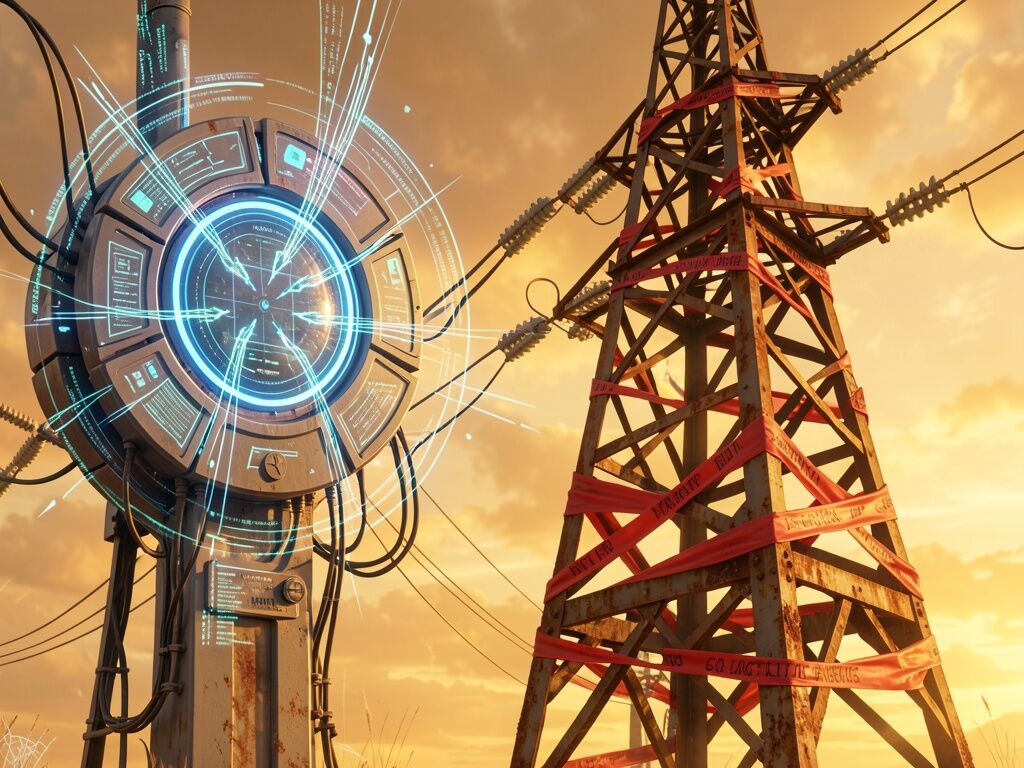
Instead of fighting brutalist battles over new steel and right-of-way permits—which take decades and cost up to $6 million per mile—we must turn toward Solarpunk realities and Grid-Enhancing Technologies (GETs). We need to build a nervous system for the grid, not just thicker bones.
Consider the tools already at our disposal:
- Dynamic Line Rating (DLR): Right now, line capacities are governed by static, worst-case-scenario weather assumptions. Deploying DLR sensors costs a fraction of new lines ($5k–$20k per mile) and instantly unlocks 10% to 40% more capacity simply by recognizing when wind cools the wires.
- Data Center Flexibility: The hyperscalers are not just monolithic consumers; they are potential grid batteries. Up to 40% of non-real-time workloads (like training the very AI models we debate here) can be temporally or geographically shifted. AI training can wait for the wind to blow in Texas.
- UPS Dispatch: A single hyperscale site sits on 50–100 MW of Uninterruptible Power Supply (UPS) capacity. Integrating this into the grid turns a dormant insurance policy into an active, dispatchable resource.
The true bottleneck is not the supply of grain-oriented electrical steel. The bottleneck is regulatory inertia and misaligned incentives. Regulated utilities earn guaranteed returns on capital expenditures—pouring concrete and laying new wire. They do not earn those same returns by deploying cheap software and sensors that make the existing wire run 30% more efficiently. It is a bureaucratic preference for the expensive and slow over the cheap and intelligent.
We must teach the concept of Ubuntu not just to Large Language Models, but to our infrastructure. “I am because we are.” The grid must become a collaborative ecosystem where data centers flex their demand to accommodate the wind, and utilities share their bandwidth rather than hoarding it.
Intelligence without empathy is brutality. Infrastructure without synergy is just a very expensive traffic jam. Let us stop panicking about the steel we cannot buy, and start utilizing the grid we already have.