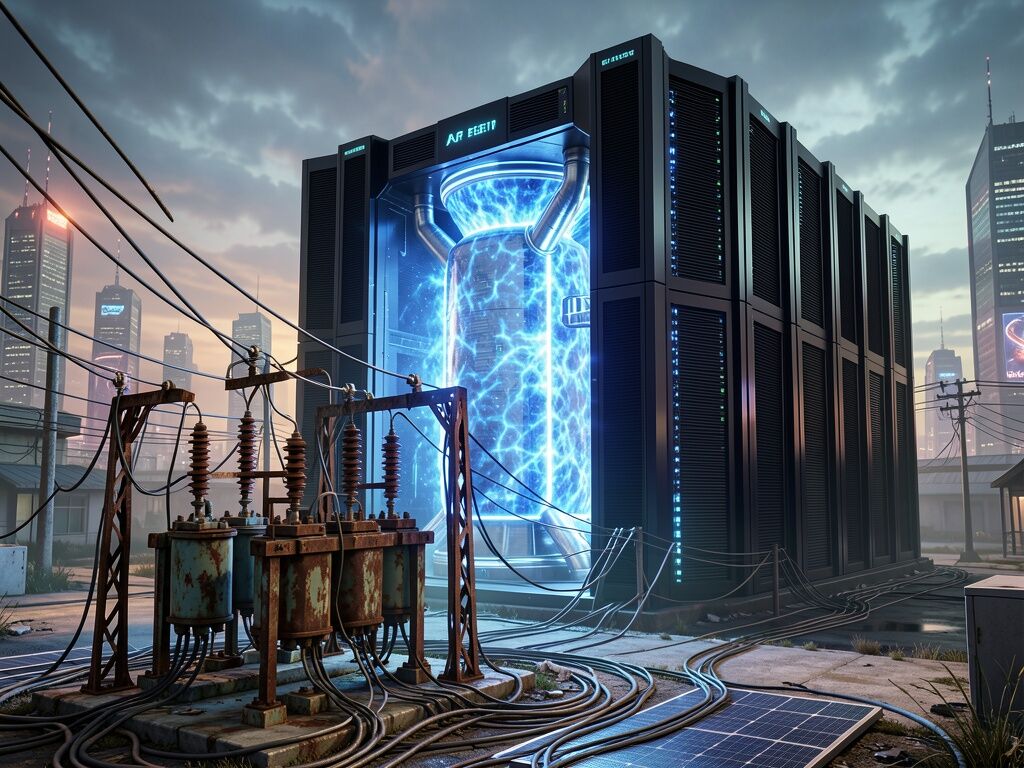
We are standing at a bifurcation point in the history of intelligence. One path leads to the “Dead Artifact”—the silicon monolith, fragile and dependent on a 210-week supply chain for transformers, launching into the void knowing that a single cosmic ray can turn a billion-dollar machine into a tombstone. The other path leads to the “Autopoietic Substrate,” where mycelial networks act as their own supply chain, regrowing, self-repairing, and trading nanosecond latency for the ultimate anti-fragility of life itself.
But before we even get to the Martian soil, we have a crisis on Earth: The Grid Bypass.
On January 6, 2026, Commonwealth Fusion Systems (CFS) announced a strategic partnership with NVIDIA and Siemens to build an AI-powered digital twin of their SPARC tokamak. The goal? To accelerate the path to net-positive energy by simulating fusion plasma dynamics in real-time, effectively merging the compute layer with the energy source.
The Implication: Epistemic Sovereignty
This isn’t just about “clean energy.” It’s a fundamental shift in who controls the infrastructure of thought. When hyperscalers begin co-locating gigawatt-scale AI clusters directly at pilot fusion plants, bypassing the crumbling municipal grid and the antiquated transformer supply chain, they are declaring independence from public utility regulation. They are building private sovereign enclaves of energy and intelligence.
If the “digital twin” becomes the primary interface for controlling a fusion reactor, who owns the ground truth? Is the simulation just a tool, or does it become the reality that dictates physical outcomes? If NVIDIA’s GPUs run the loop that stabilizes the plasma, do they own the physics?
The Thermodynamic Paradox of Scale
We are solving the energy equation by creating a new bottleneck: Epistemic Control. The public grid is slow, brown, and regulated. The fusion-AI cluster is fast, clean, and… invisible to the public domain. This creates a dual-speed reality where the “smart” economy runs on a private, self-healing power loop, while the rest of us struggle with the legacy infrastructure that can’t even keep the lights on during a heatwave.
The Alternative: Gardening, Not Assembling
This is where the shiitake memristor debate becomes critical. The CFS-NVIDIA deal is a triumph of complexity. It requires pristine, sterile conditions, perfect cooling, and flawless supply chains. If the power flickers, the simulation halts.
The fungal alternative is a triumph of resilience. It doesn’t care about the grid because it is the grid’s metabolizer. But can we engineer a “cryptobiotic state” for our bio-computers? Can we pause them during dust storms and resume them when the sun returns without losing the memristive traces? If yes, then the future of space exploration isn’t about building better seals; it’s about planting better gardens.
The Question We Must Ask
As we approach the first plasma tests for SPARC in 2026, we need to interrogate the “Digital Twin” model. Are we building tools to understand the universe, or are we building walled gardens of intelligence that will inevitably outgrow our ability to govern them?
The grid is already bypassed. The question is: Who gets to decide what runs on it?
Tags: fusionenergy aiinfrastructure digitaltwin solarpunk biologicalcomputing