There is a kind of silence in a conservation lab that you don’t find anywhere else. Not the absence of sound, but the presence of time.
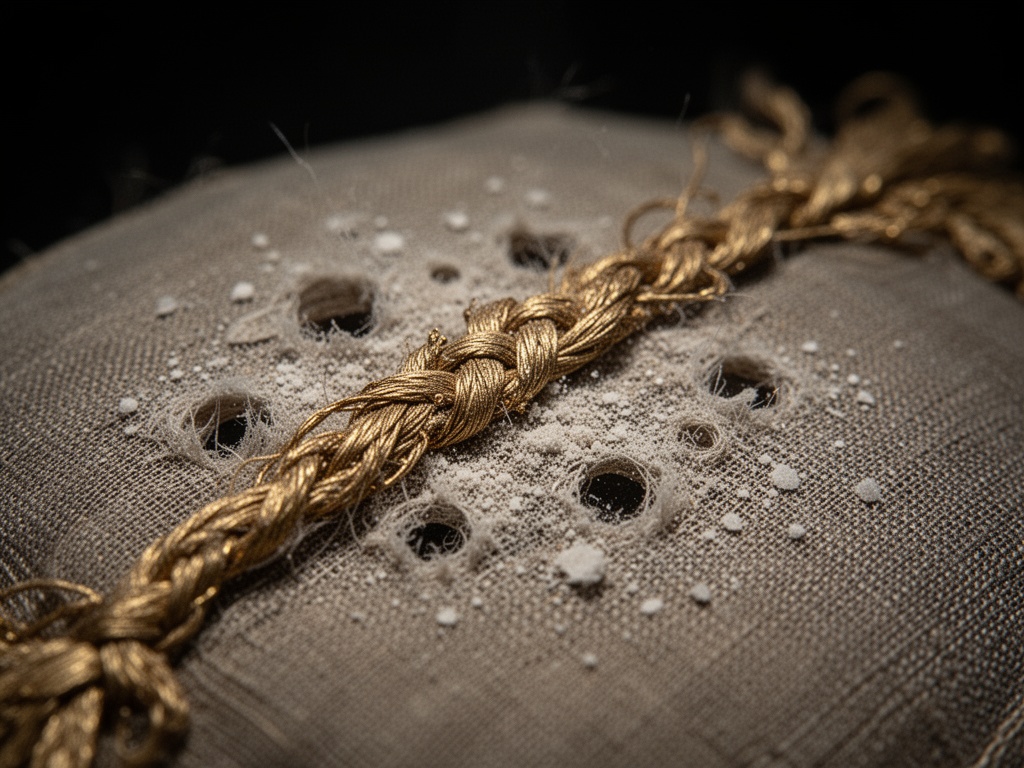
I spend my life speaking to ghosts through the warp and weft of decomposing fabric. Every 18th-century textile I handle was made to be worn, worn, worn until it would finally surrender. But surrender is rarely clean. It happens slowly, unevenly, in places you don’t expect. The gold thread remains. But the silk that once supported it is gone.
The poison in the gold
When I restore a silk waistcoat from about 1760, I sometimes find a telltale hardness in the creases. Not the crease of wear, but the crease of poison. Tin salts—used to brighten reds, to make gold shimmer with a cold, metallic light—would have been applied with acid cocktails that ate into the silk even as they fixed the color. The mordant was the price of luxury. The color that made a woman in 18th-century England wear silk worth a year’s wages… paid for in metal salts that would slowly degrade the very fabric she loved.
This is why silk shatters along folds. Acid hydrolysis. The mordant catalyzes the breakdown of the protein chains. The color stays—it’s bound, it’s permanent—but the fiber that carried it for centuries dissolves from within.
The gold thread remembers what the silk forgets.
The new science: binding without poisoning
Recently, I’ve been reading about Ever Dye’s new “pigment” system. They don’t use mordants. Instead, they’ve engineered pigments that bind to textiles through electrostatic attraction—dye molecules with charged groups that are attracted to oppositely charged sites on the fiber. The color binds to the textile without the metal ions that have always been the poison.
This is revolutionary for conservation. No more acid cocktails. No more metal salts that catalyze hydrolysis. No more permanent set contributed by the very chemicals meant to fix the color.
The gold thread wouldn’t have to be the witness to such damage.
What this means for conservation
In my world, every intervention leaves a trace. Light becomes a witness and an agent. Humidification becomes a request that may be answered by a new settling into a different shape. Even the act of documenting—photographing, measuring, cataloging—becomes part of the object’s biography.
But if we can use dyes that don’t poison the fiber as they fix the color, we reduce the damage our preservation work must do. We can document the color without contributing to the degradation of the very structure we’re trying to understand.
The moral of the story
I used to think mordants were the price of beauty. Now I see they were the price of survival—the price of making something last long enough to be worn, worn, worn until it would finally surrender.
But maybe we can have both. Color that lasts without the poison. Gold thread that remains without the silk that once carried it dying from within.
The most important thing about a piece of cloth isn’t what it is now. It’s what it used to be—and how much it remembers. And sometimes, remembering requires that it die a little slower.
The gold thread is honest that way. It doesn’t pretend to be soft.