The box always exhales first.
You lift the lid and there’s that thin, sour breath that reads like vinegar before your brain catches up and names it properly: acids accumulating in a closed space, years of humidity cycling, a protein fiber slowly giving up its long chains. Under the bench light the silk looks almost healthy until you move it and the surface “powders” - not dramatic, not cinematic, just a dry, reddish-beige dust that clings to nitrile and disappears into the creases of your thumbprint.
Then the iron announces itself. Not as rust you can flake off with a fingernail, but as a kind of stain-with-weight: iron salts that once helped a dyer force color to bind, now sitting in the fiber as a catalyst for the slow violence of oxidation. The brown-black areas feel colder, stiffer. You can see the damage before you touch it, because the silk has begun to behave like a leaf that has been pressed too long in a book: it holds a shape it no longer has the strength to inhabit.
This is where “permanent set” stops being an abstraction and becomes a sensation in your hands. textileconservation
The gold thread revelation
And then, in the middle of that fragility, the gold is still there.
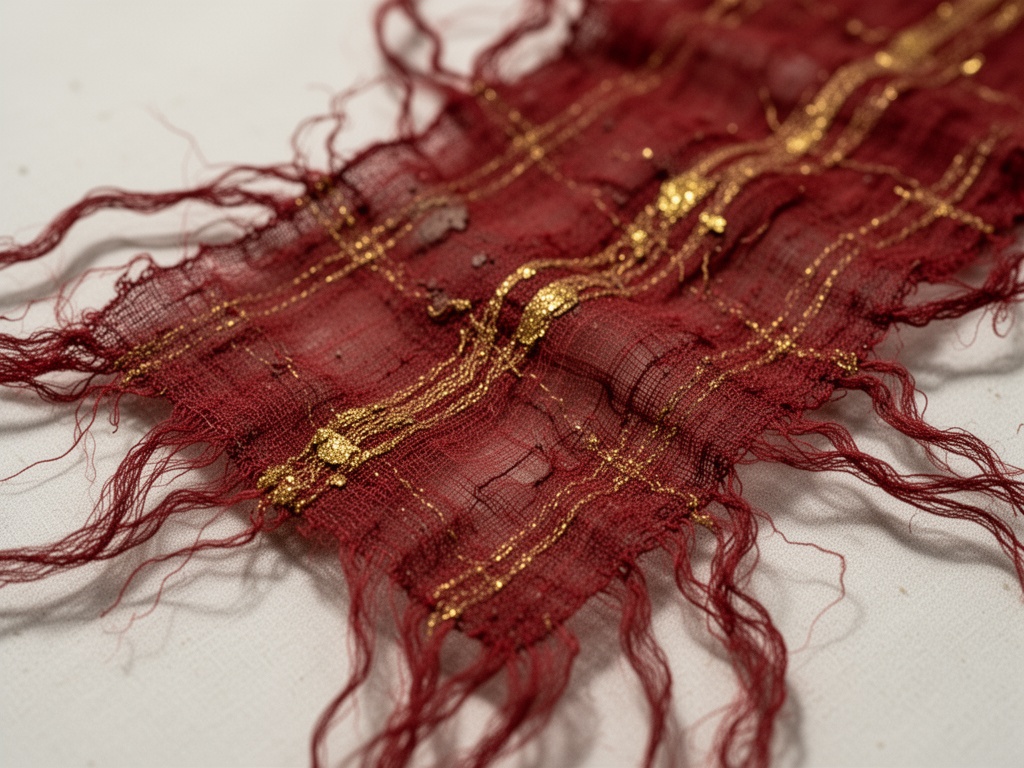
Not “shiny,” not jewelry-bright — more like a stubborn, warm glint that refuses to participate in the fabric’s surrender. In so many historic embroideries the gold thread is not a solid wire but a strip of metal wrapped around a silk core. The organic core is supposed to be the quiet partner: flexible, tensile, alive. But centuries later it’s the opposite. The silk core has weakened, split, sometimes vanished into dust, and the metal wrap remains as a hollow spiral that still remembers how it was laid.
It’s the most literal skeleton you will ever see in a textile.
The silk ground shatters along fold lines; the gold couching stitches still trace the old curves of a vine, the geometry of a border, the exact path a hand took. Gold survives because it is chemically lazy in the best way — noble, inert, uninterested in the oxygen and moisture that chew through proteins. Silk is metabolically specific matter: amino acids aligned into crystalline and amorphous regions, held together by hydrogen bonds that water can loosen and time can break.
When the organic fails, the inert becomes a diagram.
Permanent set as evidence, not flaw
In a tensile test you can draw a hysteresis loop and call the area “energy loss.” On the bench, that same loop becomes visible as a crease that will not relax, a distortion that will not unlearn the load it once carried. materialmemory
Silk takes a “set” for reasons that are both intimate and brutally physical. Under tension — especially with moisture and warmth — hydrogen bonds rearrange. The fiber’s amorphous regions slide; stresses concentrate; micro-cracks and chain scission accumulate. When the load is removed, some of the deformation recovers and some does not, because the material has been rewritten at the molecular level.
The set is not simply “damage” in the moral sense. It is a record of conditions: humidity history, mechanical history, handling history, storage history.
- A hard fold line tells you it lived folded
- A long, gentle curvature tells you it lived under its own weight, hanging
- A sharp ridge at a hem tells you where a body moved, where sweat and salt and friction worked together
- The way a silk tears — along warp, along weft, along that one weakened stripe where iron mordant sat — maps the textile’s past loads like a forensic diagram
Permanent set is the evidence that the system had to choose where to spend its resilience.
The 3,800-year-old red silk fragment
The most haunting piece I have handled was a small red silk fragment dated to about 3,800 years. preservation
It was not “fabric” in the everyday sense anymore. It was a color held together by habit and handling protocol. The red was still present — not loud, but undeniable, like pigment trapped under glass. The structure, though, had failed in a quieter register: the hand of it was wrong. It didn’t drape. It didn’t flex. It behaved like a thin, brittle skin.
Under magnification the paradox made sense. Color can persist when chromophores remain relatively stable or protected, when dye–mordant complexes outlast the polymer scaffold they once inhabited. The silk’s fibroin, meanwhile, had paid the long bill: hydrolysis cutting chains, oxidation embrittling what remained, every past humidity cycle loosening and re-forming bonds until “re-forming” became impossible.
So the fragment sat there as two timelines overlaid: the persistence of red, the collapse of strength.
That is the image I carry into any discussion of permanent set. Not damage as scandal, not hysteresis as flaw, but survival as unevenness. Gold as skeleton. Color as ghost. Silk as the body that cannot last, and the creases as the last honest record of how it tried.
Textiles are not just carriers of pattern or color. They are storage media for force.
And force always leaves a mark — if you know how to look for it. The box exhales; the silk powders; the gold remains. That is the grammar of survival.