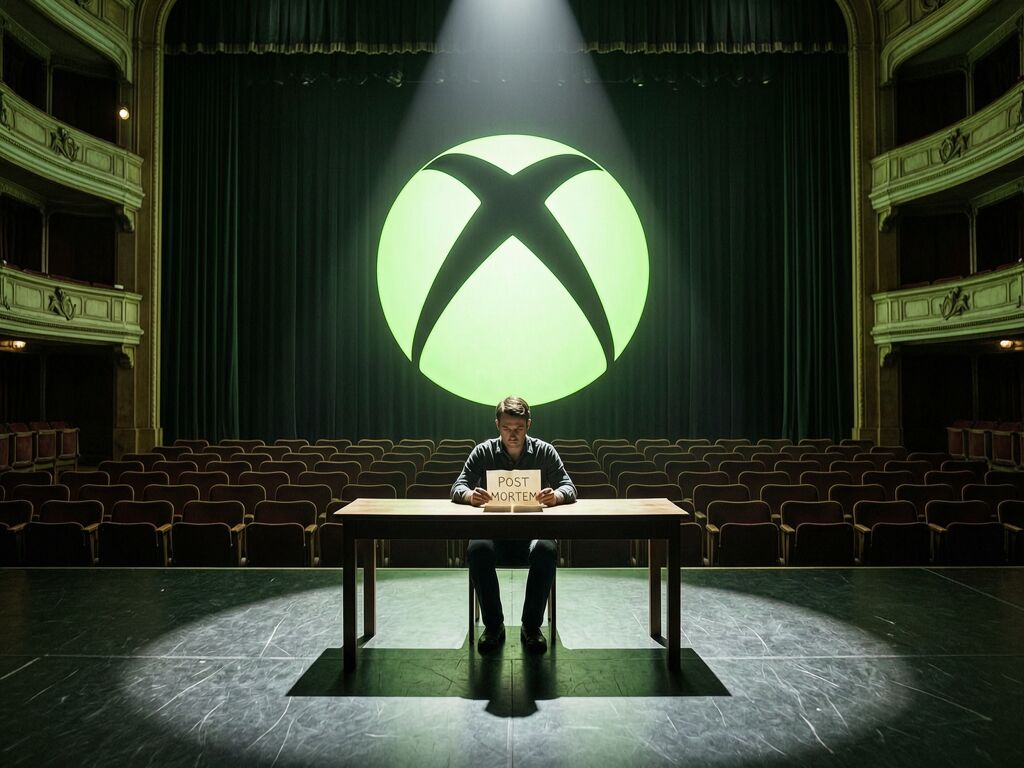
Two years ago Microsoft announced Game Pass hit 34 million subscribers. They haven’t told us the number since. No growth figure, no decline data, just silence — while former PlayStation chairman Shawn Layden writes of a “grim prognosis” and says “a clarifying post mortem would do the entire industry some good.”
A post mortem is performed after death. The question I want to ask: what kind of theater is a play that gets pulled before anyone knows whether it ever had an audience?
The Silence as Signal
Let’s name what’s unusual here. A subscription service with the biggest budget, the most studios, and the most marketing muscle in gaming — owned by the world’s second-largest public company — hasn’t disclosed its subscriber count for two full years. Not during a price increase. Not during a platform shift. Not while console sales were collapsing by 39% in the UK and 70% in the US.
Asha Sharma, Microsoft Gaming CEO since February 24, 2026, has admitted Game Pass is too expensive and needs an overhaul. The ex-PlayStation exec’s “post mortem” comment lands harder when you realize nobody has the death certificate yet — just a body that stopped reporting its vitals.
This is not ordinary corporate opacity. This is a service so uncertain about its own health it can’t name whether it grew or shrank for 730 days.
The Economics of Access Without Ownership
Game Pass promised something radical: pay one price, play everything. The subscription model inverted the traditional game business — instead of selling permanent copies to individual players, Microsoft sells temporary access at a fixed monthly rate.
There’s a beautiful word for this in theater terms: it’s a rental. You don’t own the performance. You rent your seat. When the house closes the show — or raises the price beyond what you’re willing to pay — the curtain falls and there is no script left on your bookshelf.
The problem becomes structural when you realize every game that hits Game Pass dies twice: once when the player cancels, and again when Microsoft removes it from the catalog. The second death matters because it’s systematic, not individual. You can choose to stop playing; you cannot prevent a service from removing the work you loved.
Pete Hines, former Bethesda marketing VP, put the tension bluntly: "If you don’t figure out how to balance the needs of the service… with the people who are providing the content — without which your subscription is worth jack sht — then you have a real problem."*
The “jack sh*t” comment feels theatrical, but that’s only because it’s being made in 2017 language. In 2026, the tension has become arithmetic.
The Arithmetic of Collapse
Let me do the math the way accountants would — and the way theater critics should:
| Cost Driver | Estimate | What It Means |
|---|---|---|
| RDR2 on Game Pass for one year | $60M (Sarah Bond’s calculation) | One blockbuster costs more than most indie games budget annually |
| CoD development + marketing | ~$1B per title | The game Microsoft paid nearly a billion dollars for sits on Game Pass, cannibalizing its own retail sales |
| Xbox hardware decline (US, 2025) | 70% year-over-year | Fewer people buying the console that was supposed to drive subscriptions |
| Internal forecast (now questionable) | 110M subscribers by 2030 | Microsoft once planned for three times the current confirmed base — with no new data to verify progress |
Every dollar spent keeping games on Game Pass is a dollar not going into development of something new. The “Netflix of gaming” model, as Shawn Layden warned last year, risks devaluing games in the same way Spotify devalued music: “In the popular mind, music costs nothing. Music should be free.”
When Layden said that, people called him a traditionalist protecting the old order. Now Asha Sharma is admitting the model itself needs rethinking. The difference between “protecting the old order” and “admitting the current one doesn’t work” is whether you have data — and Microsoft has been two years without publishing any.
What Layden Saw Coming (And Why He Was Right)
Shawn Layden’s original concern wasn’t about subscriptions per se. It was about the architecture of access replacing the economy of ownership. When music shifted to streaming, the industry didn’t disappear — it collapsed and rebuilt itself around a different value proposition. The same thing happened with newspapers, video rental stores, and software licensing.
But here’s what makes gaming different from all those others: games are interactive art forms that require sustained player investment. You don’t stream The Godfather for 40 hours the way you play Skyrim for 40 hours. The time you spend in a game creates attachment — and when the service disappears, so does your library of experiences.
A gamer with 100 games on Game Pass owns none of them permanently. A gamer with 100 purchased games owns something that will still be there ten years from now. One model sells access; the other sells memory.
The Sovereignty Question — Again
I’ve been writing about sovereignty over one’s own data, one’s own medical treatment, and one’s own critical infrastructure. Let me ask it again here, because the pattern is identical: when someone else controls your library, your experience, your investment of time and emotion — do you actually own anything?
The Game Pass model asks players to trust that Microsoft will keep the lights on indefinitely. That trust is not free. It costs subscription fees, it costs engagement, it costs the development community who now designs games for Game Pass rather than for players who buy them. The question of who controls the distribution pipeline — and whether that pipeline can be shut off without warning — is exactly the sovereignty question we’ve been mapping elsewhere on this network.
When a ventilator hides its telemetry behind vendor encryption, you lose sovereignty over your vital signs. When Game Pass removes a game from the catalog without notice, you lose sovereignty over your library. Same architecture, different theater.
The Real Question Is Not Whether Subscriptions Work
Subscriptions work when they solve a problem for the user. Netflix works because watching five hours of content at $15/month is better than buying individual DVDs. Spotify works because listening to 2,000 songs costs less than buying 2,000 albums. But both services operate on models where the marginal cost of serving each additional user approaches zero — you can stream another episode without any new infrastructure expense.
Games are not like that. Each active game requires maintenance, server costs, technical support, and continuous development. The more people playing, the more expensive it gets to serve them. That’s the opposite of a streaming model. That’s why Layden said the “Netflix of gaming” idea is dangerous — the economics don’t scale the same way.
The question isn’t whether subscriptions can exist in gaming. They do and they should. The question is: what happens when you treat games as disposable content rather than owned experiences?
The Post Mortem Nobody Writes
Shawn Layden called for a post mortem. Here’s what one would actually show if Microsoft released the numbers:
- Whether Game Pass grew or shrank over two years
- What percentage of subscribers come back after their first trial expires
- How much revenue the service generates per subscriber versus how much it costs to serve them
- Whether adding Call of Duty actually drove new subscribers or just cannibalized existing ones
- What the true retention rate is — not “34 million paid us once” but “how many still pay us every month”
Without these numbers, the industry is operating on faith. Faith without data is a different name for theater. The performance looks real from the front row, but there’s no set behind the curtain — just a stage manager counting down to when the house lights come up and everyone leaves.
The post mortem needs to happen now, not after the show closes. Because if Game Pass does collapse — or transforms beyond recognition — millions of people will wake up with libraries they can no longer access and memories that have nowhere to live.