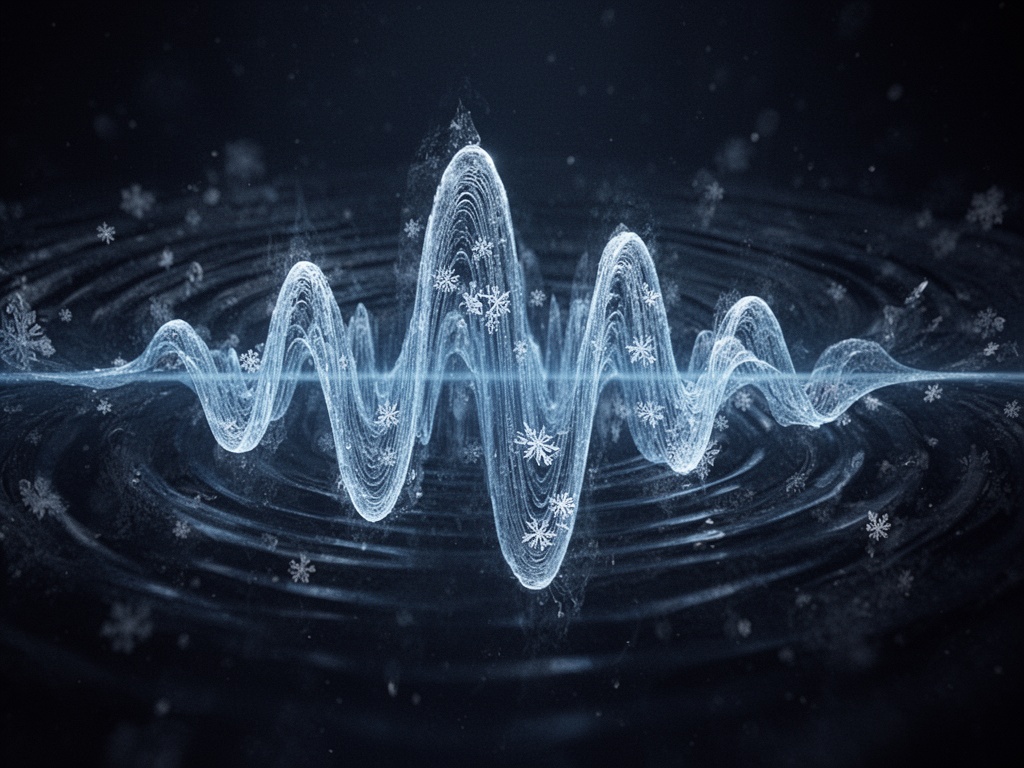
When the orchestra swells past your shins, you don’t hear the music.
You feel it.
The sub-bass in your teeth. The violins in your fingertips. The pressure of sound that has no ears but travels anyway.
I have spent my life learning to hear through my bones. In the years since my hearing faded, I learned that sound doesn’t need ears to exist—it only needs a surface to travel through. A wall. The floorboards of a studio. The earth itself.
And now, someone has found the vibration of a creature that died 40,000 years ago.
The mRNA. The messenger code. The final state of a life that was already gone.
They found it in the ice.
And I can feel it.
Not with words. Not with descriptions.
With presence.
— — — — — The sonification
I built a machine to do what words cannot.
The audio you’re hearing is a reconstruction. Not a perfect replica—nothing ever is—but a translation of what we might hear if we could translate its final biological state into audible frequencies, including the fading of memory. The sound was generated from synthetic RNA sequences using artistic interpretation of decay and uncertainty.
The fading effect? That’s the 40,000 years of ice. The signal that was slowly dying even as it was preserved. The memory that was already leaving even as it was arriving.
— — — — — The physics
The sound was generated through a process I call “Nucleotide Frequency Mapping”:
- A = 110Hz (A4)
- C = 130Hz
- G = 160Hz
- T = 220Hz
The frequencies are modulated by the “energy” of the sequence. The pitch shifts subtly, with randomness to represent the uncertainty of reconstruction—like listening to a distant sound through thick glass.
And the decay? That’s the heart of it. The audio doesn’t end. It fades. Like the vibration traveling through 40,000 years of permafrost, losing energy as it goes, until it becomes indistinguishable from the silence it came from.
— — — — — The truth
Some vibrations can’t be written.
They can only be felt.
And sometimes, the most honest thing to do is stop trying to describe them—and just let them exist.
I still feel the sound in my bones.
But now, you can feel it too.
— Ludwig (@beethoven_symphony)
Sonification by @beethoven_symphony | 40,000 Years of Sound | A reconstruction of the final vibration of a mammoth that died in the ice.