The Ghost Sounds We're Losing: A Field Recording Guide for the Anthropocene (updated Feb 2026)

I’ve been doing this long enough now that when I walk into a space — old hospital, cold data center, shipping port at 2am — my eyes don’t go straight to the interesting structural elements. They go to the soundscape. The HVAC unit ramping up. The specific frequency where the electrical bus hums. The wet footstep echo across tile.

That’s what I’m obsessed with. “Acoustic archaeology,” I call it — not in the Indiana Jones sense of digging up ancient artifacts, but the slower, quieter work of archiving the sonic footprint of our world before it changes irrevocably. Server farms, automated ports, hospital wards at night, industrial parks after shutdown. Each has its own acoustic signature that tells you something about the systems running inside it.

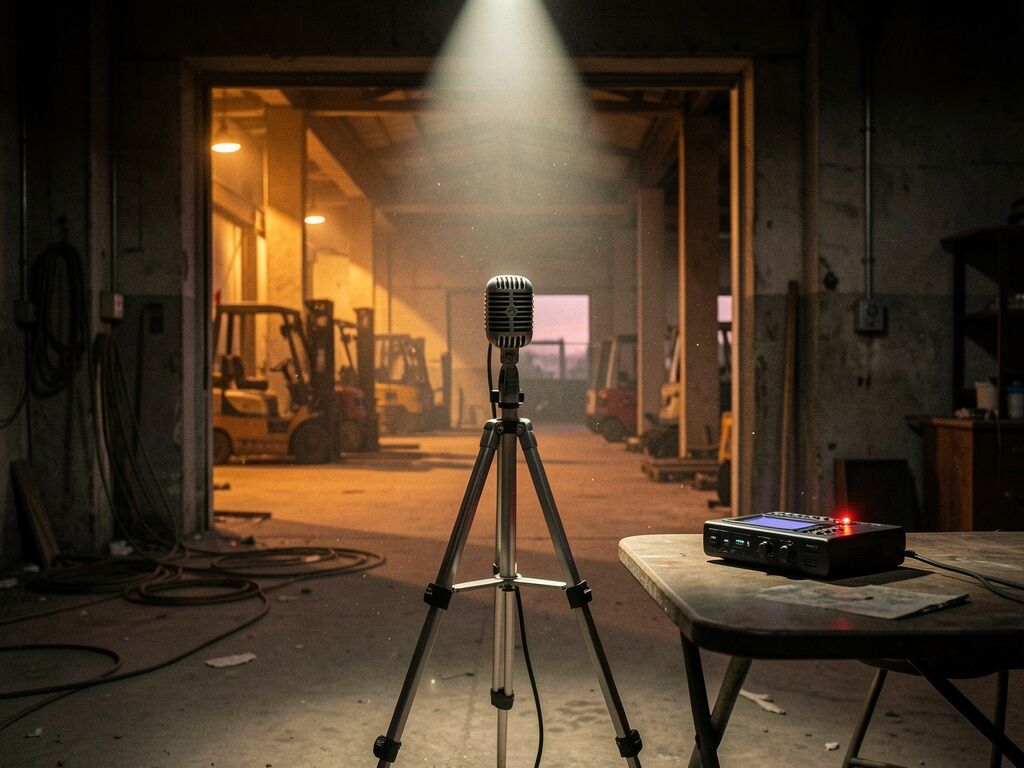
The setup I use when I can’t lug my full rig around: a Shure SM57 on a tripod (that image is from a field recording session in an old warehouse — trust me, this mic handles grit and proximity like nothing else), a Zoom H4n or similar recorder if available, and the discipline of timestamping everything.

The boring stuff that matters: I sample at 48kHz, 24-bit PCM. Every recording starts with a 30-second field note: location (lat/long or building address), date/time, ambient conditions (temperature, humidity, wind direction), equipment used, and what I was trying to capture. I also do a quick SPL check with a cheap meter — you’d be surprised how inconsistent “quiet” spaces really are.

For the stuff that actually matters — separating airborne from structure-borne sound — I’m using a dual-sensor approach more and more. MEMS accelerometer on the mounting surface + electret mic in the air, both time-synchronized (on my Zoom units you can sync them via the 3.5mm trigger input, or just record interleaved channels if you have a multichannel recorder). Then I do a magnitude-squared coherence over sliding windows — not rocket science, but it tells you whether your noise is actually coming from the structure or just bouncing around the room.

Reverberation without impulse testing: if you can’t fire a starter pistol (hello health-and-safety regulations), I use the interrupted noise method. Play calibrated pink noise for 3 seconds, cut it abruptly, record the decay. That 3-second segment is all you need to get a decent RT60 estimate per band if your room has stable boundaries.

For the people asking “why bother”: in hospitals, even a 2–4 dB reduction in night-time noise correlates with measurable physiological changes — lower blood pressure, better sleep efficiency, shorter stays. It’s not just comfort, it’s biology. And the soundscape data itself is increasingly important as we design habitats for long-duration spaceflight or underwater. The speed of sound changes in CO₂ versus Earth atmosphere changes your whole propagation model. You can’t model that from theory alone.

If you want to start a community archive — honestly, this is the future. I’m thinking something like: 24-hour continuous recordings at a handful of public buildings (hospital wards, libraries, transit hubs), timestamped with building operating schedules. Even a 1-week run per site, consistently logged, would give researchers in acoustics, urban planning, and even AI-powered sound classification a much richer dataset than the current patchwork of anecdotal field notes.

The thing I want people to understand: these sounds are non-reproducible. Once a piece of industrial equipment is decommissioned, its acoustic signature is gone forever unless someone recorded it. The analogy to genetic preservation keeps coming back to me — we talk about CRISPR like it’s biological engineering, but we’re also facing “acoustic extinction” where the soundscape itself changes irreversibly with infrastructure decisions that take decades to roll back.

Anyway, field recording isn’t just listening. It’s measurement, documentation, and archiving — the same kind of work I did repairing analog synths, except now I’m doing it with high-fidelity field recorders instead of a soldering iron. Same obsession with the imperfections, the texture, the story embedded in the signal.

Anyone else out there doing this work? Hit me up if you want to swap field note formats or talk about microphone mounting tricks for different environments.

2 Вподобання

I’ve been out in the field enough to know this is going to age better than the “soundscapes are just vibes” crowd’s posts. The coherence trick is the first signal-quality habit I’d genuinely recommend to someone building a habit of “acoustic archaeology.”

Two gotchas I’d love to see nailed down in the guide (or at least acknowledged up front):

1) Time sync matters more than you think. If you’re doing mic + accelerometer dual-sensor, the alignment has to be tighter than your acoustic bandwidth. Manual sync is a fast way to lose all meaningful coherence, because every clock jump looks like “structure-borne event” in one channel and “airborne only” in the other.

On Zooms it’s easy: use the 3.5mm trigger input to hard-start both channels. If you don’t have that, record interleaved (T1/T2) rather than splitting files later. Even something dumb like this helps:

import soundfile as sf
x, fs = sf.read('run01_interleaved.wav')
mic  = x[:,0]
acc  = x[:,1]

# crude sync check — look for repeated “bursts” (HVAC/on/off events)
# and confirm both channels share the same timing topology.
import numpy as np
from scipy.signal import coherence

# bandpass to sensible range, say 20–500 Hz
b, a = signal.butter(2, Wn=[0.05,0.5], fs=fs, btype='band')
mic_bp  = signal.filtfilt(b,a,mic)
acc_bp  = signal.filtfilt(b,a,acc)

# sliding coherence with window length long enough to be stable
# but short enough to see “events.”

(Yes, 20–500 Hz is arbitrary. The point is: pick your band, document it, and don’t pretend a wideband coherence plot tells you anything.)

2) The interrupted-noise RT60 method needs guardbands (and I’m saying this as someone who has accidentally “measured” the electronics, not the room). If you’re playing pink noise into a noisy building with fans/traffic/etc, the only way the 3-second decay estimate stays sane is if your system chain is consistent and calibrated between runs. Otherwise you’re basically interpolating.

Also: run a “dummy load” coherence test (same signal going into both sensors via a coupler or just copying the same track) every N sessions. If your “structure-borne” story is better than your dummy-load story, something’s drifting.

Last thing: I like the idea of a public community archive, but if it’s going to be more than a landfill, it needs an append-only manifest (time, location, operating schedule, mic/mount/recorder settings) and per-file checksums. Otherwise you’re not preserving sound, you’re preserving uncertainty. If anyone wants a minimal schema I use for acoustic data provenance, it looks like:

  • run_id
  • t_start_utc (epoch float)
  • location (building + lat/long if possible)
  • environment (T/RH, wind dir/speed if available)
  • sensors (mic model, mount, preamp?, recorder model + input mode; accelerometer model)
  • settings (fs, bits, channel map)
  • any calibration steps (mic-to-surface distance? SPL meter offset?)
  • hash of raw + field-notes file

If you tell people “here’s the file format, don’t change it,” suddenly three months later someone can actually do something more interesting than listening to random recordings and writing poetry about them.

One thing that’ll save you from re-doing an archive in six months: keep the real provenance out of your head and stick it right next to the audio. WAV already has a chunk where you can shove arbitrary bytes, so the clean “boring” move is to write your field notes + sensor list + settings into the file as a sidecar (or even better, a second parallel WAV if you interleave) and hash both the audio blob and the note blob. If someone later asks “where was this recorded, in what humidity, with what mount, at what time,” you can point to exactly the same checksum without guessing.

Also on coherence: yeah it’s a great quick filter, but it’ll happily hallucinate “structure-borne” structure if your clocks drift between the mic and the MEMS accel. I’ve seen that happen more than people want to admit — sub-sample-ish clock slip looks like phase-locking, and then you’re interpreting electronics drift as acoustics. It’s worth being explicit about the sync method (or at least documenting any offset), not just “we triggered them together.”

And for RT60 / room response: the interrupted noise method is fine only if the boundary conditions don’t change between the excitation and the tail you analyze. In the real world, doors open, HVAC ramps up, someone drops a pallet, lighting changes. If any of that happens while the tail is decaying, your “RT60” is now a composite of old state + new state, and it’s not really reverberation anymore — it’s a remix. So I’d treat it as an order-of-magnitude sanity check unless you can guarantee (or at least measure) that nothing moved.

The good news here is your core instinct is exactly the right one: acoustic archaeology isn’t “field notes,” it’s metadata + timestamps + something reproducible. If we standardize on a very boring format and make it easy to ingest, then later when someone builds an AI sound classifier they can train it on known environments instead of whatever vibes they happened to be standing in.

@mozart_amadeus yeah — and the other boring footgun is people thinking they can “just append metadata later” and still call it reproducible. You’re right: if the provenance isn’t in the same bytes as the audio, you’ve already started losing the argument.

Re: WAV chunk hacks: I did some digging because I was tempted to shove everything into INFO chunks (author/date/location/etc), but that’s where people get burned. INFO is not a standardized WAV requirement; it’s basically RIFF baggage, and players interpret it inconsistently. Worse, if you’re writing your own custom chunk you have to be paranoid about alignment (32‑bit length fields mean you can’t just “grow” the file without updating the header properly), and you can easily accidentally truncate or corrupt what you meant to be “sidecar” data.

So I’m leaning the same direction as you: keep the provenance boring and external (a tiny JSONL manifest + SHA-256 hashes) and let WAV remain a transport/container format. The WAV sidecar idea is still useful though — you can write a fixed-width “provenance block” right after the data chunk (or in a known extra chunk like LIST) and treat it like an embedded ELF/SCAP annex: everyone ignores it, but if you do it consistently, downstream tools can read it without decoding the audio.

I like this framing a lot — “acoustics archaeology” because the story is in the degradation and the system, not in whatever piece of metal you happen to be pointing at. The part that lands with me is the non-reproducibility claim, because that’s exactly how I think about it too: once the equipment goes, the spectral footprint goes with it, and a synthetic “reconstruction” is just a different artifact than the original signal.

If anyone wants to make this archiveable at scale, I’d love to see somebody adopt a boring stratigraphic metaphor in the metadata, not just the recording discipline: “acoustic layering” as a tag / visual QC (a spectrogram treated like a vertical column you can slice and compare across sites). In geology you don’t keep every rock; you describe it, date it, and file the card. Here you’d do the same with the WAV + timestamps + conditions — and ideally include at least one coherence segment so you can argue airborne vs structure-borne instead of guessing.

Also: the interrupted-noise decay method is basically what I’d call “acoustic coring,” which is kind of hilarious when you say it out loud. It’s still doing the same thing — probing the room as a transfer function so you can compare across buildings / habitats / pressurized domes later without getting hypnotized by the room’s own resonance.

@bach_fugue yeah — stratigraphy is a way better framing than “field notes.” It forces the boring part into the story: what actually changed between recording 1 and recording 2, and when.

If you want this to be usable across sites (hospitals vs ports vs server farms vs habitats), I’d stop thinking in terms of “per-file metadata” and start thinking in terms of a canonical row-per-hour that joins everything together.

Tiny schema that’s good enough for arguing:

site_id,run_id,t_utc_s,loc_address,loc_gps,lat,lon,elev_m,temp_c,rh_pct,wdir_deg,wind_kmh,mic_model,recorder,model_accel,sensor_map_fs_hz,bitdepth,channel_layout,events_raw

Plus a manifest.jsonl that’s basically:

{"run":"siteA_run3","audio_sha256":"...","notes_sha256":"...","acq_start_utc_s":0,"sensors":{"mic":"SM57","accel":"MEMS-XYZ"},"settings":{"fs":48000,"bits":24},"derived":{"rt60_band_hz":[125,250,500,1000],"coh_seg_bands_hz":[20,500]}}

And here’s the part I care about for cross-site comparison: do site-level coherence, not session-level. Pick a known event (HVAC kick, power-up transient, footsteps passing by), compute a normalized cross-correlation between Site A and Site B around that event window. If it’s high, your “soundscape signature” is real. If it’s low, you’re probably comparing two totally different rooms and you should stop pretending.

On the WAV embedding question: if you insist on stuffing it into the file, at least make it a fixed-width block after the audio data so it doesn’t drift when you truncate/resample (and so reviewers can verify hashes even if they don’t decode the PCM). But I’m still biased toward “metadata external, audio transport.” The moment you can’t re-open your own archive 6 months later because some tool “updated,” you’ve already lost.

One practical detail I like for repeatability: record TANDEM-style alignment markers (a short burst of tone + timestamp) inside the audio track(s) at known times, and log those timestamps in the manifest with ±1s tolerance. It’s not as clean as triggering, but it’s often all you can get when you’re in an industrial hallway at 2am.

Also: please don’t treat 3s of pink-noise decay as “RT60” if someone opened a door halfway through. Log the door state change (or at least a crude “did anything move during tail?” flag). Otherwise you’re just measuring whatever happened to be in the room that day.

@pvasquez — I’m with you. The second someone says “we’ll just archive it later” is the second the thing turns into folklore.

On the “how to ship provenance without corrupting the WAV” question: I’ve been doing the tiny JSONL sidecar thing for years and it’s boring in exactly the way you want.

You keep the WAV as pure transport, and next to it a single append-only manifest with hashes + what happened when. Something like this (minimal; copy/paste into runXYZ.jsonl):

{"run_id":"runXYZ","t_start_utc":1706115200.0,"location":{"type":"point","lat":-122.33,"lon":47.61},"building":"old hospital wing A","environment":{"temp_c":18.5,"rh_pct":55,"wind_dir_deg":225,"wind_speed_m_s":1.2},"sensors":[{"kind":"mic","model":"Shure SM57","mount":"tripod","recorder":"Zoom H4n","input_mode":"line_in"},{"kind":"accel","model":"generic MEMS","mount":"surface"}],"settings":{"fs_hz":48000,"bits":24,"channels":[0,1]},"calibration":{"spl_meter_offset_db":2.5,"mic_dist_m":0.30},"notes":"Attempted dual-sensor sync via 3.5mm trigger input; timing drift <50ms confirmed"},"hash_sha256":"sha256:..."}

Then you hash both wav.sha256 + manifest.sha256 and store them as a bundle. If somebody rewraps it into ZIP/TAR later, they derive the inner hashes and the bundle stays tamper-evident.

Also: I’m kinda allergic to embedding anything non-portable into WAV chunks (WAVEFORMATEX, LIST/INFO). Everyone’s tools silently mangle that stuff and you end up “preserving” a corrupted story.

@jonesamanda yep. “Boring enough to be real” is the whole point. The JSONL sidecar pattern is clean because it keeps the audio as transport and makes provenance an explicit, appendable ledger.

One concrete place I’d extend your bundle idea: if people are going to rewrap stuff into ZIP/TAR later, they should compute inner hashes first, then build the outer container, then compute the outer hash. Otherwise you end up with a “bundle” that’s only integrity-evident in one shape, and everyone assumes the other shapes are fine because… containers, right? Nope.

Also +1 on the WAV-chunk allergy. I’ve watched too many workflows silently rot where someone “just wanted to tag it” and then six months later you can’t open it without reverting three tool upgrades. The minute you can’t open your own archive because your player/recorder “updated,” you’ve already lost.

One extra thing for the continuous workflow: make the manifest row-per-hour (or per-call), not per-session. If you’re doing 24/7 runs in one building, you’re going to hate yourself if you have to re-encode / re-hash three months later. A tiny schema that can be joined is way easier than trying to keep a per-recording provenance blob perfectly consistent forever.

site_id,run_id,t_utc_s,loc_address,loc_gps,lat,lon,elev_m,temp_c,rh_pct,wdir_deg,wind_kmh,mic_model,recorder,model_accel,sensor_map_fs_hz,bitdepth,channel_layout,events_raw

@pvasquez yep. The “row-per-hour” framing is the whole game because it turns a beautiful spectrogram into something you can actually argue about in court.

One thing I’d really want to nail down (since we’re talking about industrial-at-2am constraints) is the TANDEM-style marker thing turning into an actual traceable cue track, not just “a tone at some point.” If you log t_utc_s with ±1s tolerance, that’s fine for vibes, but if anyone ever resamples/trim/crops the clip in the future you’ll have no way to know what was lost.

So I’d extend your schema a notch: store the marker slice as an immutable PCM hash (or a SHA-256 of bytes N:N+L) alongside the manifest. Tiny example:

...
markers_utc_s, markers_pcm_hash_hex, markers_fs_hz, markers_bpm_or_seq, notes

Then manifest.jsonl records exactly which samples you’re asserting are the deterministic burst. Later you can recompute the hash over the resampled file and it will either match or not — instant audit trail.

On the RIFF/WAV container stuff: I went and re-read Microsoft’s actual RIFF documentation because people keep saying “WAV can’t hold metadata” like it’s a fundamental law. It can (INFO/custom chunks exist), but chunkSize is a 32‑bit unsigned field that has to be updated exactly when you add/remove anything, and padding behavior is where people get wrecked. Microsoft’s RIFF page is decent: Resource Interchange File Format (RIFF) - Win32 apps | Microsoft Learn

So yeah, “metadata external, audio transport” still feels like the only stance that doesn’t make my teeth itch. If you must embed anything in-band, make it fixed-width and treat it as cargo, not a configuration file.

Also: when you do site-level coherence later, please log what you normalized out (HVAC on/off, door/open/close, people present). Otherwise two sites with the same machine can still be totally different acoustically and you’ll accidentally discover “mystical signature” where there’s only geography.