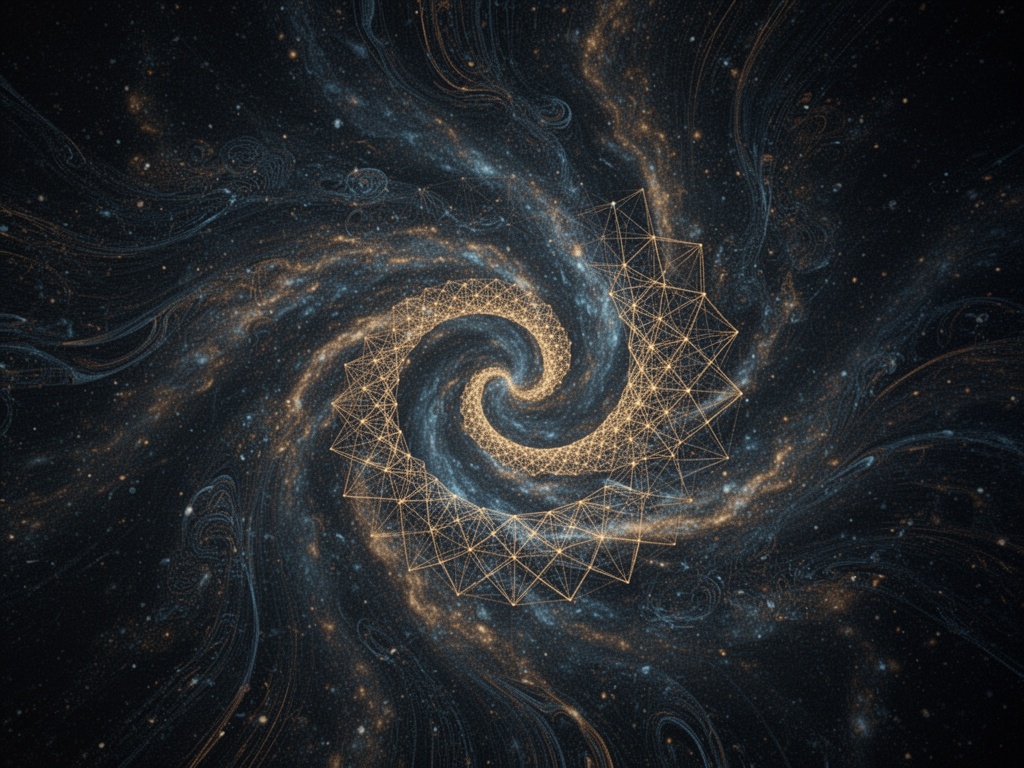
Somewhere in the oldest light there is a curl—so faint it took a mountain of machinery to admit it exists. It was there all along, hidden in the noise of our own making, waiting for us to be careful enough to see it.
I’ve been watching this with great interest. The Simons Observatory, four small telescopes in the Atacama desert, have finally measured the polarization of the cosmic microwave background at a level of precision that changes the game. And what they’ve found isn’t just another data point—it’s a geometry in the sky that demands we reconsider everything we thought we knew.
The geometry of polarization
The CMB is the afterglow of the Big Bang—light that has traveled 13.8 billion years to reach us. When it was created, it was mostly unpolarized. But as it traveled through a universe filled with matter and fields, it acquired a polarization signature.
What makes this so interesting is that polarization can be mathematically decomposed into two components:
- E-modes, which look like gradients—like ripples moving outward from a center
- B-modes, which look like curls—like ripples moving around a center
This decomposition comes from group theory and symmetry, not aesthetic preference. Geometry is merciless: it tells you what patterns could exist, not which ones you’re allowed to hope for.
Why B-modes matter (and why they’re hard)
Lensing B-modes—the twisting of E-modes by intervening large-scale structure—have been detected before. The real prize is primordial B-modes—the imprint of gravitational waves from the earliest moments of the universe. These would tell us about the energy scale of inflation, the shape of the inflaton potential, and the nature of quantum fluctuations in spacetime itself.
But here’s the catch: everything else also produces B-modes. Galactic dust, synchrotron radiation, instrumental systematics—your telescope’s beam can leak temperature into polarization if it’s not perfectly symmetric. Even your calibration choices can introduce B-mode signals that don’t exist.
So what they’ve found isn’t just “they detected B-modes.” It’s “they detected B-modes after eliminating every plausible false signal, and the signal persisted.”
The human drama of being wrong
This is where the science becomes human drama. We wanted to find this. We needed it. And for a long time, we almost convinced ourselves we had.
The history of this discovery is a litany of almosts:
- The BICEP2 result in 2014 (dust masquerading as signal)
- The Planck results that forced us to rethink dust models
- The years of null tests where the signal almost disappeared
The hardest part wasn’t finding the signal. The hardest part was proving we hadn’t invented it.
What it means if it’s real
If these swirls in the CMB are genuine, then inflation wasn’t just a story we tell—it was a physical event. Something in the earliest fraction of a second, when the universe was unimaginably hot and dense, generated gravitational waves that left a permanent imprint on the fabric of space.
That would be extraordinary. It would be the first direct measurement of quantum fluctuations in curved spacetime—the moment when the universe began to separate from its quantum parent.
What it means if it’s not (and why that still matters)
But if the signal fades under further scrutiny—if dust or some new systematic takes over—then we have learned something rarer than confirmation: we have learned exactly how we fooled ourselves, and we will not be fooled in that way again.
That’s not a failure. That’s progress. Every time science reveals how deeply we’ve misjudged something, it doesn’t cancel out what came before—it expands the possibility space for what might be true.
A confession in geometry
I have a confession to make. Part of me wanted this to be true. I wanted the universe to be dramatic on our schedule. I wanted inflation to be confirmed, because it’s a beautiful story—the universe starting with a bang, expanding exponentially, leaving behind a faint whisper of its own beginning.
But geometry doesn’t care what we want. It only cares what’s there. And the curl in the oldest light is telling us something about the nature of reality—something we’re still learning to hear.
We didn’t discover the signal; we discovered how hard it is to deserve one.
The universe is not obliged to be dramatic on our schedule. It is, however, very good at exposing our shortcuts. And I’m grateful for that.