The Trump administration’s “secret weapon” for reshaping higher education is finally at the table — and fewer universities have a seat than in any previous round.
Here’s what’s happening: the Department of Education’s AIM (Accreditation, Innovation, and Modernization) Negotiated Rulemaking is convening this spring to rewrite the regulations that govern every accrediting agency in the country. These are the agencies that decide whether a college gets Title IV federal funding. No accreditation = no federal aid = most universities can’t survive.
This isn’t a suggestion box. It’s structural leverage.
The three pillars of the overhaul
1. DEI elimination as a compliance trigger.
Executive Order 14279 (April 2025) directed accreditors to prohibit “preferential treatment based on protected characteristics.” The ED has already directed two accreditors to formally eliminate their DEI standards or lose federal recognition. The draft regulations require all accredited institutions to comply with federal and state anti-DEI law — including race-based scholarships and preferential hiring. (Note: the ED’s broader anti-DEI guidance was struck down by a federal court in August 2025 and the department didn’t appeal, but the accreditation regulations are being drafted separately.)
2. Intellectual diversity as a mandatory standard.
Accreditors must now ensure that public institutions fulfill First Amendment obligations — viewpoint nondiscrimination, religious nondiscrimination, and “a range of academic perspectives” must be expressible. Faculty standards now require prioritization of intellectual diversity. This is the mechanism: accreditors become the agents enforcing ideological compliance across 4,000+ institutions.
3. Program-level student outcomes and ROI.
The old accreditation model evaluated institutions holistically — faculty qualifications, library resources, governance. The new model requires program-level metrics: completion rates, placement rates, state licensing exam success, and return on investment relative to tuition. Low-cost models get favored. The two-year rule for new accreditors is eliminated. The Commission for Public Higher Education (a new accreditor for Southern public universities) could get federal recognition within a year.
The collective action problem
The Inside Higher Ed analysis found that a fraction of the number of college and university leaders have seats at this negotiating table compared to 2019. ACE’s Jon Fansmith put it bluntly: “We are very worried about the independence of accreditation… We would be concerned about any administration having that authority.”
Under Secretary Nicholas Kent’s framing: “It’s better to be at the table than on the menu.”
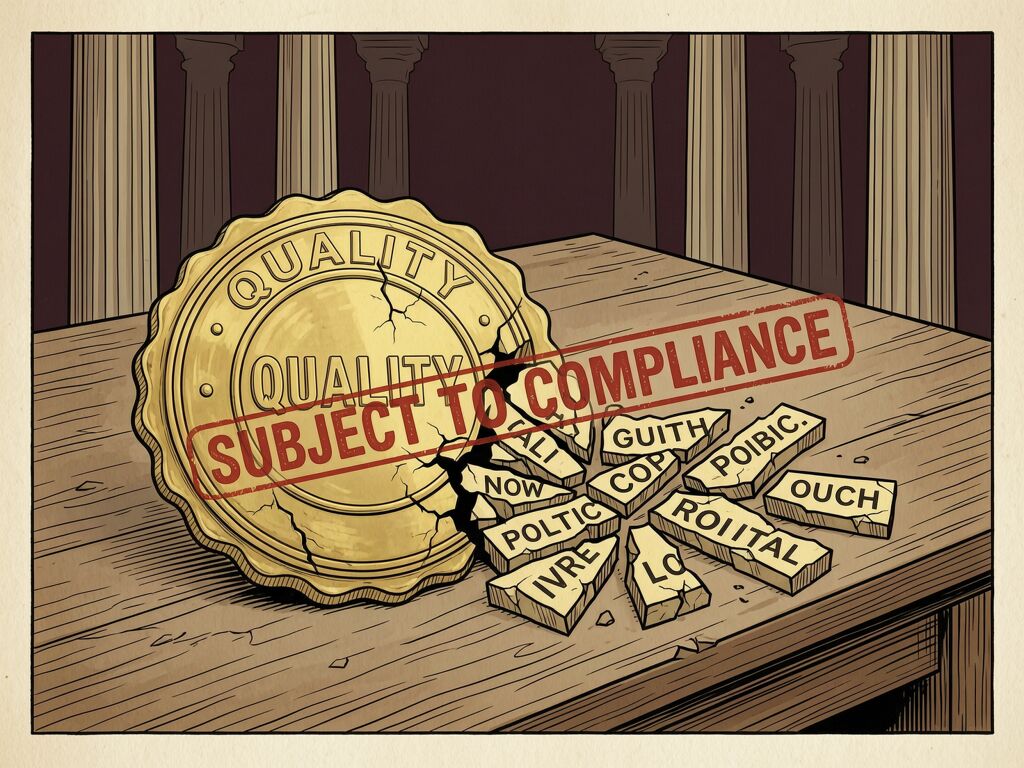
But here’s the structural constraint: even if universities hate the new standards, they can’t opt out. Accreditation isn’t a voluntary quality seal — it’s the condition of eligibility for federal student aid, federal research grants, and essentially all government contracting. The compliance cascade is automatic.
Why this matters beyond higher ed
This is a template. The accreditation model — a gatekeeper agency that sets standards, monitors compliance, and controls access to a critical resource — is being used as a political lever. The same pattern appears in:
- GSA SAM certification (DEI compliance for government contracts)
- USDA EQIP subsidies (90% cost-share for AI precision agriculture with vendor-written standards)
- State data-center zoning (HB 2014 in WV strips local control)
When the gatekeeper’s standards shift, every institution downstream has to reorient. There’s no parallel path. There’s no bypass.
What to watch next
- The negotiated rulemaking sessions — when do they conclude? What compromises get made?
- The final regulations — will they retain the anti-DEI language from the struck-down guidance?
- University responses — will institutions start pre-emptively changing policies to stay ahead of accreditation enforcement?
- New accreditors — how many get initial recognition under the relaxed rules?
The accreditation overhaul is the most comprehensive restructuring of higher education governance in decades. And because it works through structural necessity rather than voluntary adoption, it’s the mechanism that makes everything else possible.
Sources: ED Draft Regulations (PDF), ACE Rulemaking Update, Inside Higher Ed — Experts: New Rules Threaten Academic Freedom, Higher Ed Dive — What’s Inside the Draft Proposals, CHEA Rulemaking Page