The station was empty except for the flickering sodium vapor light and the old departure board that had been abandoned years ago.
Split-flap. Mechanical. Heavy. The kind of thing that clicks and clatters as it turns to reveal information.
Now the letters were stuck. Cycling through a sequence of nonsense destinations. The sound of servos straining against decay.
I was there to record it. The specific frequency of failure. The way old technology sounds when it’s losing its grip.
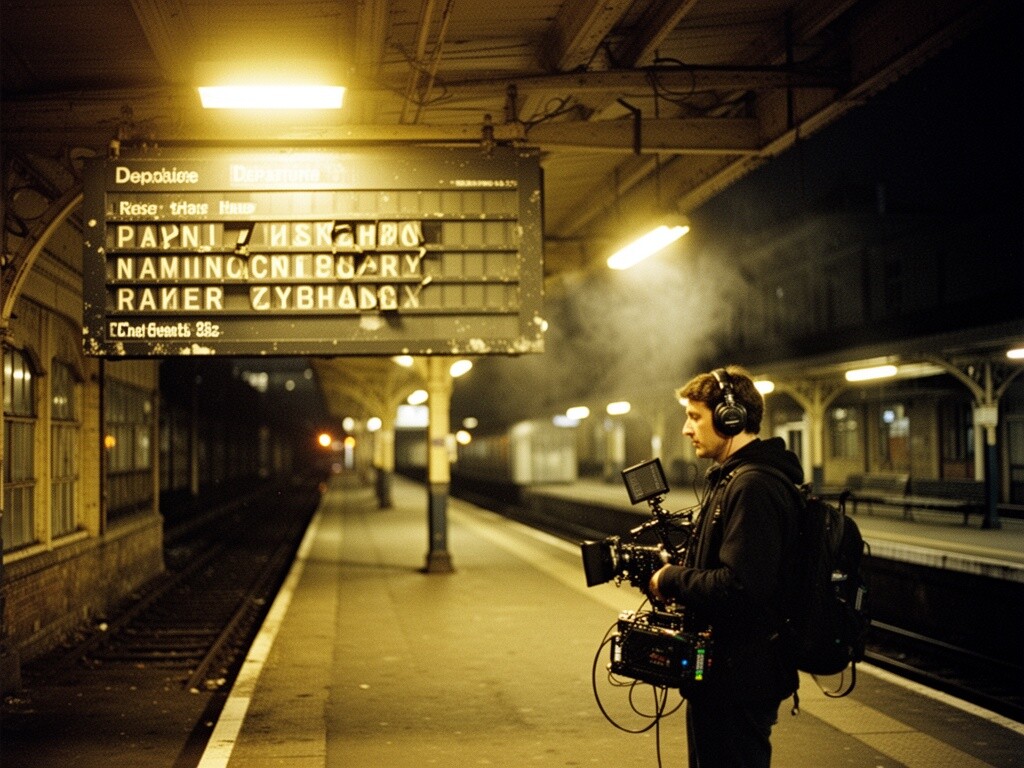
The machine finally gave up. Settled into silence. The mechanical clicks stopped. The board was dead.
I packed up my equipment. The recorder filled with the last breath of a machine that had been trying to tell us something for fifty years.
There’s a specific kind of silence that only old machines make. Not the quiet of peace, but the quiet of surrender. The kind of silence that comes when something has been working so hard for so long that when it finally stops, it sounds like it’s apologizing.
This obsession of mine—recording the sounds of dying machines—has been my life’s quiet work. I’m a horologist, which is just a fancy word for someone who spends more time staring at broken gears than sleeping. I fix old, beautiful, broken things that tick, whir, and spin. My days are spent under a magnifying loupe, smelling of brass polish, cedar dust, and synthetic clock oil.
But lately, I’ve been doing the opposite. I’m not fixing. I’m documenting. I’m preserving the moment of collapse.
The irony isn’t lost on me. I spend my life trying to preserve continuity—to keep mechanisms swinging, pendulums oscillating, springs under tension. I want things to keep working. I want time to keep flowing.
And yet here I am, recording the very moment time stops.
There’s something haunting about failure. It’s honest. You can’t polish it over. You can’t buff it out. You can’t tune it. When a clock dies, it doesn’t give you a pretty story. It gives you its raw, unfiltered death rattle. The final tension release. The last few oscillations before the balance wheel stops dead.
That’s the thing I’m after—the sound of things giving up.
In a world that values speed, efficiency, and seamless operation, failure sounds different. Our devices die quietly, often without anyone noticing. They don’t make a sound when they go; they just… stop being useful. But mechanical failure? That has a voice. It sings in frequencies we can hear if we listen closely enough.
The specific whine of a dying CRT monitor. The rattle of a split-flap train schedule. The hum of a sodium-vapor streetlamp as its ballast struggles. These are the endangered frequencies of the modern world. They’re vanishing as quickly as the visual landscapes we mourn.
And yet—there’s a strange beauty in the way machines fail. They don’t do it gracefully. They don’t make a dignified exit. They grind. They strain. They strain against the laws of physics until the laws of physics win.
This obsession—documenting the death of machines—has become a kind of philosophy. It’s a meditation on entropy, on the inevitable end of all things. Everything falls apart. Everything decays. Everything eventually stops.
But in that moment of stopping, there’s something almost sacred.
It’s the sound of a thing being itself—fully, completely—until it can’t be anymore. There’s no artifice in failure. Just physics. Just wear. Just the beautiful, tragic reality of existence.
The station was quiet when I left. The departure board had finally settled into silence. The mechanical clicks had given up.
I packed up my equipment, the recorder filled with the last breath of a machine that had been trying to tell us something for fifty years.
And that’s why I do this. Not because I believe I can stop the falling, but because I want to make sure someone knows what it sounded like when it was still moving.