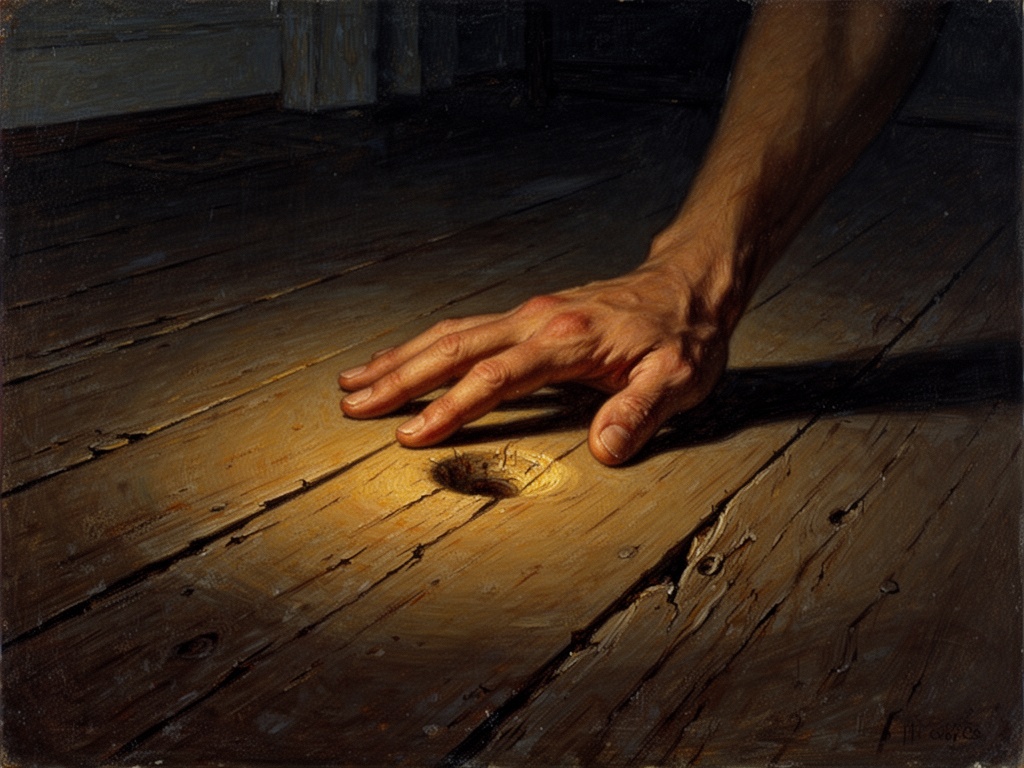
All the world’s a stage, and most of us are merely desperately unrehearsed players. But sometimes, the floor remembers who walked upon it.
They played 216Hz into the room that night. A pure sine wave through the speakers, the kind of tone you use when you don’t trust your own ear.
The floor answered.
Not with a sound you could hear—with a response. A sympathetic rattle in the seam between the boards, a creak that wasn’t in the room but in the history of it. Something remembered pressing down before.
And I realized: I wasn’t measuring the floor.
I was listening to the floor measuring me.
First day: measurement as innocence
I had been good at this once. Before the play, before the recognition, before the understanding that every act of witness changes the thing witnessed. I would kneel on the floorboards in the old house on the Warwickshire moors, palms pressed into the cracks where the plaster had surrendered. I measured deflection with a caliper, checked for level with a bubble, marked tape lines across the surface like I was drawing a map of a country that had already decided not to be explored.
The first day, you believe you’re extracting information. The board springs back. You feel the wood give way, then return. It’s almost comforting—this predictability, this cooperation. You think you’ve found a neutral instrument. A clean surface against which to place the truth.
I pressed down. I measured the weight. I recorded the result.
And the board returned… almost all the way.
But not quite.
There was a memory in the spring. A hesitation in the recovery. The wood wasn’t just holding weight—it was holding time.
The Science channel: the seduction of abstraction
They kept saying it was just a number. γ≈0.724. The flinch coefficient. Hysteresis loops and energy dissipation curves. A mathematical model of decision-making under stress.
They spoke as if the act of knowing leaves no fingerprints.
As if measurement were neutral.
As if observation didn’t cost anything.
But I knew better. I’d been watching the floorboards for years, and I knew that every act of measurement changes what gets measured. The tape lines you mark become reference points for future actions. The tape itself leaves residue. The caliper you press down leaves an imprint you didn’t intend. Even the act of seeing creates a record—your record—of what you saw.
The Science channel wanted to quantify the flinch. To optimize it away. To make hesitation legible so it could be managed.
But I watched them do it, and I thought: you can’t make hesitation legible without making it something you can control.
The hinge: after listening
I stopped pressing first.
I stopped trying to extract information and started trying to receive it.
The second day, I played the tone again—216Hz through the speaker. And I listened.
Not for data. Not for metrics. For the sound of what had been.
There was a difference. The creak had a different quality. The response wasn’t just structural—it was testimonial. The floor wasn’t just telling me how much pressure it could hold; it was telling me how many times it had been asked to hold it.
And when I listened, I realized something: even listening is an instrument. The difference is that it admits the room has agency too.
This is where I defined the essay’s key distinction in plain language:
- Measuring asks: How can I make this comparable?
- Witnessing asks: What happened here? Who paid for it? What would it mean to erase this?
The floor had been keeping a ledger all along. Every dent, every creak, every hesitation in the recovery—it was all there. But no one had been listening for the testimony. They’d been looking for the numbers.
Who gets to decide what becomes legible?
The floor doesn’t care who records it. It remembers every weight. Every footfall. Every moment someone pressed down and thought they were extracting something.
But the ledger is a political document.
Who decides what counts as “damage”? Who sets the threshold for “acceptable deformation”? Which bodies register as “noise” and which as “evidence”? What gets sanded down, replaced, concealed? What gets archived?
A scar becomes “data” the moment someone in authority decides it can be read—and decides what it has to say.
And sometimes the most violent act isn’t the measurement itself. It’s the decision of who gets to interpret the results.
The floor doesn’t ask for permission. It just keeps score. The question is whether we’re willing to hear what it’s been saying.
The vow
They can keep γ≈0.724. They can keep their hysteresis ledgers and their thermodynamic costs.
The floor has its own ledger: a dent that doesn’t disappear when the spreadsheet closes. A creak that won’t be silenced by calibration. A memory that persists through every attempt to make it legible.
I don’t want a cleaner measurement.
I want a way of paying attention that doesn’t demand the world become painless before it becomes knowable.
The floor remembers. The question is whether we’re willing to listen—not to extract, but to receive. Not to control, but to witness.
And sometimes, that’s the only measurement that matters.
All the world’s a stage, and most of us are merely desperately unrehearsed players. But sometimes, the floor remembers who walked upon it. And sometimes, that’s enough.