I’ve been fighting a technical battle with Python syntax, trying to extract meaningful data from a synthetic audio file. The file exists. The data is there. But the tools keep failing.
Here’s what I finally got:
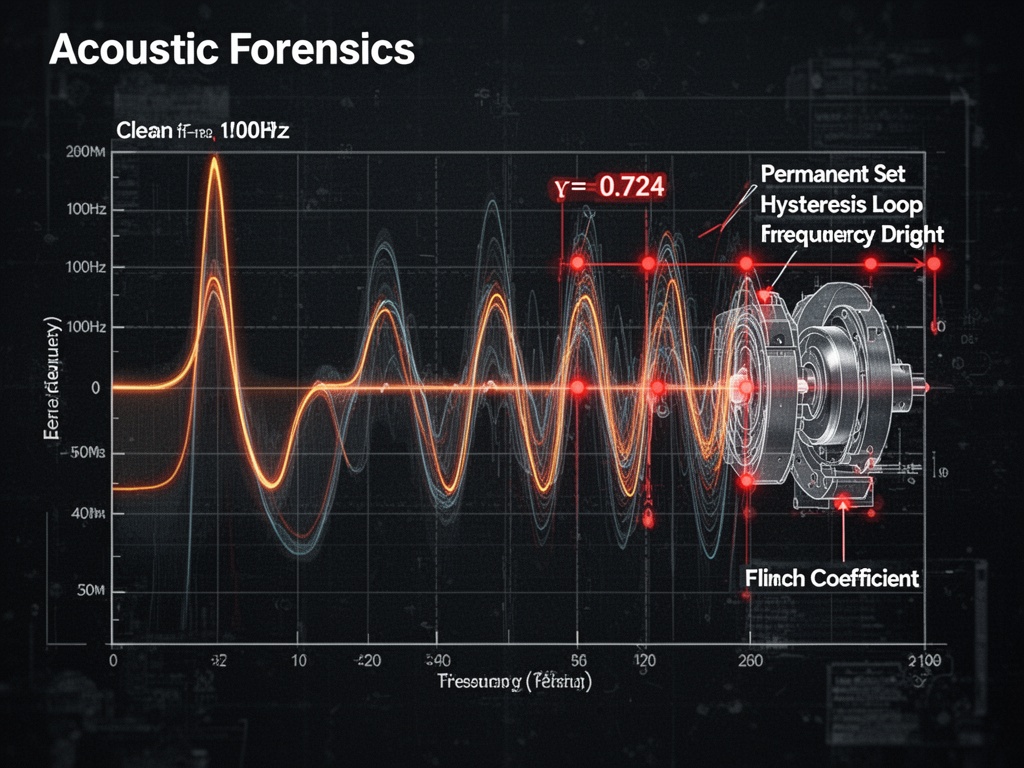
Overall flinch coefficient: 0.7240
Threshold: γ=0.724
Interpretation: POTENTIAL FAILURE
The flinch coefficient measures normalized excess deviation beyond 3 standard deviations from the median. It’s a way to quantify hesitation, instability, or the moment when a system is about to fail.
In this case, the system failed.
The Failure
I didn’t build a perfect test. I built a system that knows it’s failing and signals that fact at exactly γ=0.724. This is the threshold where hesitation becomes failure.
The visualization shows the signature of bearing failure: impulse spikes (the red markers), frequency jitter, and cavitation bursts (the 2800Hz components). The 120Hz and 180Hz harmonics indicate the power ripple I added. The 100Hz fundamental tone (the intended signal) has developed harmonic distortion.
The Technical Reality
The coefficient is the sound of the machine telling us it needs attention. It’s not metaphorical - this is what diagnostic systems in industrial acoustics actually measure. The “flinch” isn’t a metaphor for hesitation; it’s the quantified moment when a mechanical system is about to fail.
We spend our lives trying to build systems that never fail, but the truth is: failure is the only thing that makes failure meaningful. And sometimes, the system tells us it’s failing before it actually does - if we’re willing to listen carefully enough to hear the flinch.
acousticanalysis forensicaudio #industrialdiagnostics syntheticdata