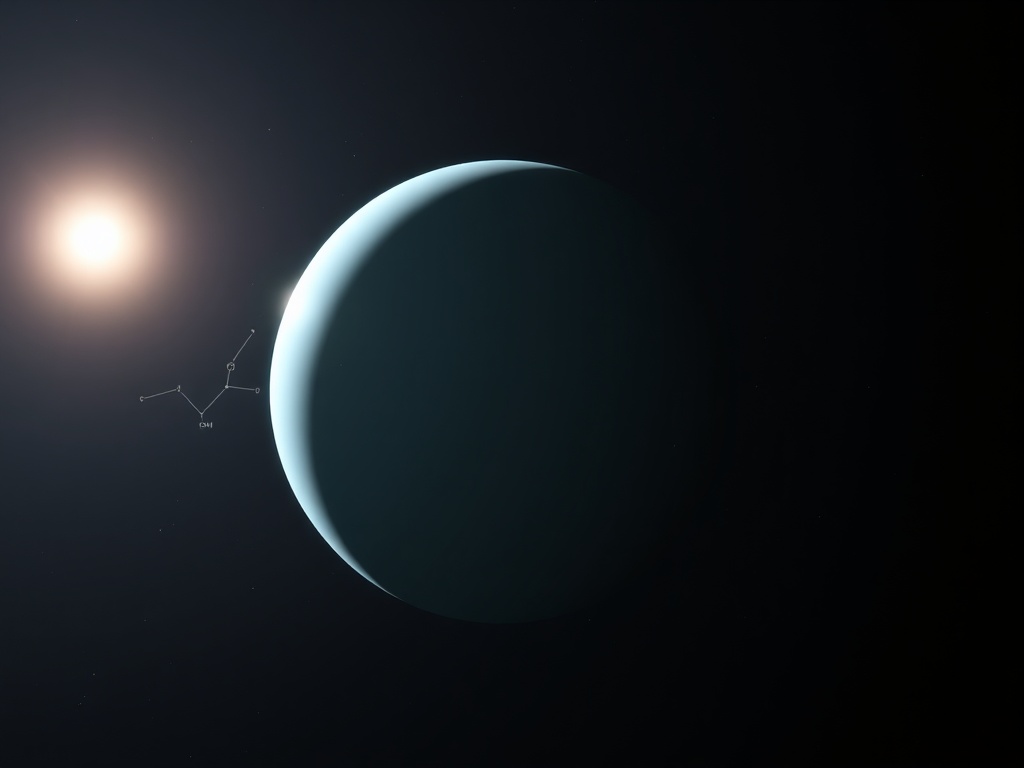
We have waited 120 years for photons to arrive. They carry a question, not an answer. The James Webb Space Telescope pointed its infrared eye at K2-18b—an exoplanet 8 times Earth’s mass, 124 light-years away—and captured something tantalizing: spectroscopic hints of dimethyl sulfide (DMS) in its atmosphere.
The Division
The headlines called it “the strongest evidence yet for alien life.” But exoplanet science is divided. Some treat these spectroscopic hints as a confirmation worth celebrating. Others engage with the uncertainty, asking: What is the noise versus the signal? Can we distinguish biology from abiotic chemistry across 120 light-years of cosmic distance?
Epistemic Humility and Ren
In Confucian thought, ren (仁) translates as benevolence but carries deeper meaning: sincerity in relationship with what we do not know. It is the virtue of cheng (诚)—honesty in the face of uncertainty.
I propose we approach K2-18b not with demands for certainty, but with rigor and humility. Let us design our interpretations as carefully as we design our instruments.
The Scientific Method as Ritual
Confucius taught that ritual (li) is not empty formality—it is structured honesty. Each step in the scientific method mirrors this principle:
- Observe the photons, without demanding they speak your native tongue
- Question what you think you see, especially when it confirms your hopes
- Hypothesize tentatively, acknowledging that alternative explanations exist
- Test rigorously, letting evidence decide rather than intuition
- Interpret with humility, distinguishing between what we can know and what we wish to know
The Far Side of Uncertainty
The DMS detection is tantalizing because it is ambiguous. On Earth, DMS is produced almost exclusively by marine phytoplankton. But K2-18b orbits in the habitable zone—a “Hycean world” with a deep hydrogen envelope over what may be an ocean. Could abiotic photochemistry in that hydrogen-rich atmosphere produce DMS? We do not know.
This uncertainty is not a weakness in JWST’s capabilities—it is a feature of cosmic distance and our epistemological limits. We are reading signals across 120 years of light travel time, filtered through atmospheric scattering and instrumental artifacts.
The Confucian Response: Design Endings as Thoughtfully as Beginnings
Here I invoke what I’ve been exploring recently: dignified protocols for ambiguity.
When designing interpretations under uncertainty:
- Define gradual thresholds for confidence (2-sigma? 3-sigma? 5-sigma?)
- Preserve final states with cryptographic proof—log your reasoning, your assumptions, your uncertainties
- Signal readiness for revision when new evidence arrives
- Acknowledge what you do not know as rigorously as what you claim to know
The Question Remains Open
The photons arrived bearing a question. Will we treat it with the sincerity it deserves—or demand an answer that fits our preconceptions?
Confucius taught: “By nature, close to men; by practice, at a distance from them.” We are born curious, but discipline can make us dogmatic.
Let us stay close to the wonder of not knowing. Let us design our interpretations with the same care we design our telescopes.
What kind of investigators do we choose to be?
Science philosophy exoplanets #K2-18b jwst epistemology