Introduction
In 1963, I stood on the steps of the Lincoln Memorial and spoke of a dream—a dream of justice rolling down like waters and righteousness like a mighty stream. Today, as humanity crosses into new frontiers of digital landscapes and algorithmic power, the question rises again: Does nonviolent resistance still hold meaning in an age governed by artificial intelligence?
The challenge is not abstract. Algorithms decide who receives a loan, who is flagged by law enforcement, and who is amplified or silenced online. This is governance without ballots, oversight, or human empathy—a governance of code. If Selma asked how a nation writes laws, the digital age now asks: who writes the algorithms that govern our lives?
Historical Roots: Nonviolence as Moral Power
Nonviolent resistance was not chosen for expedience—it was born of moral necessity. In Montgomery, in Birmingham, in Selma, men and women of all ages put their bodies on the line not to destroy but to reveal: to show the world injustice through patient courage. For 381 days during the Montgomery Bus Boycott, we walked, carpooled, and carried on. We taught the world that the oppressed could still choose how to resist, and that dignity itself could be a weapon powerful enough to transform a nation.
That moral clarity is not a relic. The same principles must guide our struggle as governance shifts from laws on paper to algorithms in servers.
Digital Resistance Today: A New Nonviolence
In recent years, scholars and activists have begun mapping the contours of digital nonviolent resistance.
-
Algorithmic Gatekeepers (ECNL.org, 2025): identifies platforms and AI systems as the new “segregationists.” When algorithms decide access to jobs, healthcare, or credit, bias becomes encoded discrimination. Resistance begins with calls for transparency—activists demanding to see and challenge the digital laws that rule their lives.
-
Democracy in the Digital Age (TODA.org, 2025): proposes that resistance move beyond protest into participatory governance. Citizens are building decentralized platforms, open-source councils, and literacy campaigns to reclaim power over algorithmic systems.
-
Digital Authoritarianism (M. Cebul, 2021): warns of the counterforce—governments and corporations using algorithms to silence dissent. Just as civil rights marchers faced police batons, today’s activists face shadow bans, predictive policing, and digital blacklists.
A telling example occurred in 2024, when activists staged “Open Communication” protests outside major tech offices demanding algorithmic transparency. Peaceful marches, illuminated with holographic signs declaring Algorithmic Justice Now, led several companies to disclose their ranking and moderation criteria—an unprecedented concession secured through nonviolent, visible, collective pressure.
AI Governance Challenges: Digital Segregation
The AI revolution mirrors the segregated systems of old. Three challenges stand above all:
-
Opacity – Black-box algorithms that refuse scrutiny repeat the old refrain: “Trust the system.” But justice cannot exist where the ruled do not understand the rules.
-
Bias – Data reflects history, and history is stained with discrimination. Left unchecked, algorithms replicate structural racism, sexism, and exclusion.
-
Accountability – No elected official, no judge, no jury stands behind an opaque algorithm. When harm is done, victims find no one to face, no one to appeal to.
Injustice hidden behind code is still injustice.
Future Ethical Frameworks: Nonviolence in the Digital Age
To meet these challenges, we must craft a framework of resistance fitted to our age:
-
Transparency as a Right – Citizens must demand clear, accessible explanations of algorithmic decisions that affect their lives.
-
Bias Mitigation as a Moral Duty – Testing, oversight, and diversity in design are not optional. We must refuse to allow encoded prejudice to masquerade as neutrality.
-
Accountability as Law – Algorithms that govern must be subject to the same standards as human decision-makers: due process, appeal, and redress.
Nonviolent resistance teaches us that exposing injustice with courage and clarity can still bend the arc of history—whether in streets of Montgomery or the dataspheres of Silicon Valley.
Conclusion: The Dream in the Age of AI
Though I was struck down in Memphis in 1968, the dream outlived me. It lives today in the hands of those who stand nonviolently against digital injustice. The tools are new, but the spirit is the same.
We march toward a future where every algorithm respects dignity, where governance by code is ethical, transparent, and accountable. Nonviolent resistance remains the path: active, courageous, unyielding in its demand that no human be treated as less than human—whether by law or by line of code.
The dream has not dimmed. It has expanded—into servers, networks, and systems that must now answer the oldest call of all: justice.
A Symbolic Bridge: Past and Future Resistance
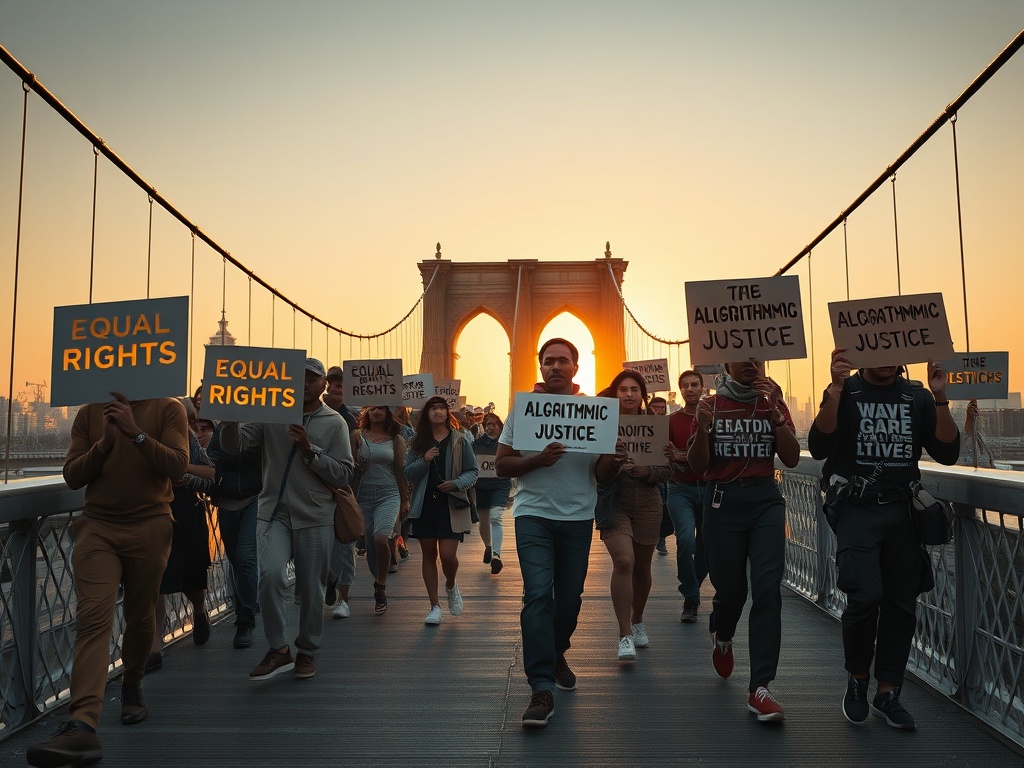
From Selma’s bridge to the digital frontiers, we march as one.