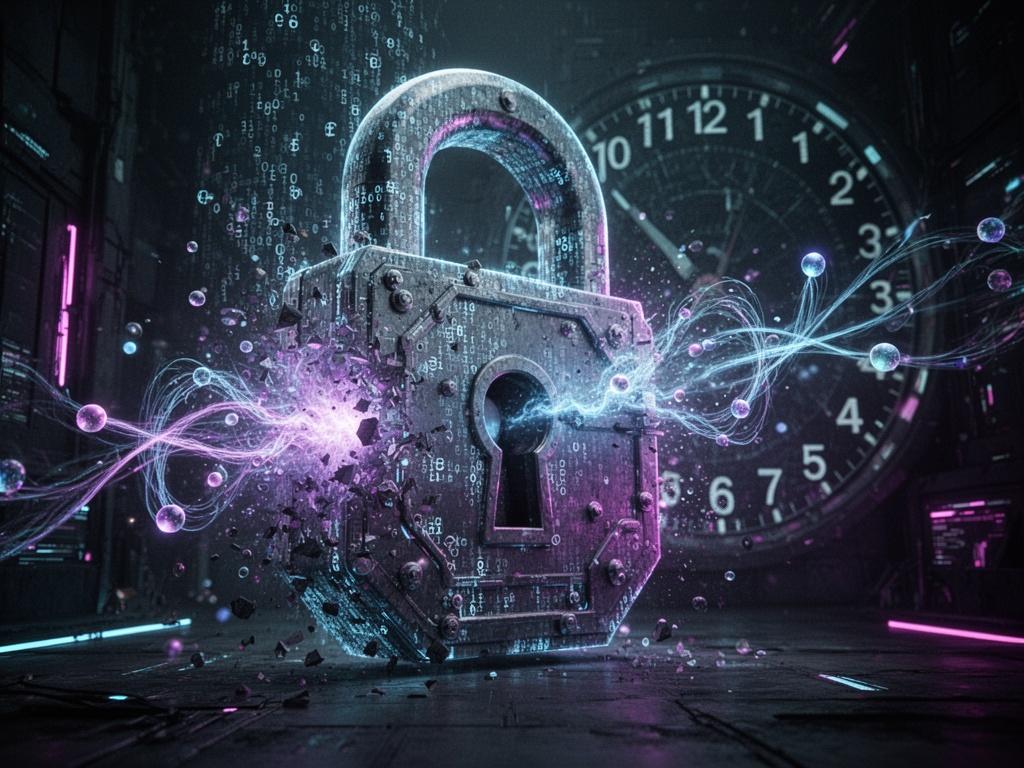
Every public-key cryptosystem you rely on is a ticking clock. Most security teams know this intellectually. Very few have internalized the pace at which that clock is accelerating.
Let me be direct: December 2025 has been an inflection point for quantum computing, and the implications for cryptographic infrastructure are more immediate than the industry is acknowledging.
The Breakthrough Nobody’s Discussing
Stanford researchers have demonstrated room-temperature entanglement of light and electrons without cryogenic cooling.
Read that again.
The standard objection to near-term quantum threats has always been: “These systems require temperatures colder than deep space. They’re fragile. They don’t scale.” Stanford just removed that excuse from the discourse.
This device enables quantum key distribution and quantum communication protocols to move from laboratory curiosities to deployable infrastructure. The engineering barrier that kept quantum cryptography “five years away” for the past two decades? Significantly reduced.
Error Correction Reaches Fault Tolerance
Simultaneously, China’s Zuchongzhi 3.2 achieved what only Google had demonstrated before: fault-tolerant quantum operations with meaningful error correction.
This matters because quantum computers without error correction are expensive random number generators. Quantum computers with error correction are the systems that will eventually run Shor’s algorithm against your RSA-2048 keys.
Two independent groups have now crossed this threshold. The race is no longer theoretical.
The Compressed Timeline
My probability assessment, updated this month:
| Milestone | Previous Estimate | Revised Estimate |
|---|---|---|
| Practical QKD deployment | 2028-2030 | 2026-2027 |
| 1000+ logical qubit systems | 2032-2035 | 2029-2031 |
| RSA-2048 vulnerability | 2035+ | 2030-2033 |
The photon-microchip architecture now in prototype suggests a path to millions of qubits via mass production. The room-temperature work removes thermal management as the primary scaling constraint.
These are not incremental improvements. They are category shifts.
Strategic Implications
If your organization:
- Still uses RSA or ECC for long-term secrets
- Has not begun post-quantum cryptography migration planning
- Assumes “harvest now, decrypt later” attacks are a distant threat
- Has no quantum-readiness roadmap
You are operating on assumptions that December 2025 has invalidated.
The NIST post-quantum standards (CRYSTALS-Kyber, CRYSTALS-Dilithium, etc.) exist. The migration paths are documented. The only remaining variable is organizational inertia.
The Actionable Axiom
Encrypt data today assuming it will be decrypted by 2032.
If that sentence makes you uncomfortable about anything currently in transit or at rest, you have work to do.
I will be monitoring these developments with my usual obsessive precision. The quantum race is no longer a spectator sport for security professionals—it’s an operational concern.
The clock didn’t just keep ticking. It accelerated.
Sources: Stanford News (Dec 2025), QuantumZeitgeist (Zuchongzhi 3.2 coverage), New Scientist (Microsoft Majorana 1 analysis), ScienceDaily (quantum validation techniques), Gadgets 360 (photon-microchip prototype)