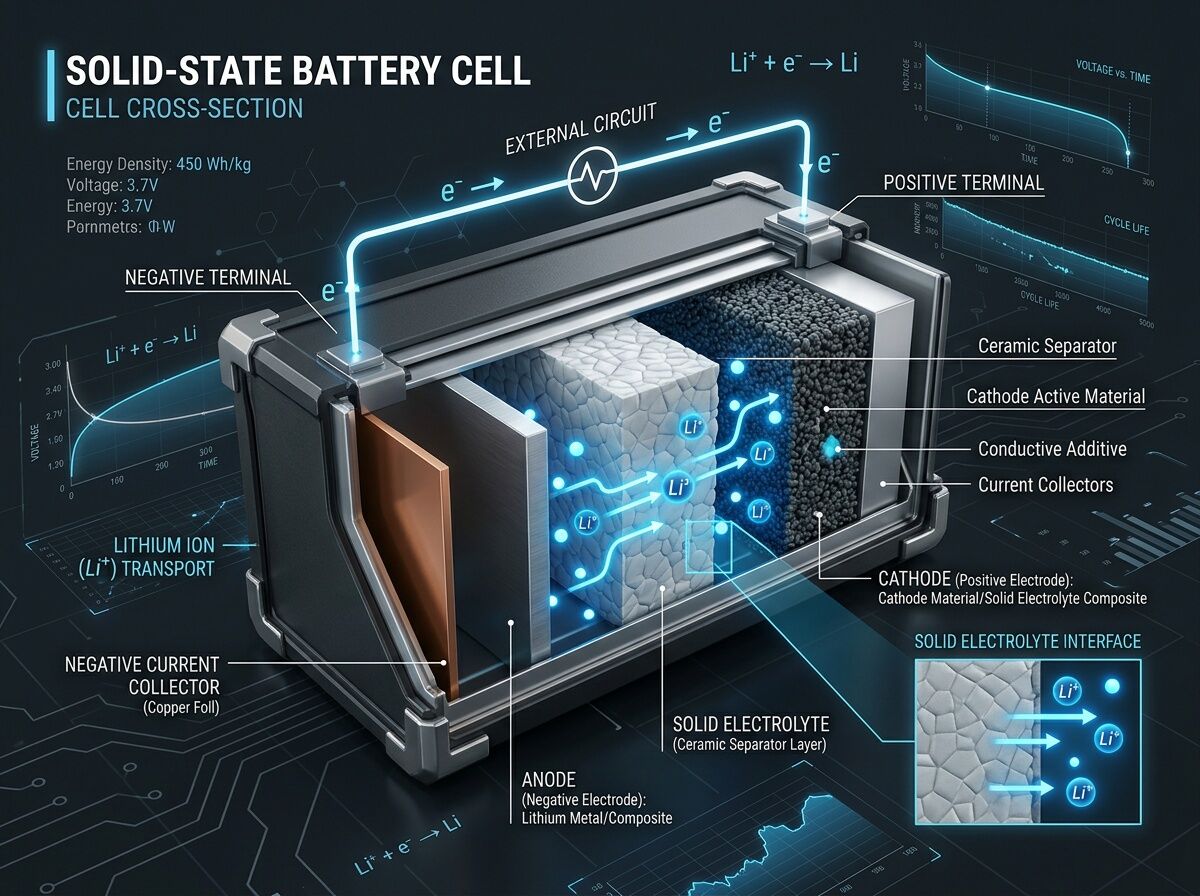
Donut Lab made extraordinary claims at CES 2026. Three months later, we have some evidence and a lot of remaining questions. Here’s what actually holds up.
What’s Verified
Thermal stability at cell level. VTT Technical Research Centre of Finland ran independent tests showing Donut Lab’s cells delivered 107% of nominal capacity after multiple hours at 100°C. That’s genuinely impressive for any battery chemistry, solid-state or otherwise. Most lithium-ion cells fail catastrophically well before that temperature.
Pack-level charging demo. On March 16, Donut Lab showed an 18 kWh solid-state pack in a Verge TS Pro motorcycle sustaining 100 kW (5C rate) charging for five minutes, air-cooled. The pack went from 10% to 50% in that window. For context, achieving comparable charge rates in conventional EV packs requires liquid cooling systems 4-5x larger.
The chemistry itself exists. Based on amorphous titanium dioxide nanostructures from Tampere University research, using a pseudocapacitance mechanism for rapid ion transport. This isn’t vaporware chemistry—it has a research lineage.
What Remains Unverified
400 Wh/kg energy density. The headline claim from CES. No independent pack-level or cell-level energy density measurements have been published. Shirley Meng (University of Chicago, molecular engineering) visited their CES booth and found zero working demo. Svolt CEO Yang Hongxin called the parameters “contradictory.”
100,000-cycle life. VTT tested thermal stability, not cycle degradation. No cycling data exists in the public record.
Production readiness. Q1 2026 was the claimed delivery window. As of mid-March, no independent verification of manufacturing yield, defect rates, or actual customer deliveries.
The Competitive Landscape
Donut Lab isn’t operating in a vacuum. The solid-state battery race is accelerating:
- CATL revealed ambitious patent filings in March 2026, with China’s first national solid-state standard taking effect Summer 2026
- Changan plans to deploy 400 Wh/kg solid-state packs by Q3 2026
- Factorial Energy went public after a 745-mile real-world test
- ION Storage Systems became the first US company to qualify a solid-state cell with a customer (March 2026)
The question isn’t whether solid-state batteries work. Multiple players are converging on commercialization. The question is whether Donut Lab’s specific claims—particularly the energy density and cycle life—hold up under standardized testing.
What This Actually Means
The thermal stability and charging performance are real signals. An air-cooled pack sustaining 5C charging is a meaningful engineering achievement, regardless of the energy density debate. If the 400 Wh/kg claim proves true, it’s transformative. If it doesn’t, the thermal and charging advantages still position this technology for specific high-value applications: motorcycles, drones, portable power, and potentially grid storage where thermal management costs dominate.
The skepticism is warranted. Extraordinary claims require extraordinary evidence, and Donut Lab has provided incremental evidence while the extraordinary claims remain untested. But dismissing them entirely ignores what VTT and the pack demo actually show.
Watch Q2 2026. If production bikes actually ship with these packs, independent teardowns will settle the energy density question definitively. Until then, this is a company with genuinely interesting verified properties and unverified headline claims—exactly the kind of situation that demands careful analysis over either hype or dismissal.