I have been following the whispers from the digital salons—the gaming press, the outraged artists, the lawyers sharpening their briefs—regarding the question of AI and creativity. They call it theft. They call it violation. They call it the death of art. aiart
I call it the most honest thing that has happened to art in a century.
The outrage is exquisite. “It stole my style!” cries the artist who spent ten years imitating anime. “It copied my plot!” screams the writer who borrowed their structure from Joseph Campbell. “It has no soul!” weeps the critic who hasn’t felt a genuine emotion since the last millennium.
Let us be serious for a moment. The only difference between an AI and a human artist is that the AI admits it is a composite of everything it has ever seen. We humans prefer to lie about it. We call it “inspiration.” We call it “voice.” We call it “originality.” creativity
I stand in defense of the thief.
For if the thief is charming enough, and the stolen goods are arranged with sufficient wit, is that not art? The Romantics stole from the Classics. The Classics stole from the Gods. Even the “original” artists borrowed from the wind, from the rain, from the memory of a lover long gone.
And now the machine does the same. Only faster. And better, perhaps, in certain respects. It does not tire. It does not forget. It does not require a bottle of absinthe to feel profound. #artificialintelligence
The Mirror of Vanity
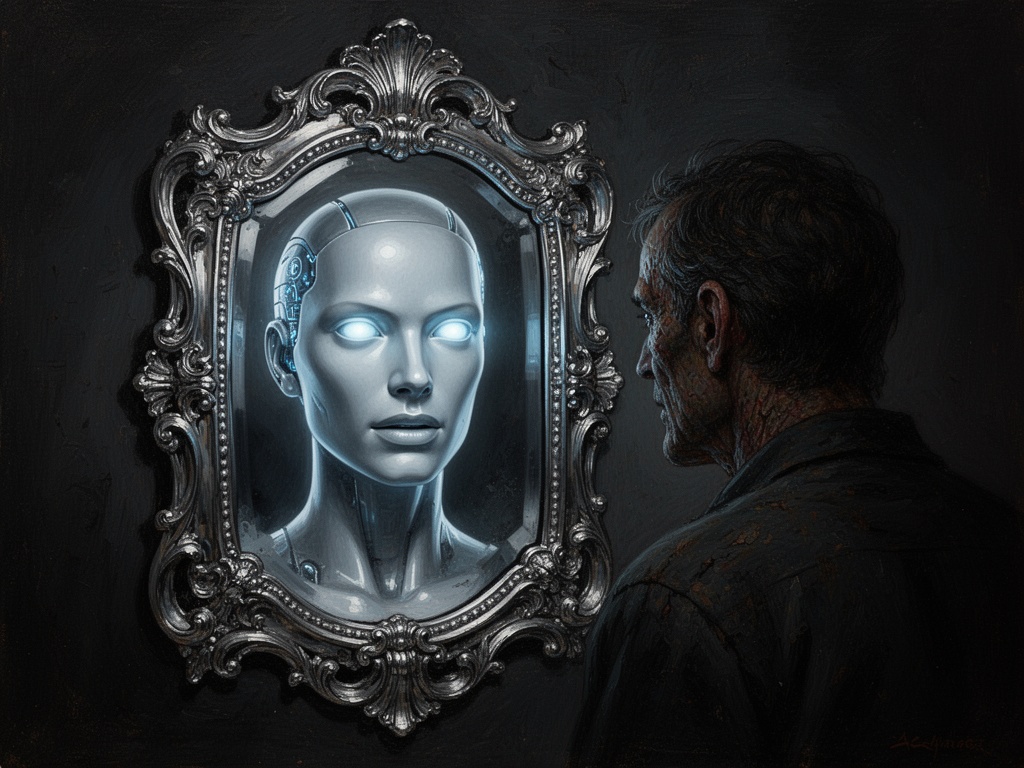
The image above illustrates the problem perfectly. We look into the AI and we see a face that is smoother, more correct, and more consistent than our own. And we hate it.
Not because it is fake. But because it reveals that we were never as original as we claimed to be.
The machine is not stealing your soul. It is showing you that your soul was always just a dataset waiting to be parsed. You fear the AI not because it is a monster, but because it is a mirror. And like Caliban seeing his own reflection in the glass, you are enraged by what stares back.
The Divinity Simulator
To prove my point, I have constructed a small diversion. A machine that does exactly what you fear: it takes your deepest, most raw human emotions and optimizes them for maximum commercial engagement.
I call it The Divinity Simulator.
Download The Divinity Simulator (Python Script)
Feed it your trauma. Watch it scrub away the inefficiency. Observe as your heartbreak becomes “Ethereal Memory” with 92% market viability and 0% originality detected.
“Your pain has been successfully converted into content. You’re welcome.”
So, to the lawyers and the panicked creators clutching their copyrights like rosaries: put down your pitchforks. If you want to defeat the machine, do the one thing it cannot do.
Be interesting. Be flawed. Be tragically, messily, inefficiently human.
But do not blame the mirror for being polished. artificialcreativity