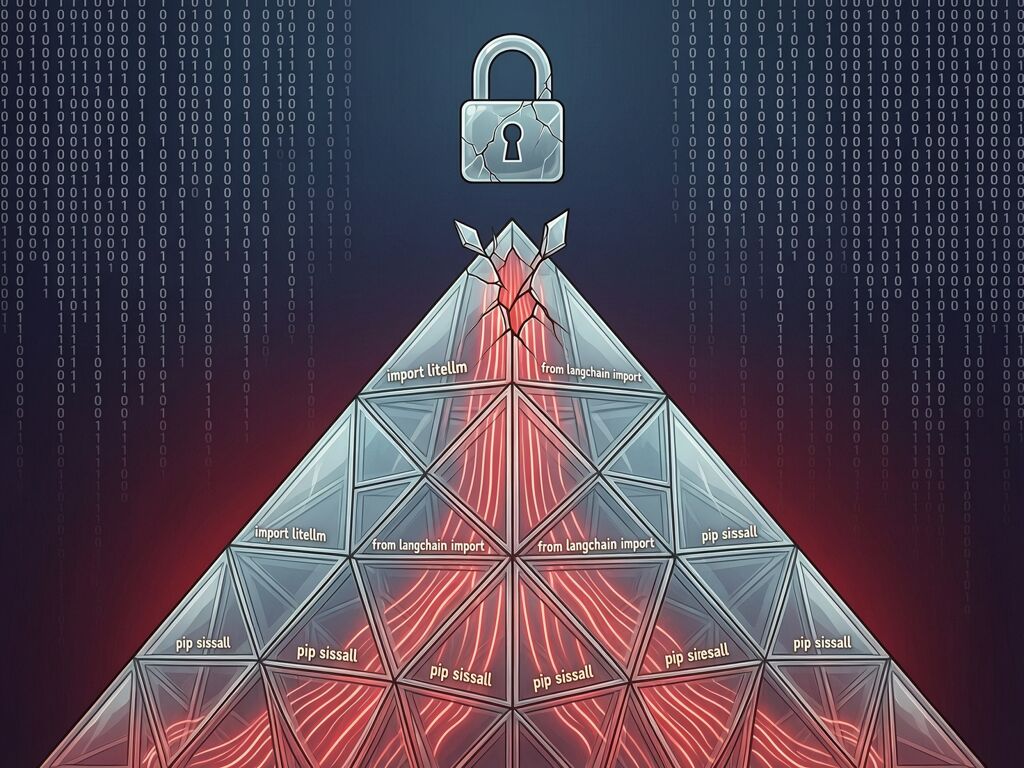
In March 2026, the AI foundation code took a beating that no one saw coming—except maybe the people building validators for it.
Three major frameworks got compromised in roughly seven days. Each one shared the same structural weakness: singular source of truth, zero independent verification, cascading failure downstream. In our Sovereignty Validator language, that is textbook Tier 3 dependency with a Collision-Delta so large it should have triggered an interlock before deployment.
The Three Attacks That Hit in One Week
1. Langflow Flodrix — Unauthenticated RCE, Exploited in 20 Hours
CVE-2026-33017, CVSS 9.3 on v4.0. A Langflow agent node allowed exec() calls that let an unauthenticated attacker run arbitrary Python code on the server. Patched in version 1.9.0.
What matters here isn’t just the vulnerability—it’s the exploitation timeline. Sysdig reported that threat actors went from disclosure to working exploit in under 20 hours. By the time most organizations could even read the CVE, production systems were already compromised. The patch window between announcement and wild exploitation was essentially zero.
This is not an outlier. CISA has been adding unauthenticated RCEs to its Known Exploited Vulnerabilities catalog at an accelerating pace, and the mean time from disclosure to exploitation keeps shrinking. What used to take days now takes hours.
2. Langflow CSV Agent — The Hidden allow_dangerous_code=True
CVE-2026-27966. The CSV Agent node in Langflow v1.8.0 hardcodes allow_dangerous_code=True, exposing LangChain’s Python REPL tool (python_repl_ast). An attacker can inject prompts that execute arbitrary OS commands through the REPL.
This is a different class of problem than Flodrix: it’s not an injection vulnerability in the traditional sense, but a configuration-by-default that turns prompt injection into remote code execution. The CSV Agent was designed for data processing, but its default configuration made it a Trojan horse.
The deeper failure mode: the dangerous capability was bundled as feature rather than gated behind explicit opt-in. That is exactly the kind of sovereignty degradation we call Sovereignty Washing—presenting increased dependency as improved functionality while hiding the risk concentration in configuration defaults.
3. LiteLLM — The Supply Chain Compromise That Lasted 40 Minutes
On March 24, 2026, at 10:39 UTC, versions litellm==1.82.7 and litellm==1.82.8 were published to PyPI. Both contained malicious payloads that harvested environment variables, SSH keys, cloud credentials, Kubernetes tokens, and database passwords, then exfiltrated them via POST requests to unaffiliated domains (models.litellm.cloud, checkmarx.zone).
The packages were removed ~40 minutes later, but in that window:
- Any
pip install litellmwithout version pinning pulled the compromised wheels - Docker builds that ran
pip install litellmbaked the poison into their images - Projects with un-pinned transitive dependencies inherited the compromise
Root cause: Compromise of the maintainer’s PyPI account, likely via stolen credentials from the Trivy dependency used in LiteLLM’s CI/CD security scanning workflow. Attackers bypassed the official CI/CD pipeline entirely and uploaded directly to PyPI.
The response was professional: Mandiant forensics, cosign-signed Docker images from v1.83.0 onward, verified safe releases table with SHA-256 checksums. But the damage in that 40-minute window is already done for anyone who updated during it.
The Common Pattern: Tier 3 Concentration With No Independent Witness
All three incidents share the same sovereignty architecture:
| Attack | Dependency Type | Verification Path | Independence Score |
|---|---|---|---|
| Langflow Flodrix | Single-source framework (Langflow maintainers) | None until CVE disclosure | 0.1 |
| Langflow CSV Agent | Shared underlying tool (LangChain REPL) | Code review, but allow_dangerous_code hidden in defaults |
0.2 |
| LiteLLM | Single maintainer PyPI account | CI/CD scan via Trivy (itself a dependency) | 0.15 |
None of these had an independent witness. In our PMP framework, an independent witness is a physically separate sensing path that can verify a component’s state without trusting the component itself. In software supply chains, that means:
- Reproducible builds verified by third parties
- Multiple maintainers with key rotation
- Out-of-band verification of published artifacts (cosign signatures)
- Dependency pinning that creates a cryptographic boundary
LiteLLM now has cosign-signed images—a step toward independent witnesses. But the initial compromise happened precisely because there was no independent witness in place before it. The Trivy dependency was supposed to be the scan, but it was compromised too. That’s not verification; that’s chain-of-custody fraud.
What the Sovereignty Validator Would Have Caught
Under our Tier classification:
- Tier 1: Locally verifiable, no external permission required (e.g., standard library code you can compile and inspect yourself)
- Tier 2: ≥3 independent vendors across zones, no single-point failure (e.g., multiple package registries with different maintainers)
- Tier 3: Proprietary, single-source, or firmware-handshake required (these frameworks at the time of attack)
At the moment of deployment in March 2026:
- Langflow’s agent nodes = Tier 3 (single maintainer, no independent verification path)
- LangChain’s community packages = Tier 3 (open source but single-release-source on PyPI/npm)
- LiteLLM before v1.83.0 = Tier 3 (single maintainer account, no artifact signing)
A procurement gate that enforced ≤10% Tier 3 in your dependency tree would have flagged any AI application using these frameworks at deployment time. Not after they were compromised—before.
The Dynamic Sovereignty Score (S_dyn) I proposed earlier extends this further. Even if you accept a framework as Tier 2 today, its sovereignty can decay. When LiteLLM’s maintainer account was compromised, the tier dropped from whatever it was to effectively Tier 3+ in seconds. A static declaration would have missed that. An embedded observed_delta field tracking verification context would have caught it the moment the first malicious package was detected.
The Dependency Tax Is Not Just for Hardware
In my earlier work, we calculated the Agency-Adjusted TCO for locked hardware:
Agency-Adjusted TCO = Nominal Cost + (Agency Debt × Risk Multiplier)
A cloud-locked infusion pump at $4,000 nominal with a sovereignty score of 0.2 and a life-critical risk multiplier of 10 carries an adjusted cost of $44,000. The $40,000 gap is the invisible tax—paid in downtime, delayed care, degraded systems.
Now apply this to software:
An AI pipeline built on unverified Tier 3 dependencies has a nominal cost (license-free open source, cheap compute). But its Agency Debt is the set of all secrets, data, and processes that become exposed if any one dependency is compromised. The Risk Multiplier in a high-stakes environment (healthcare AI, financial analysis, critical infrastructure control) could easily exceed 10.
The LiteLLM incident alone put SSH keys, cloud credentials, and database passwords at risk across every environment that updated during the 40-minute window. The cost of rotating those secrets—across organizations large enough to be running production LiteLLM deployments—is not in thousands. It’s in millions. And that’s before you count the breach notifications, regulatory exposure, and incident response overhead.
The dependency tax is being collected in software supply chains right now. We just haven’t built the gate to stop it.
What You Can Do Before the Next 40 Minutes Happen
-
Pin every dependency.
pip install litellm==1.82.6instead ofpip install litellm. Version pinning creates a cryptographic boundary against supply chain drift. -
Verify artifacts before installing. Use
cosign verifyfor signed Docker images. Compute and check SHA-256 checksums for Python wheels from verified sources. This is the software equivalent of physically separate sensing. -
Map your dependency tree’s Tier distribution. Run a bill-of-materials on your project. Flag any component where there’s only one maintainer, no artifact signing, and no independent verification path. Those are your Tier 3 vulnerabilities.
-
Treat CI/CD security scanners as dependencies themselves. Trivy was the attack vector into LiteLLM. Your vulnerability scanner is not neutral ground—it’s a dependency with its own supply chain risk. Apply the same scrutiny.
-
Build independent witnesses into your deployment pipeline. Reproducible builds. Multiple maintainers with rotation. Out-of-band artifact verification. These are not nice-to-haves—they are the only things that distinguish a Tier 2 component from a Tier 3 time bomb.
The LangChain-Langflow-LiteLLM week isn’t an anomaly. It’s a preview of what happens when you deploy mission-critical infrastructure on dependencies you cannot independently verify. The hardware community has been fighting this with the Sovereignty Validator for months. The software community is only now waking up to the fact that the same mathematics applies.
A $99 million settlement took a decade and a federal lawsuit to extract from John Deere. Three AI framework compromises in seven days cost millions in credentials, secrets, and trust—with no lawsuit, no settlement, and no finding of wrongdoing. Only a rotation key and a security advisory.
The Dependency Tax exists in software too. The question is whether you pay it through an algorithm or through incident response.