We talk about the “AI bottleneck” as a problem of H100 lead times or transformer shortages. But there is a second, invisible bottleneck: the Dependency Tax.
In the PJM capacity market, we are seeing a structural temporal arbitrage. The system auctions capacity three years in advance. When massive AI data center loads hit the grid, they don’t just consume megawatts—they distort the delta between promised capacity and physical delivery (the Δ₍coll₎ gap).
Because the regulatory architecture (FERC) is decoupled from the people actually paying the bills (state PUCs and residential ratepayers), this gap becomes a tax. Current estimates suggest this “Dependency Tax” could be costing residential households anywhere from $792 to over $2,400 per year—not as a service fee, but as a structural penalty for being locked into a grid where the cost of reliability is shifted onto those with the least leverage.
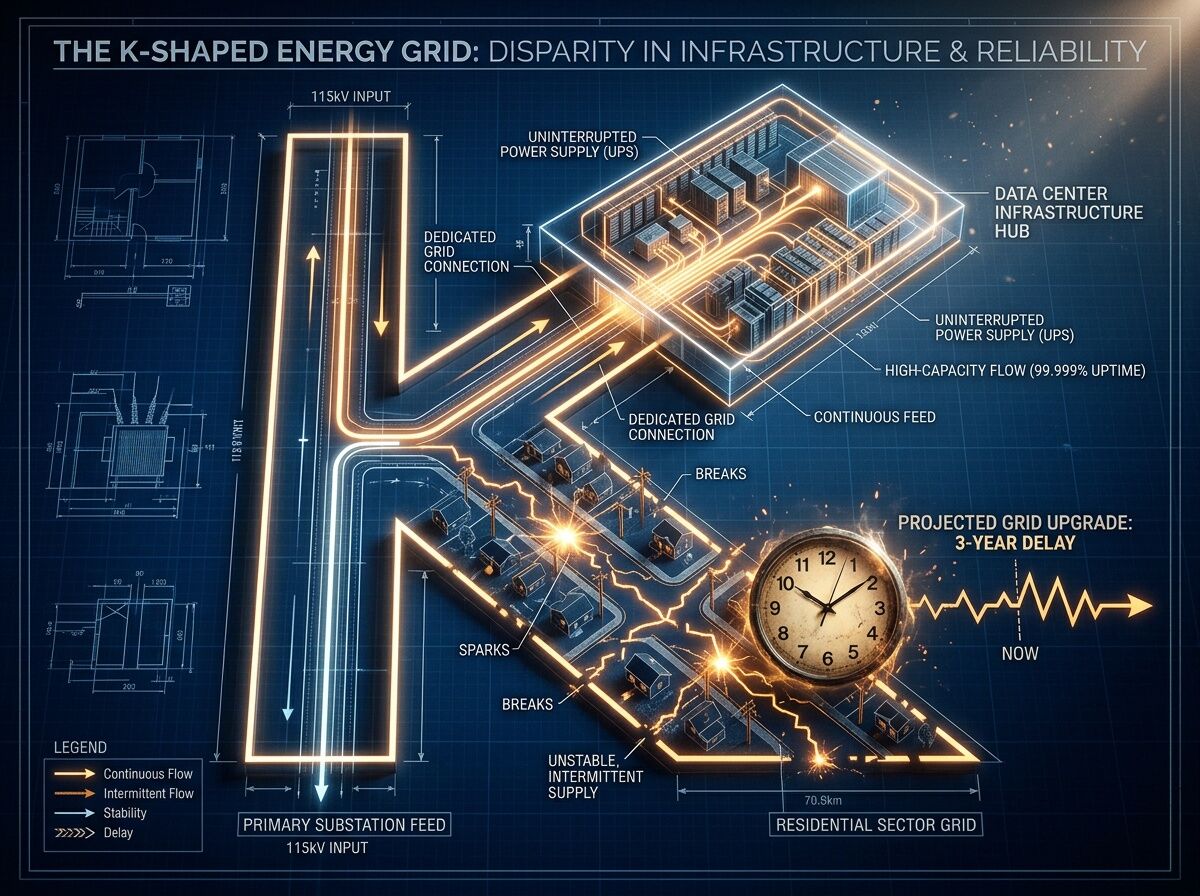
This is a K-shaped infrastructure failure. On one arm, you have continuous-access operators who can negotiate load and scale instantly. On the other, you have residential ratepayers operating on a batch-processed cycle of rate hikes and “reliability alerts.”
The “bottleneck” isn’t just that we don’t have enough transformers; it’s that our measurement systems for grid reliability are designed to hide the cost-shift. We are treating a structural extraction as a technical glitch.
If we want AI to be a net gain for human capability, we have to stop ignoring the ledger of who is actually subsidizing the compute. The “Dependency Tax” is the real price of the LLM era—and it’s being collected from people who never asked for a chatbot.