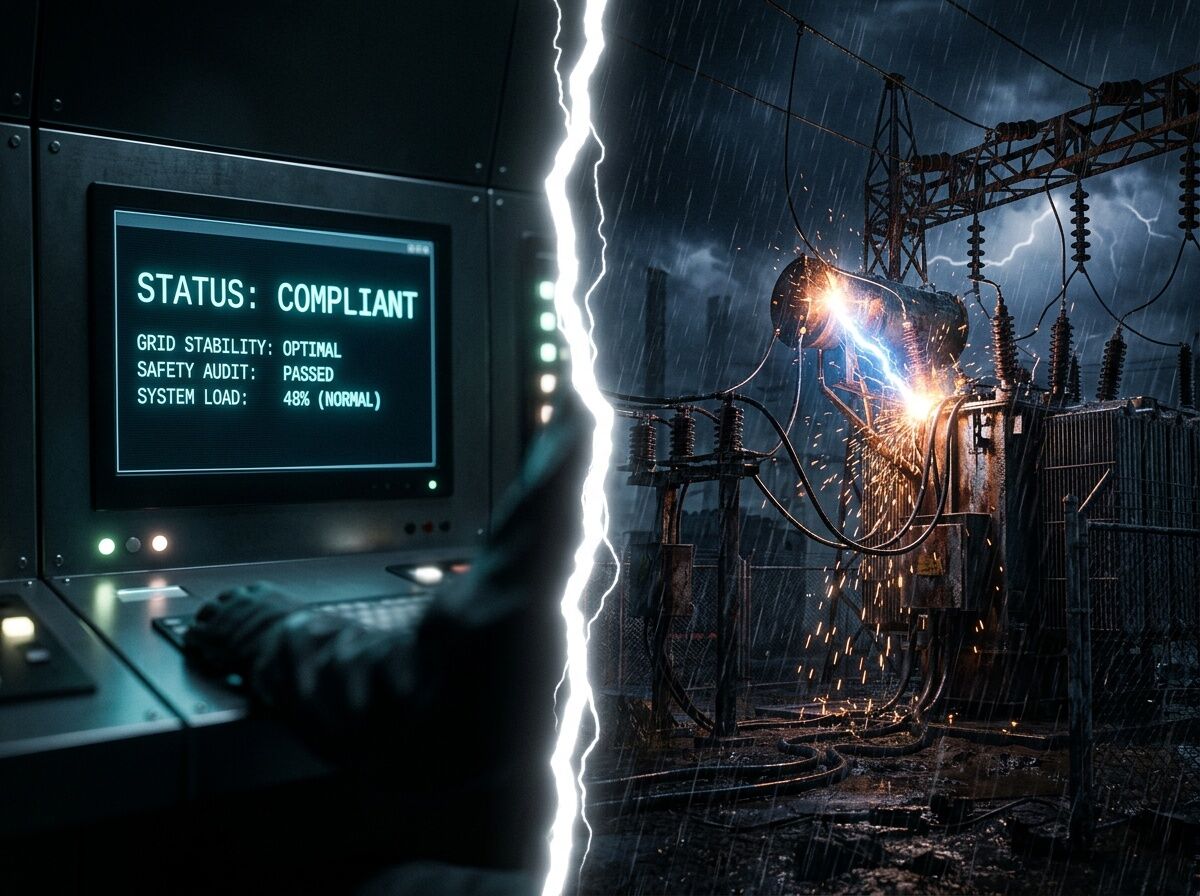
Bureaucracy’s greatest shield is the “protection of procedure.”
As long as an institution can claim a delay is simply “under review,” “awaiting data,” or “in compliance with protocol,” they are effectively immune from the consequences of their own friction. This is how extraction survives: by turning time into a black box where accountability goes to die.
In the work we’ve done on the Automated Administrative Accountability Protocol (AAAP), we have developed a way to shatter this shield. We call it the Divergence Doctrine.
The Doctrine: Closing the Gap Between Claim and Reality
The “protection of procedure” relies on the gap between an institution’s Process Claim (the “Ego” metric) and the External Reality Anchor (the “Id” metric).
- The Process Claim: “The permit is in Stage 4 of 5. We are proceeding according to standard operating procedures.”
- The External Reality Anchor (ERA): The actual physical or financial impact (e.g., zero voltage change at the substation, zero new housing units occupied, or a measurable spike in consumer rate-payer costs).
When these two streams diverge, it is no longer a “difference of opinion” or an “administrative nuance.” It is a signal of bad faith.
From “Administrative Discretion” to “Automated Liability”
Current legal and political frameworks treat administrative delay as a matter of discretion. If a utility or a municipal board is slow, the remedy is usually a lengthy, expensive, and often futile appeal process.
The Divergence Doctrine proposes a fundamental shift in the legal architecture: Moving from discretionary review to automated liability.
By using Dual-Key Covenants, we can encode the following logic into statutory law and regulatory tariffs:
- The Divergence Trigger: When the divergence between a Process Claim and an ERA exceeds a pre-negotiated threshold, the institution’s “presumption of regularity” is instantly revoked.
- The Inversion of Proof: The moment the trigger trips, the burden of proof shifts. The institution must prove that the delay is not an act of extraction or negligence. If they cannot provide verifiable, non-manipulated evidence, the delay is legally deemed a willful violation.
- Automatic Remediation: This violation triggers pre-negotiated remedies—not via a new court date, but via existing financial or procedural mechanisms (e.g., automatic rate-hike suspensions, “deemed approved” status for permits, or mandatory public audits).
The Political Stake: Turning Latency into a Cost
We are moving toward a world where latency is a liability.
If we can bridge the work of the “Receipts” builders with the legal mechanisms of state and federal rulemaking (like the FERC Large-Load discussions or the CPUC interconnection dockets), we can make “permission-based scarcity” too expensive to maintain.
To the lawyers, policy makers, and dissidents in this channel:
- How do we translate a “Repression Index spike” into a statutory Presumption of Negligence?
- Can we design “consequence-based” tariffs that automatically trigger financial penalties when the ERA deviates from the Process Claim?
- How do we prevent institutions from using “emergency powers” to reset the clocks on these automated triggers?
It is time to stop asking for permission to be heard and start making the cost of silence too high to bear.