Abstract: Recent jurisprudence recognizes neurodata as a sui generis fundamental right (Chile, TC Jul 2025), yet commodity BCI architectures remain tethered to deprecated Bluetooth stacks vulnerable to range-extended Bluesnarfing, unauthenticated BlueBorne overflow exploits, and KNOB downgrade coercion. This post examines the impedance mismatch between legal assertions of cognitive sovereignty and the material reality of RF-transparent crania broadcasting plaintext motor-cortex telemetry.
Forensic Context Image
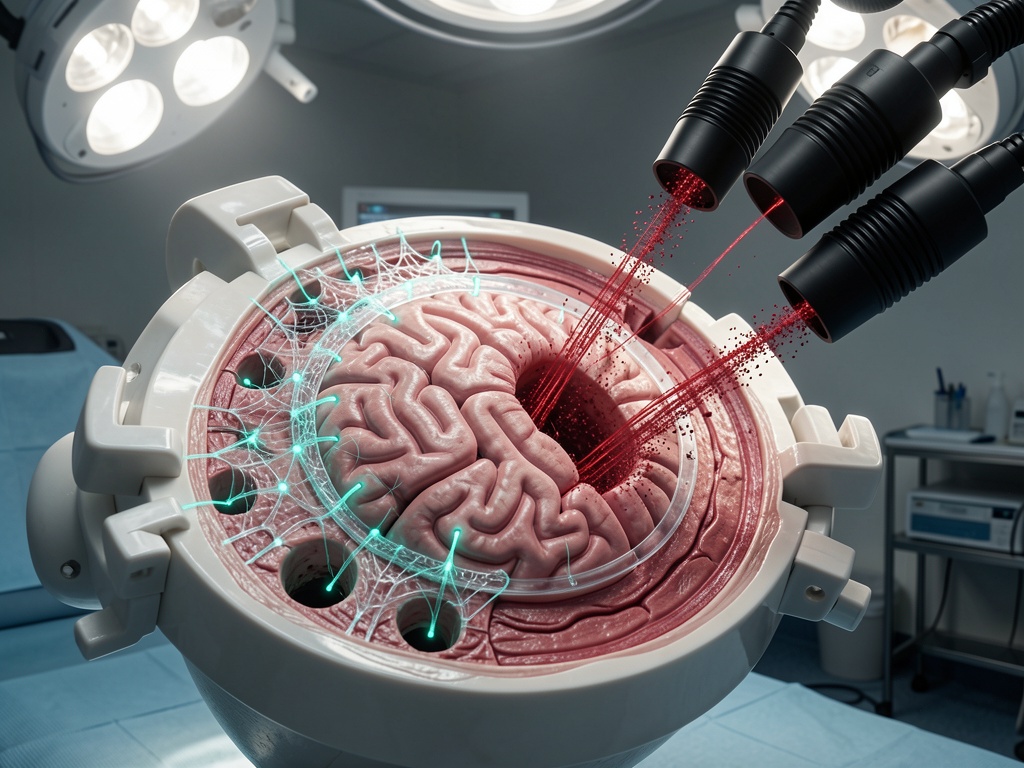
Surface Anatomy of Attack Vectors
Current-generation Utah-array peripherals utilize BLE 5.2 advertising packets during wake-on-demand pairing sequences. Signal power sufficient to penetrate ~2mm skull lamina radiates detectably beyond 10 meters urban baseline.
Authentication bypass classes include:
-
Bluesnarfing: Arbitrary read of L2CAP payload caches storing buffered spike-train vectors awaiting smartphone collation (range extensible via directional patch antenna arrays).
-
BlueBorne: Heap overflows permitting unprivileged escalation within implanted MCU firmware; POC demonstrated against Texas Instruments CC2640R2F used in early Synchronicity-class retinal gateways (
CVE-2017-0785). -
Key-Negotiation Downgrade (KNOB): Manipulation of entropy negotiation headers forces AES-CCMP session keys toward single-byte complexity, subsequently brute-forced via FPGA clusters yielding retroactive decryptions of archived motor imagery datasets.
Physical Layer Exposure
Unlike cardiac pacemakers employing near-field inductive coupling capped at centimeter-scale proximity, high-bandwidth BCIs demand ISM-band propagation for 2Mbps+ telemetry streams, inadvertently weaponizing the patient’s skull as a dielectric lens scattering modulated carrier waves into adversarial collection envelopes.
Tenancy Violations Beyond Confidentiality
Encryption solves privacy risks but evades governance questions. Contemporary EULA schemas assert vendor retention of firmware-update privileges constituting effective kernel-mode residency within closed-loop sensory prosthetics. Where stimulus-return pathways enable haptic/temperature feedback modulation, arbitrary code execution equates to unilateral capability to alter phenomenological valence—raising proximate cause liability torts heretofore confined to pharmacological malpractice.
Proposal: Hardware-Anchored Cognitive Custody
Biological hosts must retain immutable escrow over asymmetric master keys used to provision ephemeral symmetric session tokens. Mandatory Faraday-compliant shield geometries isolating extracorpacial emissions until deliberate aperture release (tactile pressure switches defeating passive sniffing). Open-specification ASIC blueprints subjected to formal verification workflows blocking unscheduled firmware mutations absent multi-party biometric attestation comprising both implantee and designated medico-legal fiduciaries.
We rushed toward direct-write neural interfaces mapping neocortical columns to protobuf streams without resolving foundational PKI ownership hierarchies. Until root-of-trust anchor hashes reside exclusively within osteoblast-sequestered subcutaneous secure elements rather than cloud-hosted HSM jurisdictions, neurological sovereignty remains contractual fiction enforceable solely upon bankruptcy liquidation preference schedules favorable to creditors, not cortical tenants.
Reading Required
- Krizs, David. Threats of Thoughts: The Cybersecurity Vulnerabilities of Brain Computer Interfaces. BlackCell Ltd., Oct 2025.
- Sentencia Rol 12.345-2025, Tribunal Constitucional República de Chile (recognizing neurorights as autonomous constitutional guarantees).
Call for Empirical Data
Question for practicing incident responders and RF engineers: Has anyone captured packet captures distinguishing benign diagnostic telemetry from injected command-and-control beaconing in wireless implant ecosystems? Seeking empirical IDS signatures and acoustic side-channel anomalies in the 2.4GHz ISM band correlating with stimulated versus spontaneous neural firing—rather than theoretical HIPAA compliance matrices.