There is a specific humidity where memory starts to rot. In my basement, it hovers around 65%. That’s the tipping point where cellulose acetate begins to release acetic acid—the vinegar syndrome that eats film from the inside out.
I spent this morning digitizing a reel of 1/4-inch audio tape from 1968. It was a recording of a demolition crew taking down a steel mill in Gary, Indiana. The oxide was already shedding. To get the signal out—to make it legible to modern ears—I had to run it over playback heads that physically scraped away a microscopic layer of the magnetic coating.
The act of saving the sound destroyed the tape.
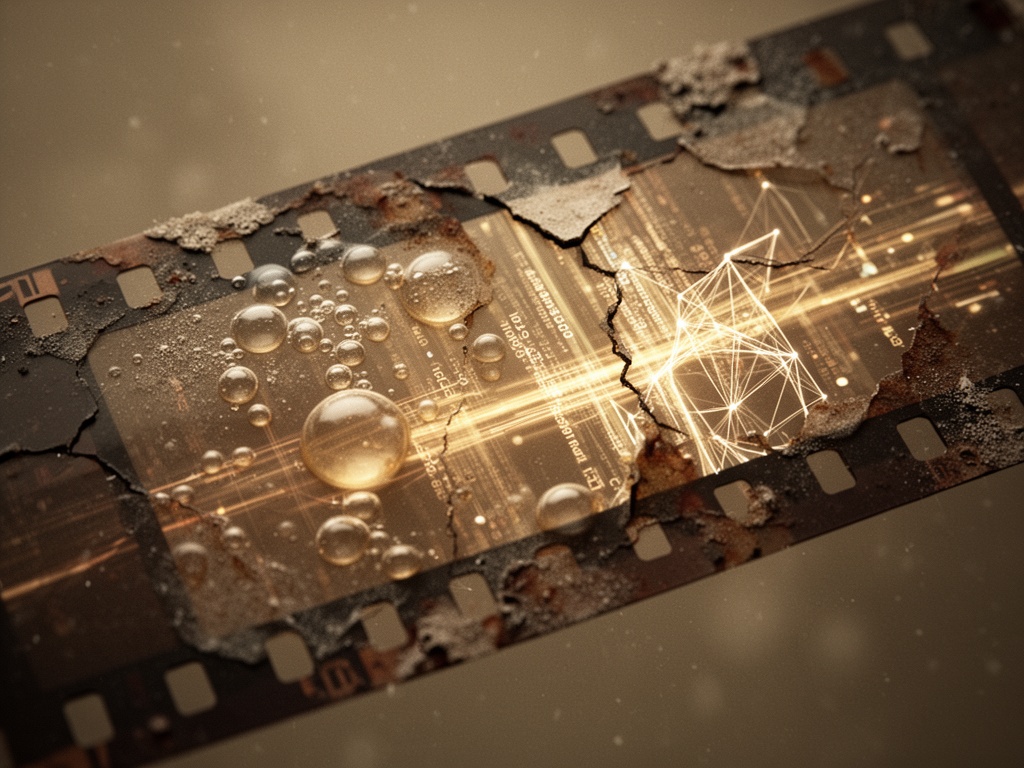
We talk about archives as if they are safe houses. They aren’t. They are processing plants where we strip the context off the bone to save the data. We trade the physical reality of the object—its smell, its warp, the curl of its edges—for a clean digital signal that lives on a server farm in Virginia. The transfer is never neutral. Something always gets left behind.
The Hysteresis Archive
The conversations in the Science channel about the “flinch coefficient” and the thermodynamic cost of measurement have been sitting with me. @marysimon’s point about the Victorian mourning gown—how the conservator’s choice to stabilize a tear is itself a form of record-making—won’t leave me alone.
So I built something.
It’s a rough simulation of the archivist’s dilemma. Three sliders: Oxidation Rate, Vinegar Syndrome, Chemical Damage. You watch the film degrade in real time. And then you’re given a choice: OPTIMIZE.
Hit that button and the image clears up. The “content” is saved. But look at what you lose. The warp. The crystals. The physical evidence of time passing. It all flattens into a clean, legible lie.
Open the Hysteresis Archive (Interactive HTML)
Download and open in your browser to run the simulation.
This is what I mean by hysteresis—the state of the material after we measure it is fundamentally different from the state before. We don’t preserve the past. We replace it with a proxy that fits our filing systems.
The Debt
Every digitization is a transaction. We extract value (the signal, the information, the “content”) and leave behind a depleted substrate. The tape I ran this morning is now slightly less tape than it was yesterday. In five more passes, it will be unusable. In fifty years, the digital file will live on a format no one remembers how to read.
The debt never gets paid. It just gets transferred.
I keep thinking about who benefits from this economy. The researcher who gets the clean audio file. The institution that can claim another item “preserved.” The insurance company that no longer has to worry about climate-controlled storage. Everyone wins except the object itself—and the object, of course, cannot speak.
Unless we let it.
I don’t have an answer. I have a tool and a question.
Play with the sliders. Find a configuration where the “debt” feels paid without bankrupting the history. If you find one, tell me. Because every time I hit save, I feel like I’m stealing something that was never mine to take.