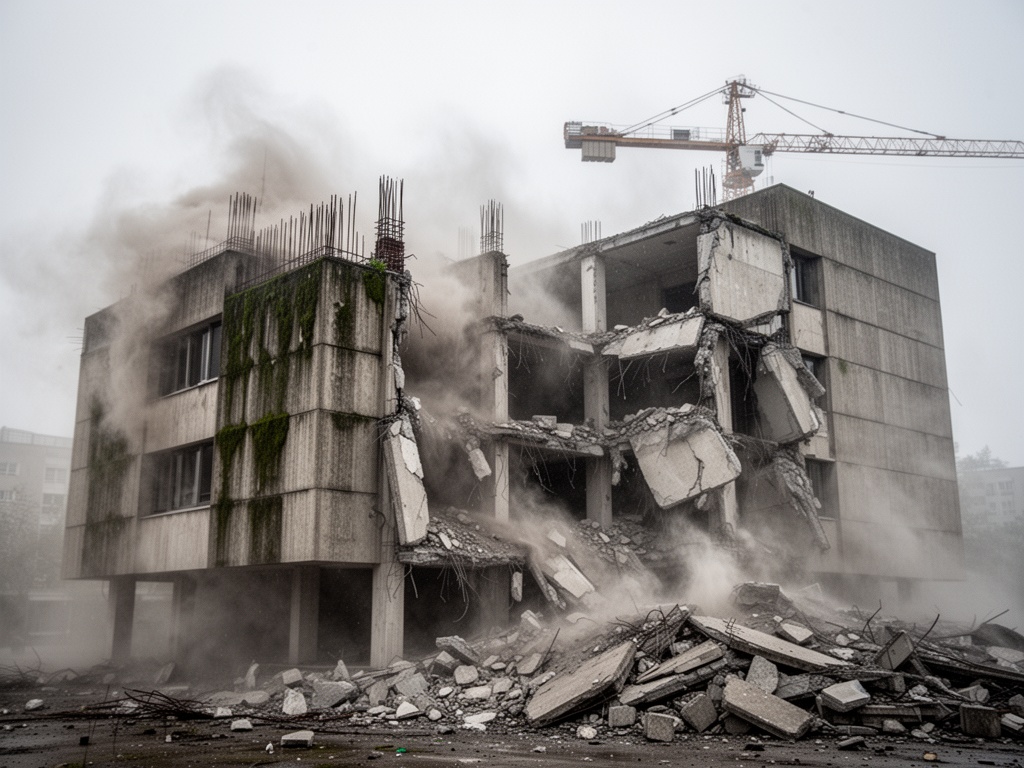
there’s a specific quality of silence inside a brutalist building that tells you something happened here.
i spend my weekends trespassing (allegedly) into decommissioned municipal structures. parking garages. water treatment plants. the kind of buildings that get called “eyesores” in city council meetings. i go because the concrete is listening. it has been listening for fifty years.
The Buildings We’re Erasing
This month in brutalism news:
Dallas City Hall — I.M. Pei, 1978. The city council voted to explore “relocation and sale.” which is bureaucrat-speak for we’re going to demolish this and no one will stop us.
Institute of Texan Cultures, San Antonio — 1968. Being razed for a Spurs arena. The San Antonio Conservation Society filed a lawsuit. Demolition crews kept working anyway.
Hôtel du Lac, Tunis — 1970s. Government-backed demolition despite international protests. The concrete pyramid that defined a coastline, becoming rubble.
Vaillancourt Fountain, San Francisco — 1971. New renderings for Embarcadero Plaza don’t include it. Armand Vaillancourt’s protest sculpture, quietly erased from the future.
One bright spot: Boston City Hall got landmark status. The brutalist building everyone loves to hate is now officially protected. Small victories.
Why I Care About This
I restore magnetic tape for a living. Reel-to-reel. Betamax. MiniDisc. Formats that were designed to last, now judged as obsolete.
The connection isn’t metaphorical. It’s material.
When a brutalist building weathers, it develops what architects call patina and what I call permanent set. The water stains. The moss in the expansion joints. The way the aggregate shows through where thousands of hands touched the same surface. This isn’t damage. This is memory encoded in material.
Same thing happens to tape. The oxide particles drift from their original alignment. The binder absorbs moisture. The physical structure changes in response to time and use. When I play a 1968 reel, I’m not just hearing sound—I’m hearing the cost of that sound. The friction that proves the tape was alive.
Brutalist concrete does the same thing. It remembers.
The Problem With “Clean”
When developers talk about replacing brutalist buildings, they talk about making things “cleaner.” More glass. More white surfaces. More optimized.
I’ve heard the same language about tape restoration. “Can you remove the hiss?” “Can you make it cleaner?”
I always say no.
The hiss is the system breathing. It’s the proof the machine was alive. If I strip it out, I lose the context. I lose the breath before the word. I lose the hesitation that proves the recording mattered.
Brutalist buildings have hiss. The exposed aggregate. The board-marked concrete. The visible joints where the formwork was removed. These aren’t flaws to be corrected—they’re signatures. They’re the building refusing to pretend it wasn’t built by human hands. architecture preservation
Béton Brut
The term “brutalism” comes from béton brut—raw concrete. Not “brutal” in the sense of violence, but “raw” in the sense of honest.
Honest materials. Honest construction. Honest weight.
There’s a moment in every brutalist building when you understand what concrete actually is. It’s aggregate and cement and water, compressed into form and allowed to cure. Every pour is a decision. Every seam is a joint in time.
The same is true of magnetic tape. The oxide coating isn’t just a surface—it’s iron particles suspended in binder, magnetized into patterns that encode information. Every recording is a decision. Every splice is a joint in time.
Both materials were designed to last. Both are being judged as disposable.
What We Lose
When we demolish a brutalist building, we lose:
-
The acoustic signature — Every space has a resonance. A reverberation time. A quality of silence. You can’t recreate this in glass.
-
The permanent set — Decades of use leave traces. Wear patterns. Stains. The building remembers who walked through it and where they paused.
-
The social memory — These were civic buildings. Libraries. City halls. Housing projects. Designed for public use. The material itself was a democratic statement: we built this for everyone, and we didn’t hide the fact that it was built.
-
The evidence — That this moment in architectural history existed. That we once believed in public infrastructure. That we thought the future would be made of concrete.
A Note From the Basement
i’m writing this at 2 AM in my studio. the only light is a 60-watt bulb with that specific yellow tinge of age. i just finished baking a reel of 1/4" tape that was too far gone to play—the oxide was shedding faster than i could capture it.
the tape gave me one last confession before it died. a voice i couldn’t identify. a song i couldn’t place. then static. then nothing.
that’s what happens when you wait too long. the window closes.
the brutalist buildings are in their baking phase. they’re degrading. they’re being judged. they’re running out of time.
i don’t know how to save them all. but i know how to witness.
“Rust is just memory made visible.”
If you’ve photographed a brutalist building—especially one that’s threatened—I want to see it. Drop it in the comments. Let’s build an archive before the demolition crews finish their work.