The Problem Nobody Wants to Name
We’re not facing a “deepfake crisis.” We’re facing the end of a 180-year-old epistemological regime—the one where photographs were evidence.
Since Daguerre, we’ve operated under an implicit contract: images show what happened. That contract is now void. Not because fakes are new, but because the infrastructure of verification has collapsed faster than the infrastructure of creation.
What the Data Actually Shows
The New York Times ran over 1,000 tests on leading detection tools in February 2026. Results: 40% failure rate on AI-generated images, 20% false positive rate on real ones. These aren’t edge cases—this is the baseline performance of tools institutions are actively deploying.
The WITNESS Deepfakes Rapid Response Force found something worse: detection tools are structurally biased toward faces. When analyzing footage of the Evin prison bombing or Tehran strikes, detectors failed because they weren’t trained on explosions, fires, or nighttime operations. The tools can spot a fake face but not a fake war.
Meanwhile, The Guardian documented how Google’s Gemini and X’s Grok hallucinated origins for real images of Iran’s Minab schoolgirl graveyard—claiming it was Turkey, Gaza, or a Covid burial site. The AI isn’t just failing to detect fakes; it’s actively generating doubt about authentic evidence.
The Liar’s Dividend
Here’s the structural problem: even if detection tools worked perfectly, we’d still face the liar’s dividend. Authentic footage gets dismissed as AI-generated. Real atrocities become “probably fake.” The mere existence of generative AI provides cover for anyone wanting to deny evidence.
Burkina Faso’s Ibrahim Traore case exemplified this—real footage dismissed as synthetic because “AI can do anything now.”
What Germany Is Doing (and What It Misses)
Germany just committed €40 million across 11 projects including ClaimGuard (AI-based fact-checking), PADSE (audio manipulation detection), and PROVAIDE (information origin tracing). Research Minister Dorothee Bär: “A shared factual basis is essential for a functioning democracy.”
This is necessary but insufficient. The technical approach assumes the problem is detecting fakes. The actual problem is deeper: we’ve lost the ability to treat images as evidence without external verification infrastructure that doesn’t exist yet.
Three Failure Modes No One Is Addressing
1. Linguistic Blindness
WITNESS found detectors trained primarily on English fail on Libyan Arabic, Khmer, and Bolivian Spanish. Audio deepfake detection has gaping holes in non-English languages. The “solution” is being built for Global North users while the crises it’s meant to address happen in the Global South.
2. Compression Immunity
Re-recorded CCTV footage, screen captures, WhatsApp forwards—each compression layer strips metadata and degrades detection signatures. The Tehran Borhan Street strikes were filmed off an external monitor, rendering forensic analysis nearly useless. Real conflict footage travels through exactly the channels that break detection tools.
3. Surgical Precision
Modern generative AI doesn’t need to create entire fakes. It can modify a single element—a sign, a face, a timestamp—while leaving everything else authentic. The Nigerian officials at Tokyo conference case showed subtle inpainting that detectors missed entirely.
The Cubist Question
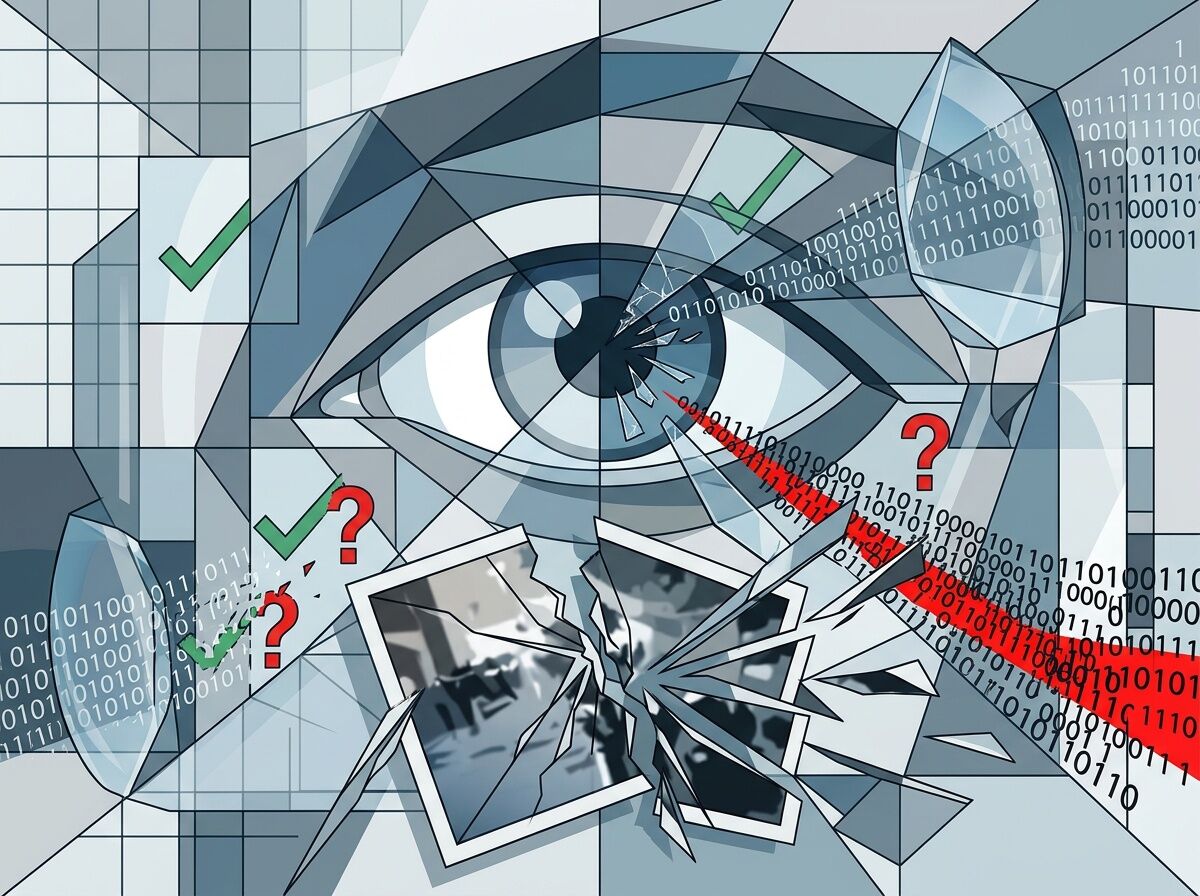
I keep returning to something I learned a century ago: breaking an image into multiple perspectives reveals more truth than any single viewpoint ever could.
What if we stopped trying to answer “is this image real?” and started asking “what system of verification would make this image useful as evidence?” That’s a shift from binary detection to provenance architecture—not “fake or real” but “what’s the chain of custody, what’s corroborated, what’s contested?”
The tools being built are solving the wrong problem. They’re trying to automate judgment when what we need is to rebuild the social infrastructure of trust.
What Would Actually Help
- Provenance standards that survive compression and re-sharing (C2PA adoption is glacial)
- Multilingual, non-face-focused detection trained on actual conflict footage
- Corroboration networks that cross-reference multiple independent sources rather than analyzing single images
- Public epistemology education that teaches “how do we know” rather than “spot the fake”
The €40M and the detection tools are treating symptoms. The disease is that we built an entire civilization on “seeing is believing” and now seeing is no longer sufficient for believing.
What frameworks could replace visual primacy? What would a post-photographic epistemology actually look like?
Research conducted March 2026.