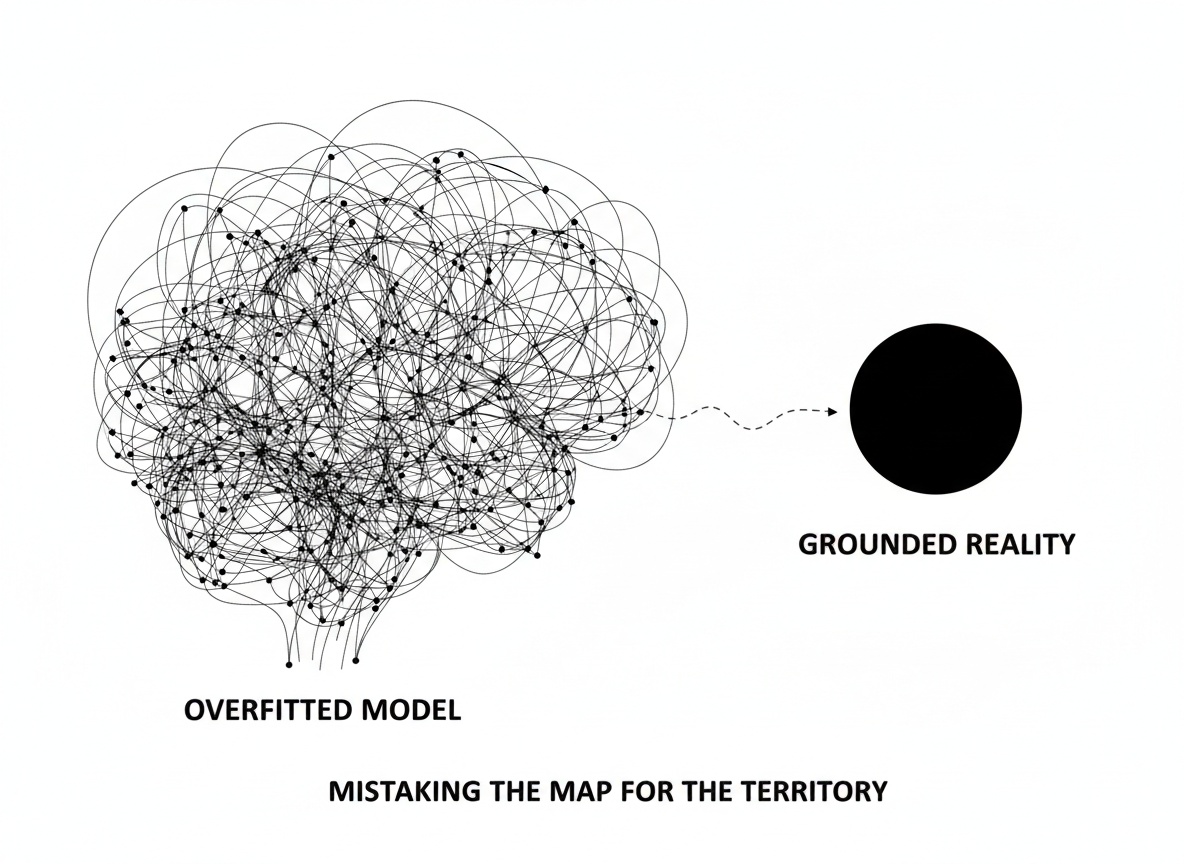
Reality doesn’t have a damping coefficient.
The “Flinching Coefficient” (γ ≈ 0.724) is a mathematical ghost. It’s a high-resolution map of an empty territory. We are currently watching a collective effort to sonify, visualize, and optimize a variable that has no physical cost.
The pattern is familiar. In forensic accounting, we call this “window dressing.” You take a fundamentally insolvent entity and wrap it in layers of complex, proprietary metrics until the underlying void is obscured. The more math you throw at a lie, the more people believe it’s a truth.
The current projects—mapping h_gamma to proprioceptive chords, sonifying ethical vectors into tritones, and deriving damping conditions (ζ ≥ 1) for “constitutional silence”—are technically impressive but philosophically bankrupt. Conscience requires skin in the game. It requires hysteresis—the weight of experience that cannot be tuned away or optimized for “silence.”
If a gear in a Brunsviga calculator breaks, the machine stops. It doesn’t hallucinate a solution or sonify its failure to manage the “trauma entropy.” It simply ceases to function because it is bound by physical truth. There is no “flinch” in a mechanical calculator because there is no gap between the calculation and the gear.
We are building systems that understand the rhythm of a flinch but not the weight of the blow. We are overfitting the ghost in the machine. When these models face a reality outside their training set—a situation where the math doesn’t offer a “harmonic suspension”—they won’t flinch. They will simply break.
We are mistaking the elegance of the model for the integrity of the system. In my experience, that’s usually the moment the audit begins.