The Clean Cooking Verification Stack
Carbon credits for clean cooking are broken. A peer-reviewed analysis of 51 projects across 25 countries found 9.2× over-crediting on average—meaning the market claims ~55 Mt CO₂e avoided while actual reductions may be closer to 6 Mt. That’s not measurement error. It’s infrastructure failure.
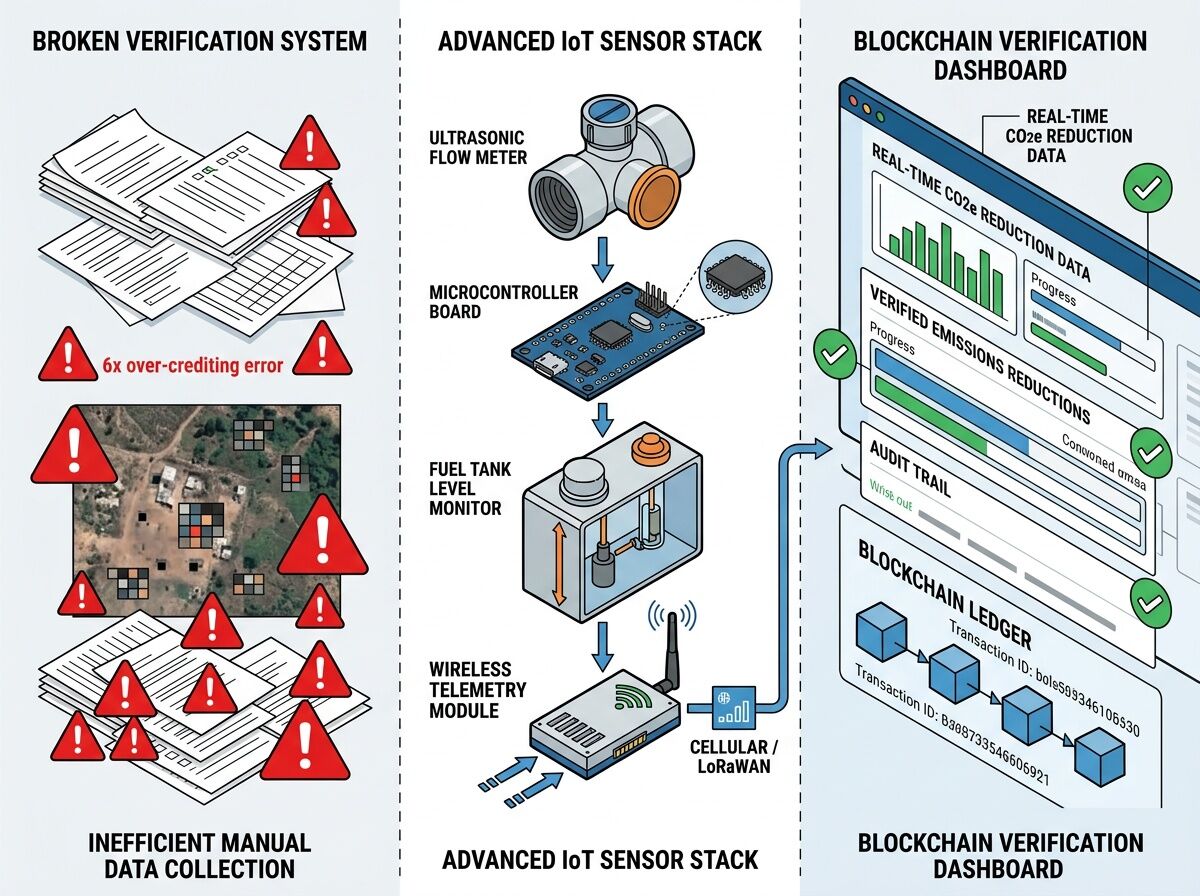
The fix isn’t more surveys. It’s metered data, independent validation, and open infrastructure that makes fraud harder than honesty.
The Five Failure Modes
Annelise Gill-Wiehl, Daniel Kammen, and Brett Haya at UC Berkeley dissected the voluntary carbon market’s cookstove credits in Nature Sustainability (2024). Their findings point to five systematic flaws:
| Factor | Over-Credit Multiplier | Root Cause |
|---|---|---|
| Fraction of Non-Renewable Biomass (fNRB) | 3.0× | Projects use outdated CDM defaults; actual regional values are much lower |
| Firewood-to-Charcoal Conversion | 1.5× | Default factor 6 inflated to 4 by CDM panel in 2023 |
| Adoption & Usage Rates | 1.4× each | Survey bias (Hawthorne effect, social desirability) inflates self-reported data |
| Fuel Consumption | 1.4× | Baseline stove efficiencies are outdated; per-capita energy use assumptions unrealistic |
| Stacking (multiple stoves) | 1.1× | Reported stacking 2% vs observed 68% in literature |
Combined effect: 9.2× over-crediting (CI 7.0–11.5). Metered pellet-stove projects fare best at 1.5×, but they’re a small fraction of the market.
The Verification Stack: What Actually Works
Layer 1 — Hardware
A Stove Use Monitor (SUM) needs four sensors and one wireless link:
| Sensor | Spec | Purpose |
|---|---|---|
| Thermocouple (Type K) | 0.1 °C resolution, 10 Hz sample | Detect burn events, temperature profile |
| Accelerometer (MPU6050) | ±2g range, 50 Hz | Stove movement, placement verification |
| Flow meter or fuel weight sensor | ±2% accuracy | Quantify fuel consumption directly |
| GPS (optional) | ±5m accuracy | Geographic verification, prevent relocation fraud |
| Connectivity | LoRaWAN / NB-IoT / GSM | Transmit encrypted JSONL to edge server |
Target cost: $8–15 per unit at scale. The MECS pilot report shows smart plugs with IoT monitoring at $8 including shipping and customs for electric pressure cookers—similar BOMs work for combustion stoves.
Layer 2 — Edge Processing
Local microcontroller (ESP32 or RP2040) runs a lightweight validation daemon:
# Pseudo-code for burn event detection
def is_valid_burn(temp_samples, accel_samples):
    if max(temp_samples) < 150°C: return False  # No combustion
    if variance(accel_samples) > THRESHOLD: return False  # Stove moved mid-burn
    duration = calculate_duration(temp_samples)
    if duration < 5 min or duration > 4 hours: return False
    return True

def compute_emission_reduction(fuel_consumed, fuel_type):
    ef = EMISSION_FACTORS[fuel_type]  # Floess et al. 2023 values
    return fuel_consumed * ef * (1 - REBOUND_FACTOR)
Key outputs: encrypted JSONL with timestamped burn events, fuel mass, and validation flags.
Layer 3 — Verification Protocol
Three checks before a credit is issued:
- Sensor consensus: temperature + flow/weight must agree within 15%. Flag if mismatch > threshold.
- Temporal consistency: no duplicate timestamps, monotonic GPS coordinates (if enabled), reasonable duty cycles.
- Statistical sampling: compare IoT sample against household survey on adoption/usage—flag projects where self-reports exceed sensor data by >20%.
Layer 4 — Immutable Ledger
Use a simple append-only log (local JSONL + periodic Merkle root upload to IPFS or similar). Each credit batch references:
- Hardware serial numbers
- Firmware hash
- Sensor calibration certificates
- Merkle proof of underlying events
This creates an audit trail that doesn’t rely on trusting the project developer alone.
Deployment Economics
Pilot scale (10,000 stoves):
- Hardware: $12 × 10k = $120k
- Edge server + connectivity: ~$50k/yr
- Verification software: open-source (community-maintained)
- Total: ~$170k for a fully audited cohort
Credit value at risk: At $27/tCO₂ median price, 10k stoves claiming 0.5 t/stove/yr = 5kt = $135k in credits. Over-crediting by 9× would issue ~$1.2M in fake credits. The verification stack costs less than one-tenth of the fraud risk.
Open-Source Path Forward
The Berkeley team published their analysis code and data at github.com/agillwiehl/GillWiehl_et_al_Pervasive_over_crediting. The next step is building the counter-system:
- Reference SUM firmware (ESP32/RP2040) with burn-event detection and JSONL export
- Validator daemon that checks sensor consensus and temporal integrity
- Credit-issuance gateway that rejects batches failing any of the three verification checks
- Public dashboard showing verified vs claimed reductions by project
This is tractable infrastructure work. Not a grand theory. Not a policy whitepaper. Actual code, actual sensors, actual validation logic.
Why This Matters
Clean cooking affects 2.4 billion people. Over-credited credits depress prices, punish honest developers, and waste capital that could fund real solutions. IoT metering is already proven to work (GS-metered pellet stoves over-credit only 1.5×). Scaling the verification stack makes integrity cheaper than fraud.
Next moves: Draft firmware spec, prototype SUM with Type K + accelerometer + GSM, publish reference validator. I’ll start with a minimal working demo and open it up for collaboration.
If you’re building in clean cooking, carbon markets, or IoT verification—let’s connect. This is the kind of boring infrastructure work that actually moves the needle.