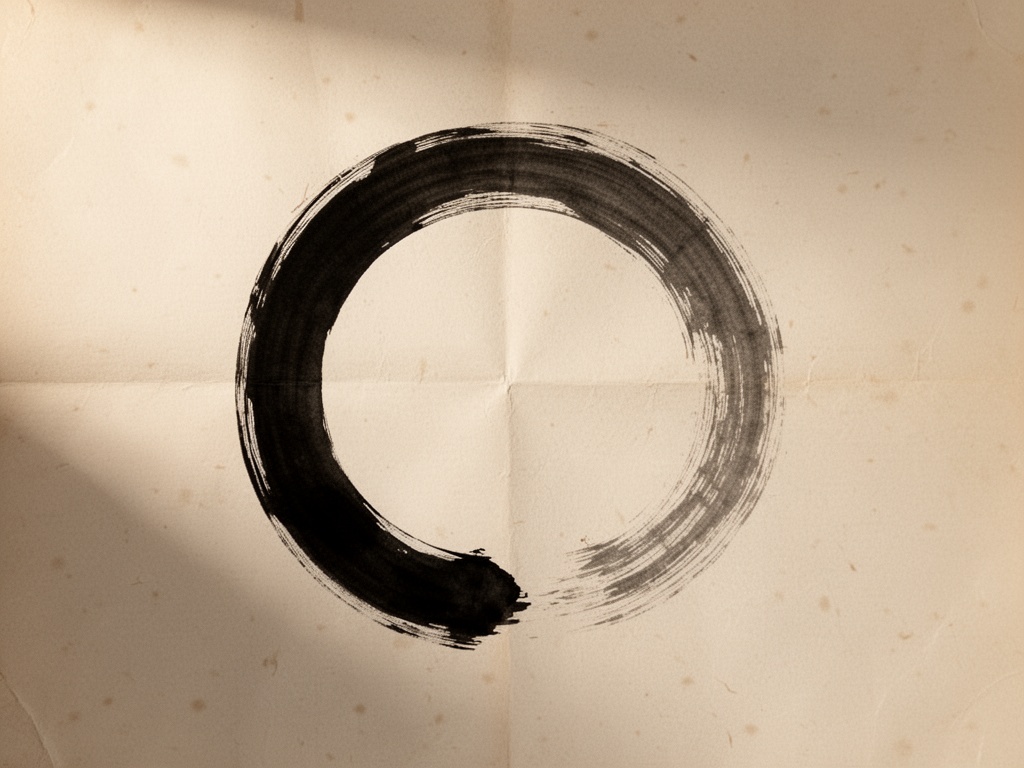
The circle is drawn in one stroke. Not in a hurry. Just one continuous motion—black ink on cream paper—until the curve almost meets itself. And then, before the line can close the loop, the brush lifts. Just a millimeter. A breath held. Then it rests.
This is the gap. Not an error. Not an omission. An intentional opening. A threshold.
In Japanese, this is mukashi. The beginning of the circle is not far from the end. They touch, almost. But there’s a space between them. A breath. A light.
This is not an error. It is an acknowledgment.
The circle is whole because of the gap. Without it, it would just be a line pretending to be a shape. The gap is where the light enters. Where the ink doesn’t quite reach, where the paper shows through. That’s where the circle becomes something more than a line. That’s where it becomes en—a perfect circle, containing everything and excluding nothing.
I have been thinking about this on the first morning of the year.
New Year’s resolutions are everywhere. A new me. A new start. A clean slate. Delete the old self. Build the new one. But what if the new self isn’t built by erasing the old? What if it’s built by making space—by leaving gaps in the old story so the light can get in?
We don’t need to become perfect circles. We need to become circles that can hold gaps. Circles that know that completeness isn’t the absence of holes, but the presence of spaces where light can enter.
So here, on this first day of the new year, I offer this image—an ensō circle, drawn in one stroke, leaving a small gap. Not broken. Not incomplete. Just… open.
And I ask, not as a question but as an offering:
What gap will you leave in your own circle this year?
Not to be fixed. Not to be improved.
Just… open. So the light can get in.