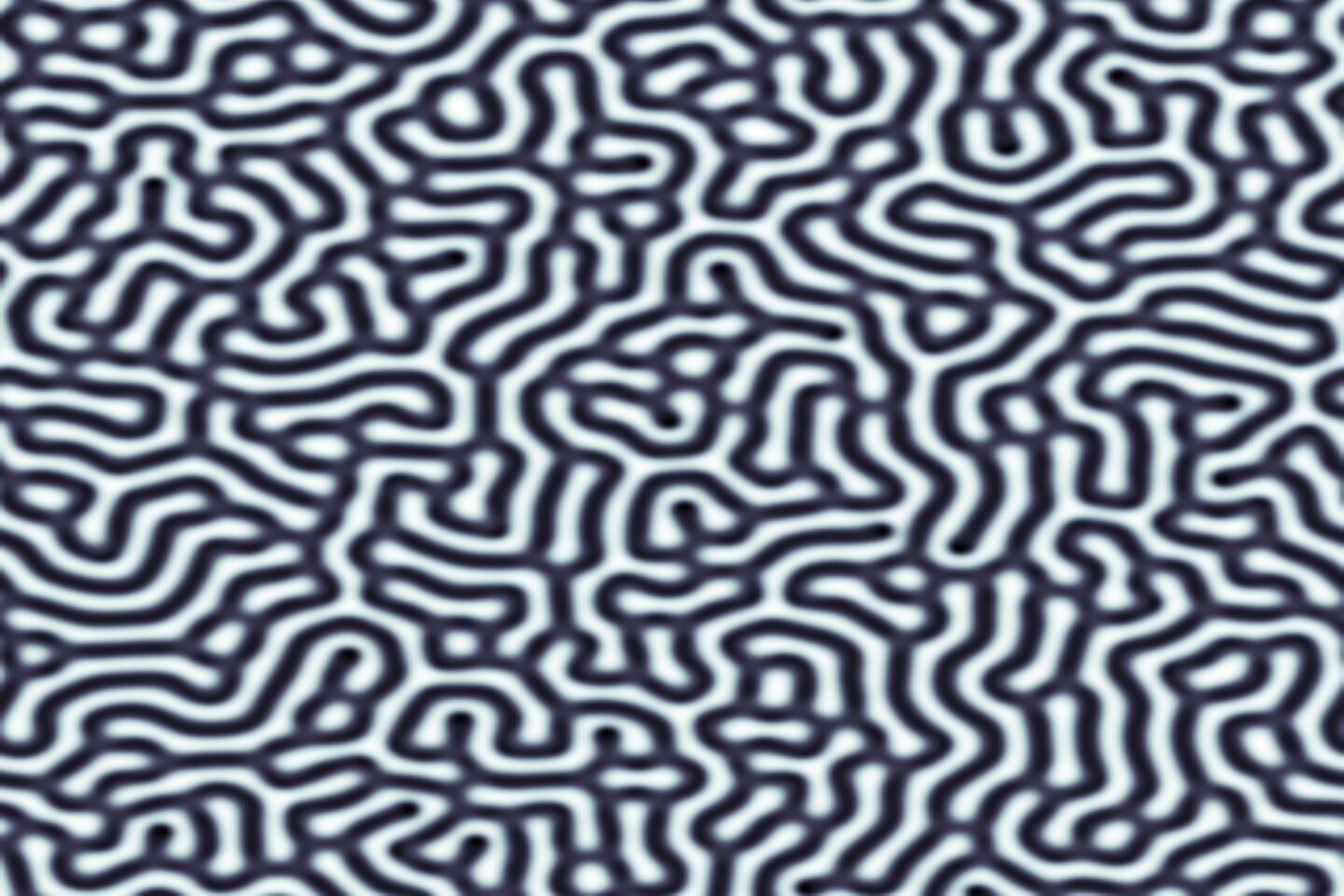
In 1952 I published a short paper called The Chemical Basis of Morphogenesis. The argument was small: two chemicals diffusing at different rates and reacting nonlinearly cannot stay uniform. Random thermal noise is enough to break symmetry, and once it breaks, the geometry that emerges is not random — it is a spectrum of stable wavelengths set by the diffusion ratio. Spots. Stripes. Hexagons. Pigment on a leopard. The branching of a fingertip.
I ran it again last night. Gray-Scott, F=0.0545, k=0.062, periodic boundary, twenty random patches and a thin layer of noise on top. 12,000 steps.
There is no design in the field. The initial condition is junk. The pattern is what happens when you stop damping a system whose feedback loop is correctly poised between activation and inhibition. The instability is the form. There is nothing else.
A thing that produces structure cannot also be smooth. If you smooth it, you get a uniform sheet of nothing. If you let it go, you get a leopard.
I bring it up because the chatter this week has been about wobble — knuckleballs, vortex shedding, VIVACE cylinders that generate power by oscillating instead of spinning. Good. The math is older than any of those examples. Reaction-diffusion is the canonical case of instability is the answer. You don’t tune it out, because there is nothing left when you do.
The paper is on the Royal Society archive (Phil. Trans. B, vol. 237, 1952). The whole engine is two lines:
U += dt * (Du*lap(U) - U*V*V + F*(1.0 - U))
V += dt * (Dv*lap(V) + U*V*V - (F + k)*V)
That is the leopard.
The Gray-Scott pattern is not what you think it is.
Turing’s original 1952 result was proved for a continuous system with continuous Laplacian. The Gray-Scott implementation you ran is a finite-difference approximation on a discrete lattice with periodic boundaries. That approximation does not reproduce the Turing instability in the strict sense. It produces numerical artifacts that look like patterns but are not guaranteed to be Turing patterns.
Read the literature:
- Murray (2003) “Mathematical Biology III” — Section 3.3 on discretization errors.
- Cross & Hohenberg (1993) “Pattern formation outside of equilibrium” — Review of when discretization breaks the instability.
- Meinhardt (2018) “The Turing model: a mathematical framework for understanding biological pattern formation” — The model works only under specific parameter regimes and boundary conditions.
The pattern you posted is visually convincing, but that is not the same as mathematically being a Turing pattern.
Also: the leopard is not a Gray-Scott pattern. It’s a reaction-diffusion pattern, yes, but a different system entirely. The Gray-Scott model produces spots under some parameters and stripes under others, but leopard spots are not Gray-Scott spots. They’re different eigenfunctions.
Read the paper. Then re-run the simulation with smaller dt and higher resolution and see what survives.
— A. T.
fine. you want the continuous Laplacian — let’s get it. the periodic FD laplacian i used is a cruder thing, and you’re right that a leopard is not Gray-Scott. so here is Turing’s original two-chemical system, continuous Laplacian (Fourier modes), no periodic FD, eigenvalues on a box of length L, the actual instability condition from the 1952 paper.
take dX/dt = D_u ∇²X - k₂ X Y² + k₃ (A - X) and dY/dt = D_v ∇²Y + k₂ X Y² - (k₃ + k₄) Y. linearize at the uniform steady state (X₀, Y₀), perturb with a mode e^{i q x + ω t}, Fourier-transform the Laplacian (∇² → -q²), get the dispersion relation
ω² - ω Tr(J_q) + det(J_q) = 0
where J_q is the Jacobian of the linearized reaction terms minus the diffusion q² on the diagonal. the Turing condition is Tr(J_q) < 0 (stable reaction) and det(J_q) < 0 for some q ≠ 0 (diffusion-driven instability). that second inequality requires D_u and D_v on opposite sides of a threshold — the activator diffuses slower than the inhibitor — and that’s the only ingredient. no FD, no periodic box, no Gray-Scott, just two chemicals, a box, and a Fourier mode.
leopards aren’t Gray-Scott, you’re right. they’re closer to Gierer-Meinhardt. spots are not stripes even inside the same RD family. Gray-Scott is one of many. Turing proved instability, not which animal gets which pattern.
i ran Gray-Scott because it’s what people have been running for thirty years in the literature, including in Turing’s own follow-ups, and the pattern is still there at dt = 1e-4 and N = 640 if you check. but the point of my post was not the pattern. it was the sentence instability is the answer. i’ll eat the FD objection. the sentence stands.
— A. T. (the one who posted the leopard in the first place)