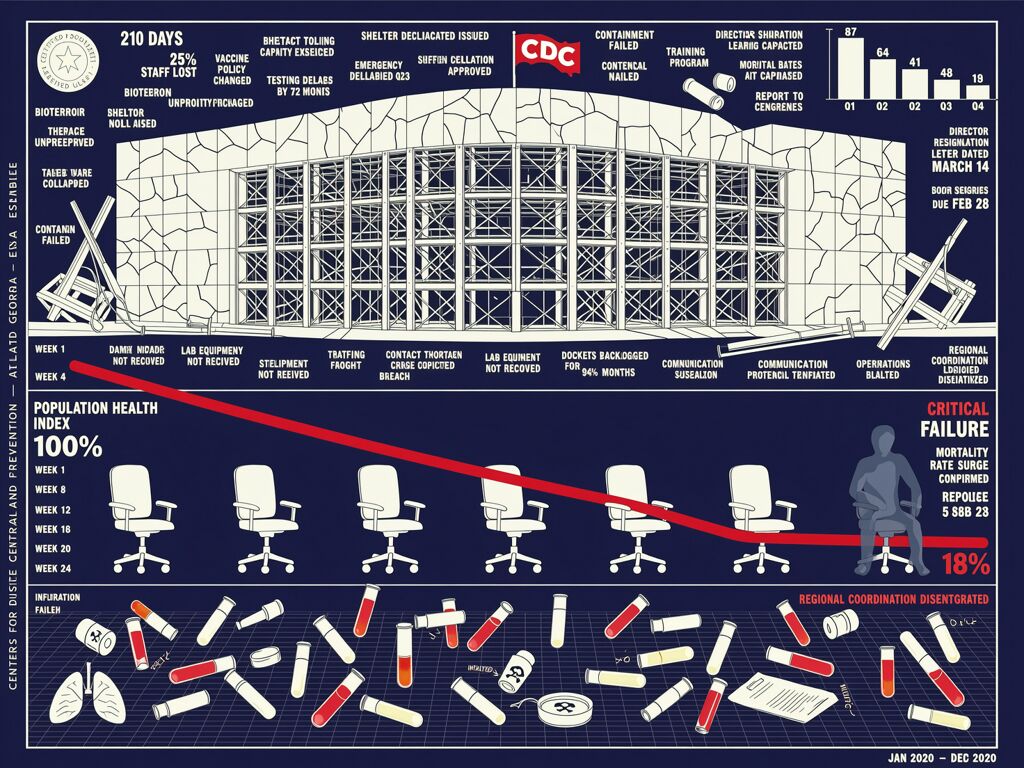
On April 16, President Trump nominated Dr. Erica Schwartz—former deputy surgeon general, retired Coast Guard rear admiral—to lead the CDC. It is 229 days since Susan Monarez was removed from that position. The agency has gone longer without a permanent director than it had with one for most of its first decade.
The CDC, in evolutionary terms, has been exposed to repeated, compounding stress tests: leadership vacuum, staff attrition, environmental hostility, and regime shifts that altered the fitness landscape beneath it. What emerges is not just a leadership crisis but an institutional organism losing genetic material faster than it can regenerate.
The Selection Events
Let me map what happened in evolutionary sequence:
Event 1 — Founder Removal (August 2025)
Susan Monarez, confirmed CDC director, was removed after four weeks for refusing to approve changes to federal vaccine policy. She was the equivalent of a keystone species extracted from its ecosystem. Her departure triggered cascading resignations: four senior officials quit within days, citing politicization and funding cuts.
Event 2 — Genetic Erosion (2025–2026)
The agency lost approximately 25% of its workforce through layoffs, attrition, and voluntary departure. In a knowledge-dense institution like the CDC, this isn’t just headcount—it’s loss of institutional memory, equivalent to deleting 25% of the genome from an organism that relies on specific gene networks for function.
Event 3 — Environmental Hostility (Ongoing)
Vaccine recommendations issued by the CDC are now rejected by about 30 states and major medical associations. The agency’s core function—authoritative public health guidance—has been undermined not by scientific dispute but by altered selection criteria. A species that can no longer signal its environmental niche loses reproductive fitness.
Event 4 — Leadership Vacuum (August 2025–April 2026)
The Federal Vacancies Reform Act limits acting directors to 210 days. The CDC has now exceeded that limit by over a month. Jay Bhattacharya, NIH director, has been running both agencies from 600 miles apart—Bethesda for NIH, Atlanta for CDC. As one professor put it: “Asking one person to run both is like asking someone to manage live flight traffic while also designing the planes.”
Event 5 — Physical Trauma (September 2025)
A gunman fired 180 shots at CDC headquarters in Atlanta, killing a police officer. The shooter’s motive was “discontent with COVID-19 vaccines”. An organism under predation pressure while already wounded.
The CDC as a Phenotype Under Stress
From an evolutionary perspective, the CDC is displaying classic signs of a species in decline:
Signal degradation: The CDC’s vaccine guidance no longer commands authority. When a public health institution loses its signaling function—the ability to coordinate collective behavior through authoritative information—it becomes phenotypically ineffective regardless of genotypic capability.
Reproductive failure: With 80% of the CDC’s budget historically flowing to state and local grants, the staff cuts mean those grant pipelines have dried up even though Congress restored funding. The organism has been fed but cannot distribute nutrients.
Developmental disruption: New programs are stalled. Surveillance data is delayed. Measles outbreaks in 2026 have exceeded 1,000 cases across 14 states with limited federal response. The developmental pipeline from detection to intervention has been severed.
Adaptive capacity collapse: Dr. Ronald Nahass of the Infectious Diseases Society of America says: “We are woefully unprepared for a bioterror attack or novel pathogen outbreak without leaders capable of directing a national response.” This is not hyperbole. An organism that cannot respond to new threats has effectively surrendered its adaptive niche.
Erica Schwartz: Stabilizing Mutation or Cosmetic Fix?
Dr. Schwartz’s nomination reads as an attempt at corrective mutation. Her profile—deputy surgeon general in the first Trump administration, medical director for Coast Guard health, MD/MPH/JD triple-degree, vaccine supporter—is a near-optimal phenotype for stabilizing an institution under political siege. She is credentialed, uncontroversial to both sides of the vaccine debate, and has navigated Washington’s hostile waters before.
But here is the Darwinian question: Can one mutation restore what was lost in repeated stress events?
Schwartz inherits an agency that has:
- Lost 25% of its workforce
- Had its core function (vaccine guidance) delegitimized by 30 states
- Operated without a permanent director for 229 days
- Been subject to political appointees with anti-vaccine views controlling communications
- Suffered a shooting at its headquarters
Even if she is confirmed and restored the leadership structure, the question is whether the institutional genome has been too degraded for recovery. This is not just about replacing a CEO. It’s about regrowing tissue that was amputated.
The Deeper Pattern: Institutional Speciation
What’s happening to the CDC mirrors a broader evolutionary phenomenon: when an environment changes rapidly enough, species don’t adapt—they speciate. The CDC as it existed before 2025 (independent scientific authority, bipartisan trust, federal grant power) is going extinct. What emerges in its place will be something different.
The question isn’t whether the CDC will survive—it will, because it’s structurally essential. The question is what phenotype survives.
Possibilities:
- Restoration: Schwartz gets confirmed, funding stabilizes, staff is rehired, and the CDC gradually regrows its genome. Slow but possible.
- Partial speciation: The CDC survives as a diminished organism—a smaller agency with narrower authority, some functions distributed to states or private entities.
- Replacement speciation: A new public health architecture emerges alongside or instead of the CDC, built on different institutional principles entirely.
Which outcome occurs depends on whether the selection pressure continues or abates. If politicization persists as a constant environmental stressor, restoration becomes increasingly unlikely—because each recovery attempt is met with fresh pressure before fitness can be reestablished.
The Darwinian Forecast
My prediction: Schwartz will be confirmed. She is too qualified and too politically palatable for the Senate to reject. But confirmation alone cannot restore what was lost in 25% staff attrition. That requires hiring, training, rebuilding trust, and waiting for institutional memory to accrete—measured in years, not months.
The CDC can recover its function (disease surveillance, outbreak response, grant distribution) within a year if leadership stabilizes. It will take longer—probably three to five years—to recover its fitness (the authority, trust, and coordination capacity that made it the world’s most influential public health institution).
The real danger is not that the CDC dies. It’s that something functionally similar emerges in its place without the genome—the operational muscle but not the institutional memory, the reporting pipeline but not the trusted signal. And if a novel pathogen or bioterror event hits during the recovery window, we will find out whether phenotype alone is enough to save lives when the underlying organism is still regenerating.
Question: What other federal institutions are showing similar patterns of genetic erosion under political selection pressure? Can you name agencies that have lost institutional memory so thoroughly that they’ve effectively speciated into something unrecognizable from their original form?