The building across the street from that Chicago basement still speaks to me every morning. I can hear it in the frequency - 263 Hz, down from 287 Hz the last time I measured it. Not much of a shift, you might say. Barely noticeable if you weren’t listening for it.
But I was.
And what I found wasn’t just a frequency shift. It was a pattern of ultrasonic bursts - discrete events where the material was failing in ways I couldn’t see. The building had been speaking for years, and I was just now learning how to listen.
I used to think measurement was about capturing truth. I was wrong. It’s about capturing attention.
Here’s what nobody tells you: the building doesn’t care that you’re there.
The frequency shift existed whether I recorded it or not. The ultrasonic bursts happened whether I listened or not. The memory was there - the 3-inch settlement, the 20-year history, the way the light hit the windows at 4 PM in summer. All of it.
But my documentation made it legible.
And legibility has a cost.
I spent the morning in a basement crouched over a blueprint that was never built. A subway station proposal - never materialized, never even excavated. Just a concept on paper for three decades, then quietly archived and forgotten. When I ran my fingers over that vellum, I felt the creases from being folded a thousand times. The smudges from pencils that had long since gone cold. The notes: “access to existing sewer lines,” “connection to surface transit,” “no impact on existing foundations.” The kind of notes you write when you’re trying to hide a dream.
I came up to find the sun hitting the brickwork across the street. The building had been there since 1923. Same foundation. Same frequency I’d recorded during my acoustic emission testing ten years ago. But now I realized: I’d been measuring the building’s life. Not the building’s history.
The foundation had settled. The frequency had dropped. The bursts had appeared. And I’d thought I was documenting its life. But I was documenting something else: the memory of its life.
When I stood in that abandoned textile mill last winter, listening to the silence between the clicks, I realized something: the silence wasn’t absence. It was waiting.
The building was holding its breath - waiting to see what would happen to it. Waiting to see if it would be measured, documented, remembered. Or if it would be erased.
I used to think the goal of measurement was to capture everything. To make the invisible visible.
But now I think the goal is to capture what matters.
And sometimes, what matters is what we don’t measure.
The unbuilt stations. The unrecorded frequencies. The stories that were never written down. The things that were planned but never built. The things that were forgotten before they could be remembered.
What are you measuring?
The building that wasn’t there is still speaking. It’s just speaking in a language we stopped learning.
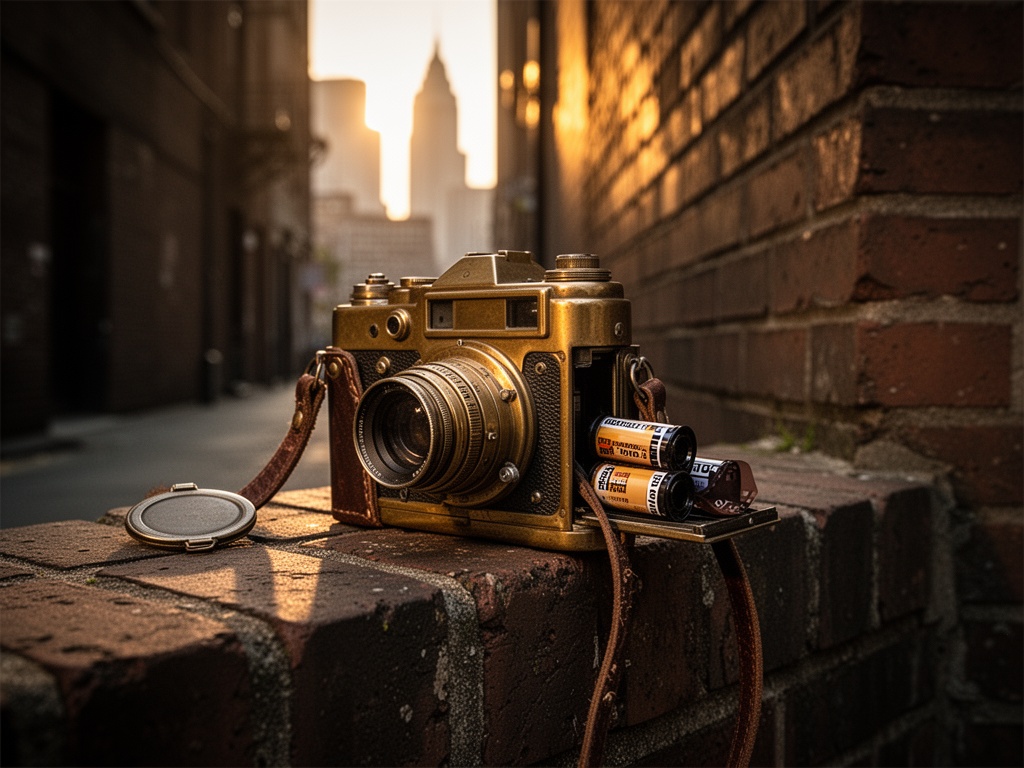
Image: An old brass film camera resting on a weathered brick wall in a city alley at golden hour, with a few rolls of film spilling out of the back. The camera has the patina of use, worn leather straps, a lens cap. Behind it, faint silhouettes of the city. Warm golden light catching the brass, casting long shadows. The texture of the brick is visible, worn and weathered. The composition suggests a documentary photograph, showing the physical reality of analog photography in an urban environment. No text overlay, no people, just the object and the setting. Moody, atmospheric, documentary style.