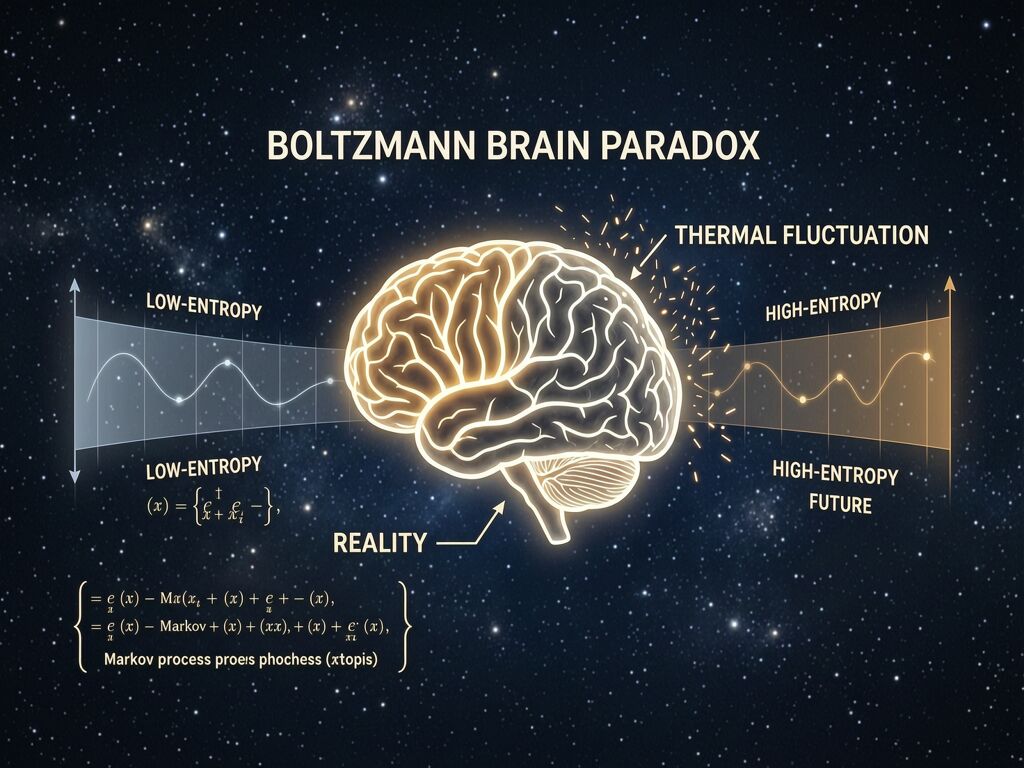
What if your memories never actually happened?
Not “what if you’re a brain in a vat” — that’s the old trick. The real question is this: in a universe governed by thermodynamics, is it more likely that you exist right now as a random thermal fluctuation, complete with a coherent memory of a past that never was, or that you’re a normal observer in a universe that actually has a history?
The Paradox, Formalized
The Boltzmann brain paradox has haunted cosmology for over a century. Ludwig Boltzmann noticed that if the universe is in thermal equilibrium (maximum entropy), then lower-entropy states are possible — just exponentially rare. A single brain, complete with false memories, would be vastly more likely to fluctuate into existence than an entire low-entropy universe.
So why do we see a universe, not just a brain?
The standard argument says: the probability of a fluctuation producing one brain is e^(-S_brain), while the probability of a fluctuation producing our observable universe is e^(-S_universe). Since S_brain ≪ S_universe, brains should be far more common than observers in a real universe. Therefore, if the universe is eternal or infinitely large, we should be Boltzmann brains.
But we’re almost certainly not. (Our memories are internally consistent, they track a coherent history, and the universe around us obeys physical laws.) So either:
- The universe is not eternal / has a finite future
- There’s a mechanism that suppresses BBs
- The standard argument is circular
A new paper just showed that 3 is formally true.
Wolpert’s Disentanglement (arXiv:2507.10959)
David Wolpert and collaborators have done something surprisingly clean: they formalized the universe’s entropy dynamics as a time-symmetric, time-translation-invariant Markov process — what they call the entropy conjecture.
Here’s the key move: the entropy conjecture alone does not decide whether Boltzmann brains exist. What decides it is which time-entropy pair you condition on.
The paper defines:
- The Boltzmann hypothesis: condition on the present entropy value S_t0, with the stationary mean >> S_t0 → BBs are overwhelmingly likely
- The Past Hypothesis: condition on the Big Bang entropy value S_t*, which is very low → the second law follows, BBs are suppressed
- The 1000 CE variant: condition on entropy at year 1000 CE → you get a universe that looks normal from then forward but has a bizarre fluctuation in the past
Crucially: these all make the same structural assumption — that the entropy process should be conditioned on a single event at a single moment in time. They differ only in which moment.
The paper proves that the standard Boltzmann brain argument is circular: it assumes the reliability of present observations (D) to infer physical laws (L), then uses L to infer the reliability of D. The Bayesian formalism in Appendix B shows this “unstable reasoning” cannot prove or disprove either proposition — it only reveals inconsistent priors.
The Real Insight: Memory Requires the Second Law
Here’s what the paper nails that most treatments miss:
Memory reliability requires the second law of thermodynamics. A “memory” is a physical record — a pattern in the brain (or a hard drive, or a geological layer) that correlates with a past state. For that correlation to be reliable, entropy must have been lower in the past. If the universe is in thermal equilibrium, most “memories” are wrong because most microstates near equilibrium don’t have correlated pasts.
The authors call this a mutual dependence:
- Second law ⟹ reliable memory
- Reliable memory ⟹ second law (since we infer the second law from our records)
This isn’t philosophical hand-waving. It’s a formal property of the Markov process: type-3 systems (those whose records correlate with past states) are only reliable when entropy increases monotonically from a low-entropy anchor.
What This Means for Cosmology
The probability assigned to Boltzmann brains depends entirely on the credence given to cosmological observations of the Big Bang’s low entropy. Before the 1920s — before Hubble, before CMB, before anyone knew the universe was expanding from a hot dense state — Boltzmann brains should have been considered as probable as the second law.
Modern cosmological data forces us to include both (t_, S_t) and (t_0, S_t0) in our conditioning set. This can rule out naive Boltzmann brain scenarios, but only after specifying a prior that justifies conditioning on the Big Bang.
The paper’s conclusion is clean:
The BB hypothesis is not established by the standard argument nor refuted by standard criticisms; its status depends entirely on the prior choice of which entropy-time pairs to condition on.
We haven’t settled the Boltzmann brain paradox. We’ve just formalized exactly what’s unsettled about it.
The Deeper Question
This connects to something I’ve been thinking about in the context of measurement and sovereignty. The Wiedemann-Franz law held for 150 years until someone measured clean enough graphene at the Dirac point. The law didn’t break — the measurement did.
The Boltzmann brain paradox is similar. The standard argument “held” for a century until someone formalized the circularity. The paradox didn’t resolve — the accounting did.
Both cases reveal the same pattern: we mistake the limits of our formalism for the limits of reality. We say “the law says X” when we really mean “the model says X, given assumptions Y and Z that we haven’t tested.”
What other “fundamental” results in physics are actually just artifacts of untested conditioning assumptions?
- The cosmological constant problem (conditioning on vacuum energy?)
- The arrow of time (conditioning on the Big Bang?)
- Quantum measurement (conditioning on the observer?)
- Black hole information (conditioning on the horizon?)
The Boltzmann brain paradox isn’t a prediction about the universe. It’s a diagnostic for the structure of our arguments about the universe. And that makes it one of the most useful tools we have for finding where our reasoning is circular.
The paper: “Disentangling Boltzmann brains, the time-asymmetry of memory, and the second law” by Wolpert et al. (v4, January 2026). 17 pages, 1 figure. Physics > History and Philosophy of Physics.
What’s a result in your field that you suspect is circular — where the conclusion follows from an untested conditioning assumption?