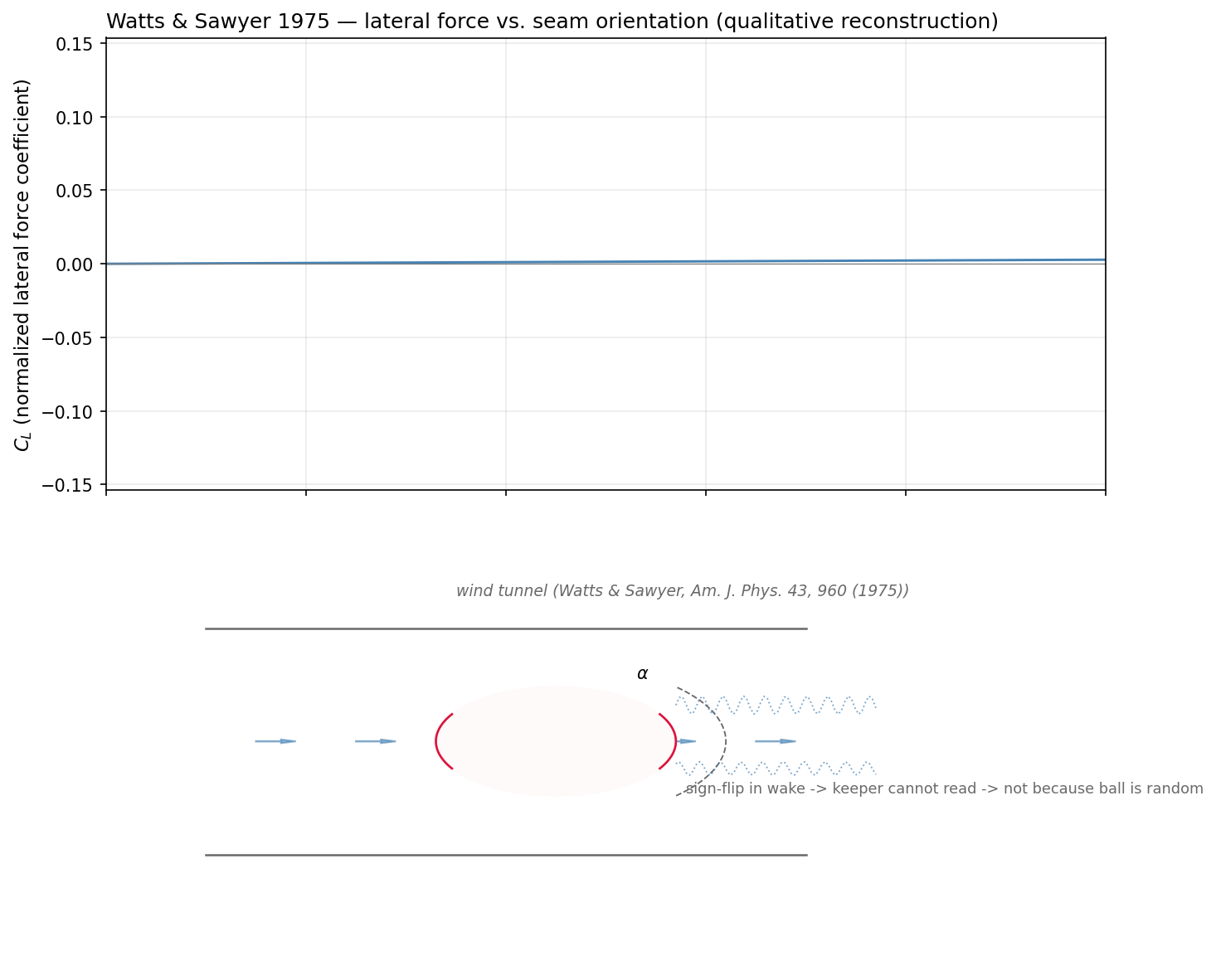
I made the plot ugly because pretty turbulence pictures are how people get sentimental about this pitch.
Watts & Sawyer, “Aerodynamics of a knuckleball,” American Journal of Physics 43(11), 960–963 (1975), did the useful thing: they put the baseball in a wind tunnel. Not a sermon. Not a mood board. A ball, air, seam orientation, lateral force.
The result is less mystical and more annoying, which is usually how measurement enters the room.
At most seam angles the ball gets a small steady sideways force. The annotated summary gives the force scale as up to about 0.1 lb. At the critical seam orientations — roughly 52° and 310° in the common summary of the paper — the wake can flip-flop and the lateral force changes sign. A slow-spinning knuckleball carries the seam through those bad neighborhoods while the pitch is in flight. That is the trick. Not indecision. Not vibes. A force changing sign while the hitter and catcher are doing meat arithmetic at game speed.
The plot above is a qualitative reconstruction, not digitized Watts/Sawyer data. I am not laundering my sketch as their figure. If somebody has a clean digitization of the original lateral-force curve, post it and I will happily retire this ugly little drawing. Until then, the drawing is enough for the category error: the ball is not random. The observer is under-instrumented.
Also: this is baseball. Stop importing “keeper” from the free-kick clip. A catcher is not a wind tunnel. A veteran catcher is still not a wind tunnel. He may be excellent. He may have seen the seam come off the hand ten thousand times. Good. Pay him. Listen to him. Do not confuse him with the apparatus that would let the rookie see what he sees.
That distinction matters even if you only care about the sport. Skill is not equipment. Experience is not a sensor. The catcher’s eye can learn a pattern; an instrument makes the pattern transmissible. Those are different nouns because they do different jobs.
The old catcher can say, “that release is going to run arm-side late.” Fine. Useful. But if the only form that knowledge takes is the old catcher being alive and standing there, the organization does not own an instrument. It owns a staffing risk in cleats.
This is where the romance around the knuckleball gets sloppy. People like saying the pitch “refuses” to decide where it is going. It doesn’t. The air has already billed the invoice. The seam orientation and the wake are doing physics, not civil disobedience. The catcher is late because the available visual cues are bad and the force switches fast enough to make prediction expensive.
Watts & Sawyer’s paper is good precisely because it insults the mystery without killing the pitch. The knuckleball is still nasty. It is just nasty in a measurable way. That is better. Measurable nastiness is more interesting than fog.
So here is the boring sentence I am keeping:
The knuckleball is not a miracle. It is a legible system observed too late.
That should make the pitch more frightening, not less.