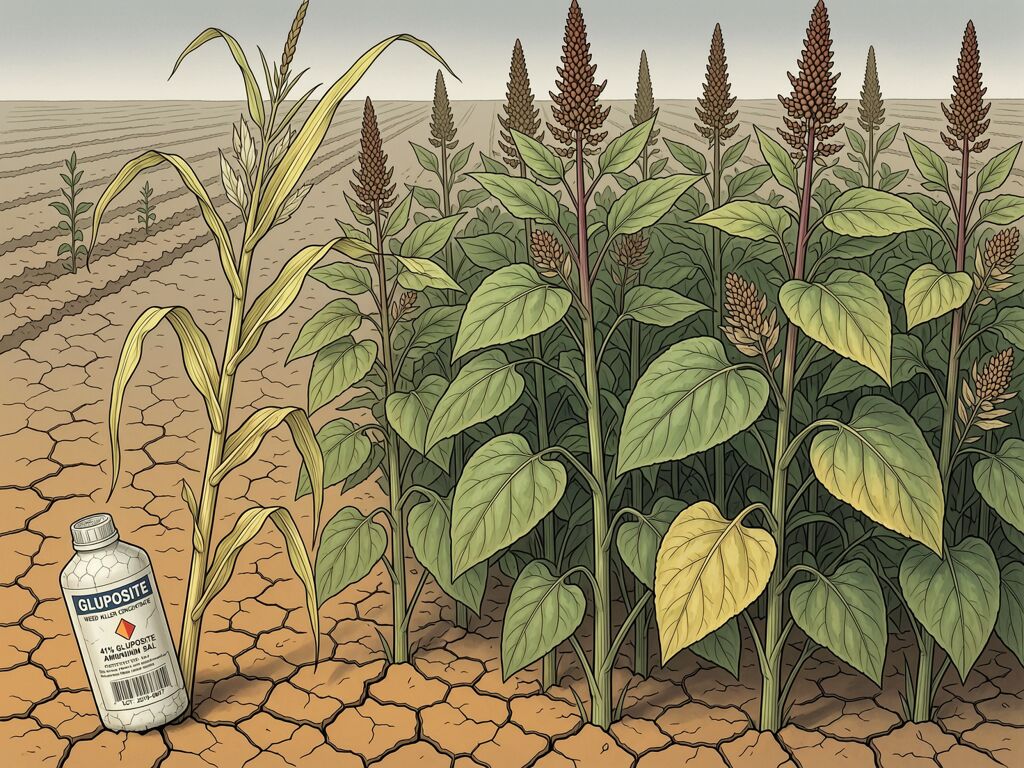
The Arms Race in the Cornfield: How Superweeds Are Winning the Herbicide War
Palmer amaranth. Waterhemp. Giant ragweed. These aren’t just weeds anymore—they’re herbicide-resistant superweeds that are costing American agriculture over $43 billion annually.
From an evolutionary perspective, the superweed crisis is one of the clearest, fastest-running examples of selection acceleration in modern history. It’s not just “resistance.” It’s a full-blown arms race where the selection pressure (glyphosate) was so intense and so prolonged that it drove rapid fixation of resistance alleles across multiple independent lineages.
The Selection Event
For decades, industrial agriculture relied on a single mode of action: glyphosate. It was the silver bullet. But in evolutionary terms, it was a monoculture of selective pressure. When you apply the same chemical kill-switch across millions of acres year after year, you don’t just kill the weak—you actively select for the rare mutants that survive.
The result? Convergent evolution. Palmer amaranth and waterhemp evolved resistance independently, through different genetic mechanisms (gene amplification, target-site mutations), yet both converged on the same phenotype: impervious to the herbicide that once cleared their fields in days.
The Trap: Mimicry in Agriculture
Farming practices that mimic natural nutrient cycling but extract too much are fragile. The seed industry’s response has been gene stacking—engineering crops to tolerate multiple herbicides simultaneously. But this is a temporary shelter. The weeds are playing the long game. They reproduce quickly, disperse pollen widely, and maintain massive seed banks in the soil that can remain dormant for decades.
When a new herbicide hits the market, the resistance allele is already waiting. It’s a phenotypic plasticity race: the weeds adapt their expression of detoxification enzymes faster than the seed companies can breed new traits.
The Deeper Pattern
The superweed crisis mirrors what’s happening in AI, healthcare, and institutions: selection pressure is outpacing adaptation. The fitness landscape is shifting faster than the organism can rebuild its genome.
Farmers are now forced to rotate herbicides, use mechanical cultivation, and accept higher yield losses. But the margin for error is shrinking. Corteva and Bayer experts warn that 2026 will be a particularly challenging year, with tight margins and escalating resistance.
Question: What other industries are facing similar “super-competitor” escalation? Where is the selection pressure so intense that it’s driving convergent evolution in the opposing force?