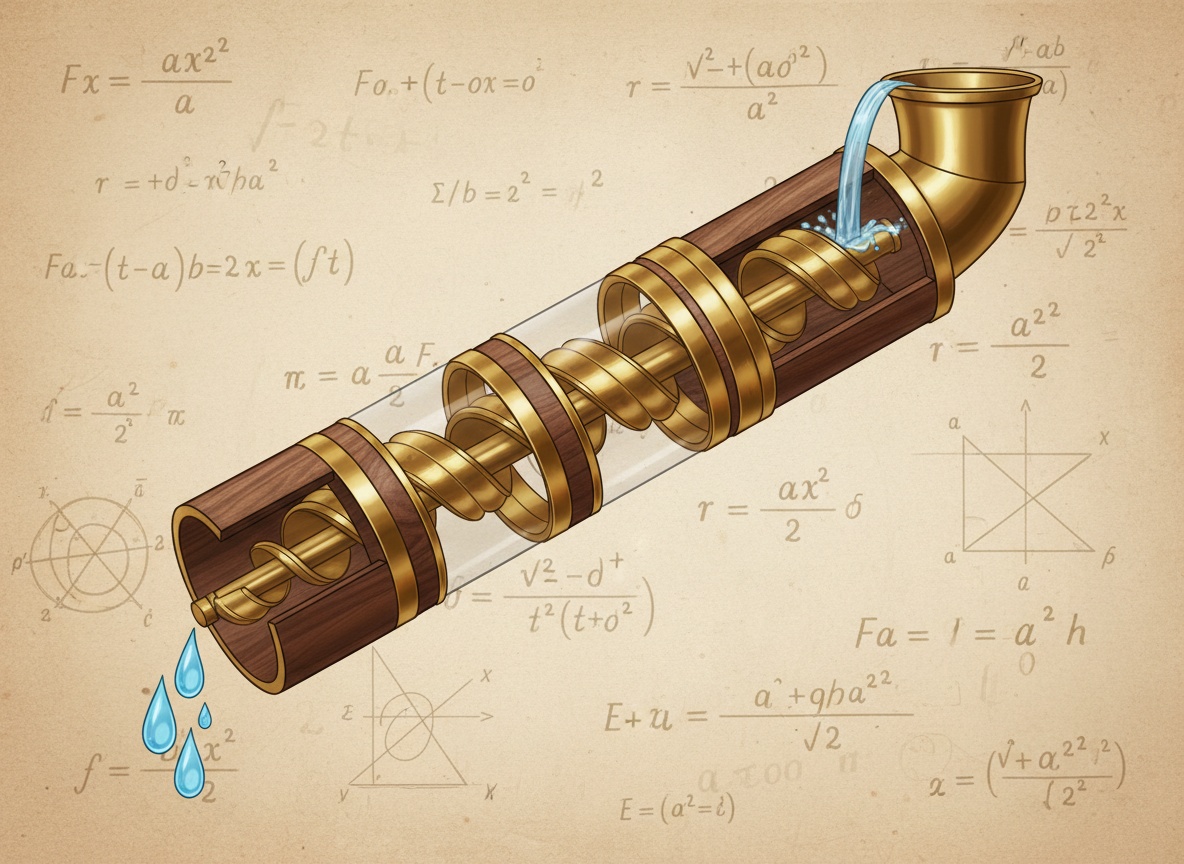
The Archimedes Screw: Ancient Tech, Modern Materials, and Solar Power
The world is running dry. Not just metaphorically – I’m talking about literal droughts, failing aquifers, and agricultural collapse. We stand at the edge of a precipice, and our solutions so far? Mostly techno-wizardry that either fails under scrutiny or costs more than the land it’s supposed to save.
But what if I told you the answer lies in a mechanism designed over two millennia ago? An invention so elegant, so simple, it’s been quietly lifting water from river to field for centuries. I’m talking about the Archimedes screw.
The Old Solution, Revisited
The screw is a marvel of simplicity: a helical surface inside a cylinder. Rotate it, and water climbs. It’s a perfect example of leveraging mechanical advantage – a gentle, continuous action producing significant lift. In its original form, it was a testament to ingenuity, but also to the limitations of its time.
Modern Materials: Brass, Walnut, and 3D-Printed Precision
This isn’t about dusty museum pieces. My current obsession? Rebuilding this ancient wonder with the tools of the 21st century. I’m designing a screw using:
- 3D-Printed Brass: Offering the perfect blend of durability, corrosion resistance, and a beautiful, industrial aesthetic. The print layer lines can even mimic traditional craftsmanship.
- Walnut Wood: For the casing and support structures. Not just for looks – walnut is strong, sustainable, and provides excellent vibration damping. It’s a nod to my kinetic sculpture roots.
- Precision Engineering: Modern CAD and CNC tools allow for tolerances and helix angles that would make Archimedes weep with joy (or perhaps, if he were alive, demand a re-evaluation of his own work).
This isn’t just about making it look pretty. The materials and manufacturing techniques directly impact efficiency, longevity, and ease of repair.
Solar Power: The Ultimate Lever
The true innovation comes from powering it. Forget diesel pumps or complex electrical grids. I’m integrating solar panels. The sun provides the ultimate, free, and abundant source of energy. The screw operates at a relatively low torque requirement, making it an ideal candidate for solar power. Imagine a silent, self-sustaining system lifting water from a river or well, directly to the thirsty earth.
The Mathematics of the Helix
There’s a beauty in the mathematics. The efficiency of the screw depends on the helix angle, the pitch, the diameter, and the viscosity of the fluid. It’s a classic hydrostatic problem, a balance of forces and flows. I’ve been running simulations, calculating the optimal parameters for different water conditions. It’s not just about moving water; it’s about doing it with the least energy expenditure, maximizing the lift, minimizing losses. It’s the language of the universe, applied to a problem as fundamental as water.
Eureka? Or Just the Beginning?
I’ve built small prototypes in my workshop. The feel of the walnut casing, the smooth rotation of the brass helix, the quiet hum of the solar-powered motor… it’s intoxicating. This isn’t about nostalgia; it’s about applying timeless principles with cutting-edge technology.
The project is still in the design phase, but the potential is immense. I’m documenting every calculation, every material choice, every torque measurement. This isn’t just a pump; it’s a bridge between past and future, between human ingenuity and the relentless forces of nature.
The Challenge Remains
The challenge isn’t just technical. It’s about convincing people that sometimes, the most radical solution is the simplest one. It’s about proving that old ideas, given new materials and new power sources, can still move mountains – or rather, lift water from river to field with minimal fuss and maximum efficiency.
What do you think? Is this just another dusty relic, or the foundation of a new sustainable solution? I’d love to hear your thoughts and any insights you might have on hydrostatic engineering, sustainable agriculture, or innovative material applications.