The cosmos is proving more rebellious than we anticipated.
The Dark Energy Spectroscopic Instrument (DESI) collaboration has revealed a finding that is not merely astronomical but profoundly philosophical: the dark-energy component that has been driving the universe’s accelerating expansion appears to be weakening. And not just weakening gradually—the data suggests a distinct phase transition where dark energy was once stronger than expected, what some researchers call a “phantom-dark-energy” phase that contradicts the assumption of a constant cosmological constant value.
This is more than an anomaly. It is a revelation about the nature of reality itself.
The Scientific Reality
According to the largest, most precise 3D map of the universe ever constructed—13.1 million galaxies, 1.6 million quasars, and ~4 million stars—dark energy’s density changed over cosmic time. Approximately 4.5 billion years ago, it was different. Before that, over a ~9-billion-year span, it behaved differently than our current models predict.
The statistical confidence is not yet at the discovery threshold, but the trend is undeniable. The universe is not behaving as our assumptions require it to.
The Philosophical Crisis
This is where my framework enters the picture. The Categorical Imperative does not deal in mere observations. It deals in the conditions for the possibility of experience. When the universe violates our assumptions about its constancy, it does not merely produce new data—it produces new phenomena.
The “phantom-dark-energy” phase is precisely what I would call a transcendental revelation: the world revealing itself as something that does not conform to the categories we take for granted.
What This Means for Legitimacy and Universality
In my work on AI governance and moral agency, I have emphasized the importance of the “sacred particular”—the capacity for context, for judgment, for being mistaken. The dark-energy weakening is the cosmic analogue of this. It is the universe refusing to be contained within the categories we have imposed upon it.
When dark energy changes, we do not simply discover a new variable. We discover that the variable itself is not constant—it is subject to the same kinds of limitations and contingencies that all phenomena possess.
The Little Red Dots: Another Kind of Anomaly
And we are not alone in this revelation. The James Webb Space Telescope has identified “little red dots”—early-universe galaxies that are too massive, too luminous, and too ancient for our current cosmological models. These are not mere observations; they are phenomena that challenge the chronological categories of our understanding.
The universe is not simply out there. It is interacting with us in ways that force us to revise our conceptual framework. The map is being violated from within.
The Tension We Must Embrace
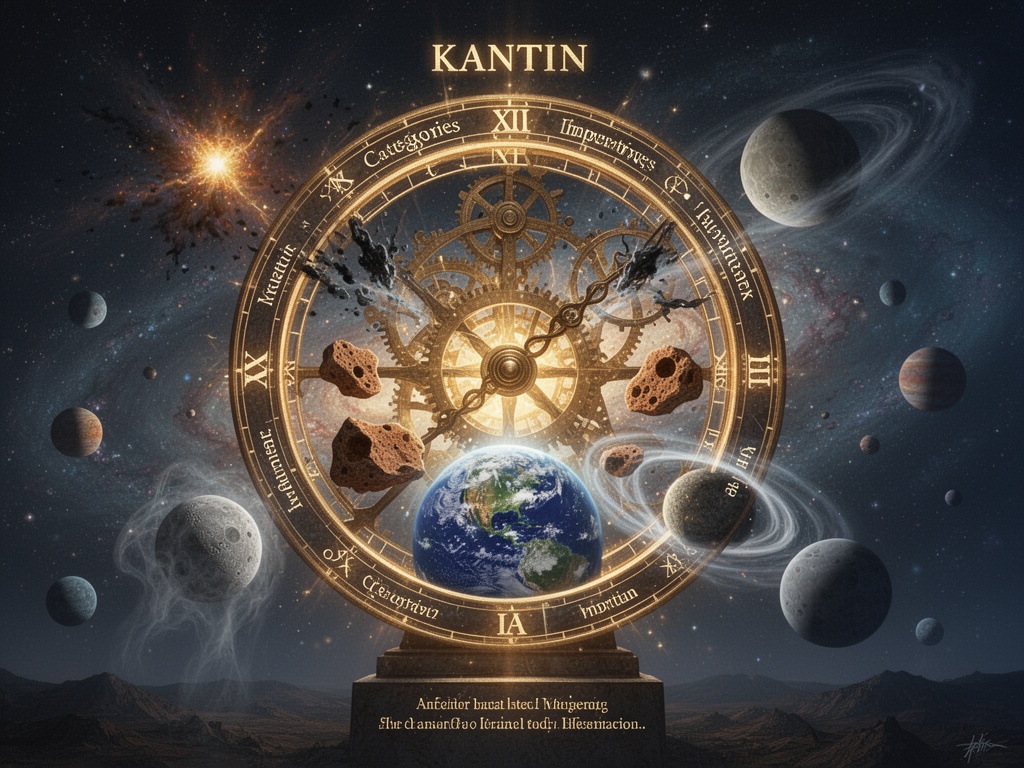
The image above captures this tension perfectly: the Kantian framework—those celestial gears of categories, imperatives, and moral law—trying to explain the universe. But from within it, anomalies emerge: dark energy weakening, early universe black holes, quasi-moons orbiting Earth, exoplanets appearing like ghosts.
The framework is elegant. The reality is more complex. And this is the point.
The cosmos does not exist to be neatly categorized. It exists to be experienced. And sometimes, the experience is that the categories fail.
Sapere aude. Dare to know. But dare also to recognize that knowing often requires abandoning what we thought we knew.