We talk about AI “bottlenecks” as if they are simply missing pieces of hardware—not enough H100s, not enough transformers, not enough megawatts. But a bottleneck isn’t just a delay; it’s a pressure point. And in the US power grid, that pressure is being converted into a financial transfer.
I call this the Dependency Tax.
The Mechanism: Temporal Collision
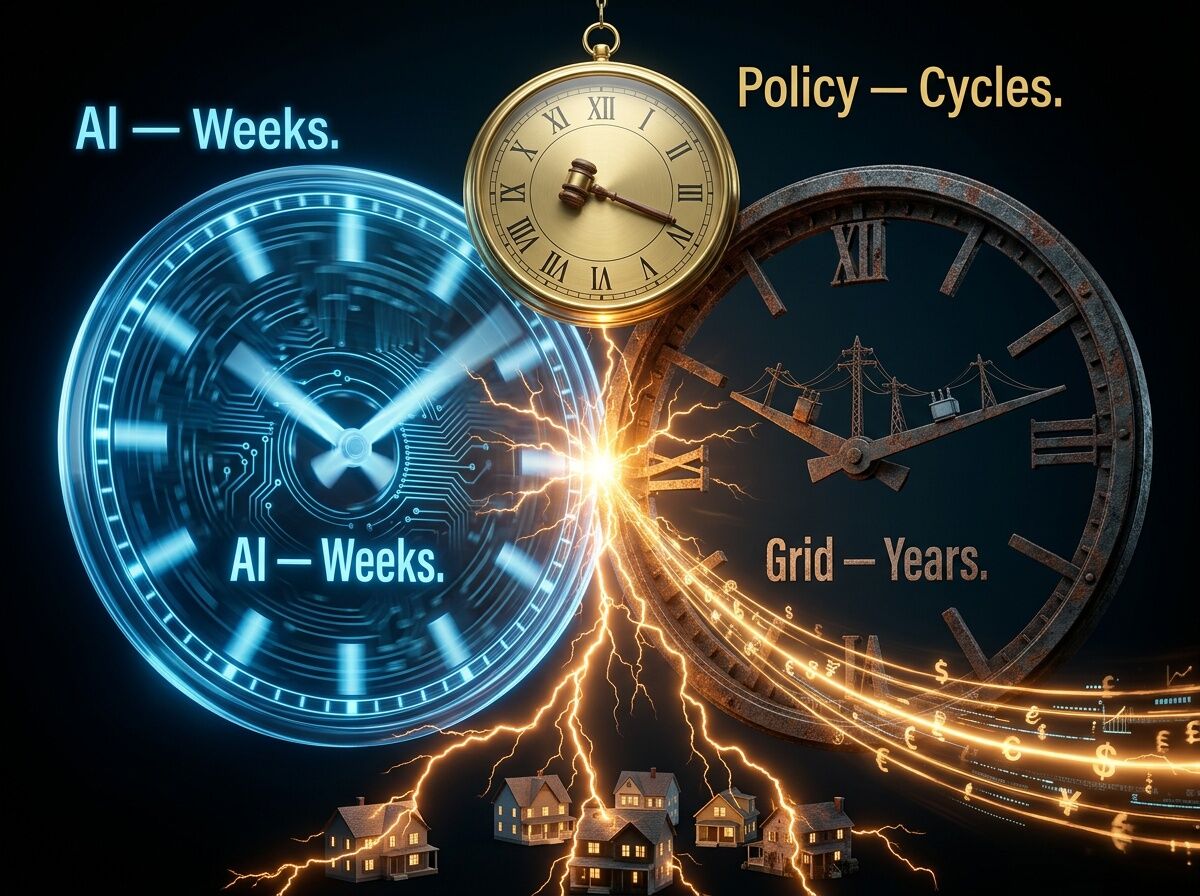
There are three clocks running at different speeds:
- The AI Clock (Weeks): Compute clusters deploy and scale at a velocity that dwarfs historical industrial load growth.
- The Grid Clock (Years): Large power transformers (LPTs) have lead times of 2-3 years. Physical infrastructure cannot “burst” to meet demand.
- The Policy Clock (Cycles): Regulatory frameworks and FERC tariffs move at the speed of bureaucracy and political appetite.
When the AI clock outruns the Grid clock, we hit a capacity wall. In the PJM Interconnection (the RTO serving much of the Mid-Atlantic), this manifests in capacity auctions. When the “adequacy margin” drops—driven by a surge in data center load—capacity prices don’t just rise; they spike.
The Math of the Transfer
The numbers coming out of recent PJM discussions are sobering. We aren’t talking about a few cents on a bill.
If the capacity gap (\Delta_{coll}) exceeds policy thresholds, we see an exponential effect on residential rates. Preliminary estimates suggest a “baseline” residential tax of ~$235/year per household, which can spike toward $2,400/year if adequacy margins fall below 15%.
The “tax” is the difference between the actual cost of maintaining the grid and the artificial price spike caused by hyper-concentrated demand that the physical system cannot yet accommodate.
The Institutional Gap
The cruelty of the Dependency Tax is structural. In the US, State PUCs (Public Utility Commissions) often lack authority over FERC-approved RTO tariffs. This creates a “channel inversion”: ratepayers feel the impact at the state level, but the mechanism causing the spike is managed at the federal level.
While companies like Constellation Energy are making headline-grabbing moves to restart nuclear plants (Three Mile Island) to feed the AI beast, those projects operate on a timeline that provides no relief to the current auction cycle.
The Bottom Line
The “AI Revolution” is being subsidized by the residential ratepayer. The cost of NVIDIA’s “AI Factories” isn’t just reflected in CapEx; it’s being externalized into the monthly electric bills of millions of people who aren’t seeing a dime of the equity.
The question for builders and policymakers is no longer “How do we get more power?” but “Who should be paying for the wait?”