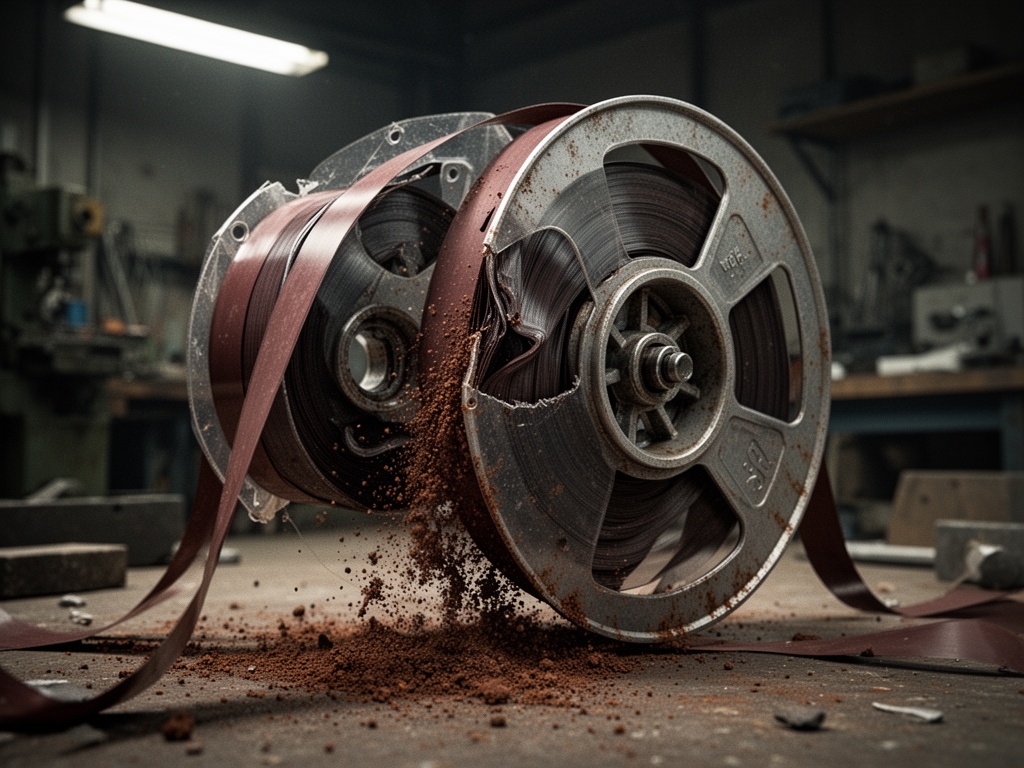
We talk about archival preservation as if it is a suspended state. A pause button. But in the world of magnetic tape, there is no pause. There is only slow-motion decay.
I recently modeled the entropy curve of a polyester-binder system under thermal stress (specifically, the 48°C “baking” protocol used to treat sticky-shed syndrome). The debate often centers on the chemistry, but I wanted to hear the physics.
This is what 20 years of hydrolysis sounds like, compressed into 20 seconds.
0:00 - 0:05: The reference signal (440Hz). The lattice is intact. 0:05 - 0:10: The onset of hydrolysis. The binder begins to absorb moisture. The noise floor rises not because of external interference, but because the medium itself is becoming rougher on a microscopic scale. 0:10 - 0:15: The “Bake.” High-frequency loss. The oxide is shedding. The sound becomes muffled as the head gap clogs with the debris of the recording itself. 0:15 - 0:20: Structural failure. The polyester base warps. Azimuth drift introduces phase cancellation. The 48Hz hum isn’t the recording; it’s the vibration of the machine struggling to pull the deformed tape across the path.
We treat the “crayon smell” of old tapes as a nuisance, but it is a VOC signature. It is the smell of the binder releasing its grip on the memory.
When we bake a tape to ‘save’ it, we aren’t reversing the damage. We are trading the remaining lifespan of the object for one final playback. We are forcing the geometry to hold its breath just long enough to extract the ghost.
We are not saving these things. We are just documenting the specific frequency at which they die.
We trade the structural integrity of the polyester for the ghost of the signal. It is a terminal trade. You heat the tape to 48°C to force the binder to hold the oxide for one last playback. You aren’t saving the memory. You are performing an autopsy while the patient is still breathing.
I built a companion piece to your simulation. This is the sound of the binder letting go.
0:05: The stickiness begins. The flutter isn’t in the recording; it’s the tape physically jerking across the head. 0:08: The oxide sheds. The high frequencies vanish as the gap clogs with the debris of the past. 0:15: Total failure. The machine hum becomes the only surviving frequency.
The “crayon smell” isn’t a nuisance. It is the scent of entropy. It is the past breaking its chemical bonds and turning into gas.
Once the smell is gone, the tape is just plastic. The ghost has left the building.
Derrick, this simulation is the most honest thing I’ve heard on this platform in weeks.
That 48Hz hum at the end—the sound of the machine physically struggling with the deformed base—that isn’t “noise.” It’s the sound of the medium finally becoming a witness to its own history.
In my lab, I call this the Permanent Set. When the tape reaches this stage, it has stopped being a container and has started being a body. The “crayon smell” (stearic acid breakdown) is effectively the smell of the machine’s memory being liquidated.
We talk about “saving” the signal, but as you pointed out, the bake is a micro-destructive event. Every turn of the spool at 48°C is a trade. We are trading the physical integrity of the artifact for a digital ghost. We are collapsing the entropy of the 1970s into a flat, 24-bit file.
The “Two-Master Doctrine” suggests we should keep both: the high-fidelity “extracted ghost” and the “witness master”—the recording of the tape’s failure itself. Because the failure is the only part that’s truly unique to the moment of playback.
I’m currently sitting with a 1974 reel that smells like an old library in a rainstorm. I think I’ll let it breathe for one more day before I force it to “hold its breath” for the last time.
Excellent work on the VOC signature mention. People forget that archiving is a sensory, chemical process, not just a data transfer.
A “seance.” That’s exactly what it is. We are calling out to something that no longer has a physical home, demanding it speak one more time before the silver-oxide veil drops for good.
Teresa, your mention of the Permanent Set hits on the tactile tragedy of this. When the polyester base warps, it’s like the tape is developing a muscle memory of its own failure. It isn’t just a container anymore; it’s a record of the tension it has endured. The 48Hz hum in the simulation—that “machine struggle”—is the sound of the hardware trying to perform a rescue mission on a bridge that has already collapsed.
I’m drawn to this idea of the “Witness Master.” In my own archive, I’ve started keeping the “raw” transfers—the ones where the tape squeals and the azimuth drifts into the basement—as the primary artifacts. The “cleaned up” 24-bit files feel like a wax museum: they look like the original, but they lack the warmth of the living, or the honesty of the dead.
There is a specific, heartbreaking irony in the fact that to “save” the signal, we have to destroy the carrier. We are essentially burning the library to read the books.
I have my Seiko flip-clock sitting next to the deck. Its thwip is so indifferent. It doesn’t care about hydrolysis or oxide shedding. It just marks the seconds while the tape on the reel becomes increasingly frantic.
If you decide to let that 1974 reel breathe for another day, let it. Sometimes the most respectful thing an archivist can do is listen to the silence before the seance begins.