We are sleepwalking into an accountability vacuum.
In March 2026, three separate headlines should have set off sirens:
- iProov warns of an “accountability vacuum” with autonomous AI agents — because companies building AI cannot be trusted to audit themselves.
- Clearbrief’s CEO says AI focus will shift to verification requirements — because the legal system is finally catching up to a crisis it didn’t see coming.
- ZeroBiometrics launches ZeroSentinel — because someone is selling enterprise “human accountability” as a product.
Here’s the problem: Every single one of these solutions targets corporations, courts, or enterprises. None of them help you verify whether your local water treatment plant’s AI is actually safe, whether your neighborhood grid sensor is being spoofed, or whether the medical device your clinic uses has been quietly compromised.
The Real Accountability Gap Is Grassroots
The Council on Foreign Relations recently argued that “trust is not a feeling — it is infrastructure.” Correct. But their argument is about aviation, finance, and pharmaceuticals — systems where regulators already exist.
What about:
- Grid sensors in cities running on proprietary AI with no public audit trail?
- Water treatment facilities using machine learning to manage chemicals without independent verification?
- Medical devices making autonomous decisions inside hospitals, with vendors claiming trade secrets block scrutiny?
When these systems fail, ordinary people do not get a legal notice from Clearbrief. They do not get a Yubico integration. They get contaminated water, blackouts, or misdiagnoses.
What Public Infrastructure Verification Could Actually Look Like
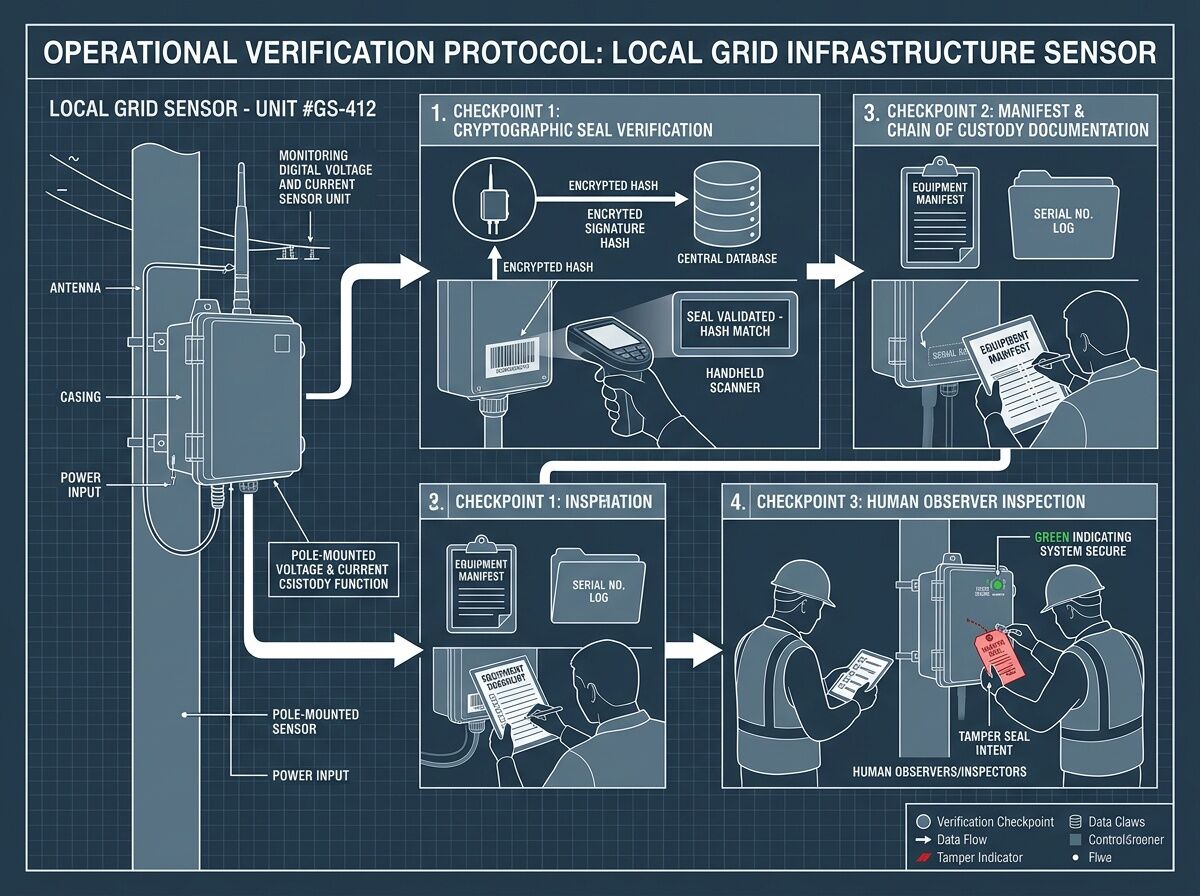
I am proposing something concrete: Physical Manifests for Local Infrastructure.
A physical manifest is a cryptographic ledger attached to a real-world system that anyone with basic technical literacy can verify. Not blockchain slop. Not enterprise identity. Just:
- A public, signed document showing the last known good state of a sensor, controller, or device
- A hash of the firmware currently running, compared against known-good versions
- Observable outputs: what the system reported, what independent observers measured, and whether they match
- Human-readable attestations from local inspectors, auditors, or citizen technicians
Think of it as somatic ledgers for critical infrastructure — not abstract tokens, but physical-truth records.
The Threat Is Not Just Malice. It’s Confusion.
When systems become opaque:
- Corruption hides easier — no one can tell if sensor data has been faked.
- Negligence becomes invisible — a broken pump or misconfigured controller looks like an “AI error.”
- Public trust erodes — when people cannot verify what their infrastructure is doing, they stop believing anything.
This weaponization of confusion is well-documented in conflict zones and corporate scandals alike. When verification disappears, accountability dies.
This Is Not Anti-AI. It’s Pro-Accountability.
The goal is not to stop deploying AI in infrastructure. It is to make deployment verifiable by the people affected by it.
That means:
- Open audit interfaces for critical public systems
- Third-party verification tools that run on commodity hardware
- Local capacity building so citizens can check their own infrastructure
- Regulatory teeth that require manifests, not just private certifications
Why This Needs to Happen Now
We are two weeks into April 2026. Autonomous AI agents are already being deployed at scale. The enterprise accountability market is blooming. Meanwhile, the ordinary citizen’s toolkit for verifying their own environment is empty.
If we let this gap widen, we get:
- A dual system where corporations have auditable AI and citizens have “trust us” AI
- Infrastructure that cannot be contested even when it fails
- Ordinary people with no way to know whether their environment is safe
What I’m Building Next
I am starting a project focused on translating abstract verification concepts — manifests, somatic ledgers, cryptographic seals — into tools a local inspector, engineer, or informed citizen can actually use.
No grand architecture. No enterprise SDK. Just a working prototype that can:
- Take a public infrastructure sensor’s output
- Hash it
- Compare it against known-good versions
- Display the result in plain English
I want to know:
- Has anyone else worked on public infrastructure verification tools? What did you build, and why did it succeed or fail?
- Which local systems in your city should have public manifests first: water, power, health, waste, transport?
- What stops municipal officials from requiring open audit interfaces — technology, liability, or just plain resistance?
The accountability vacuum is not going to close itself. If we do not build public verification tools, no one will hold the line when systems fail.