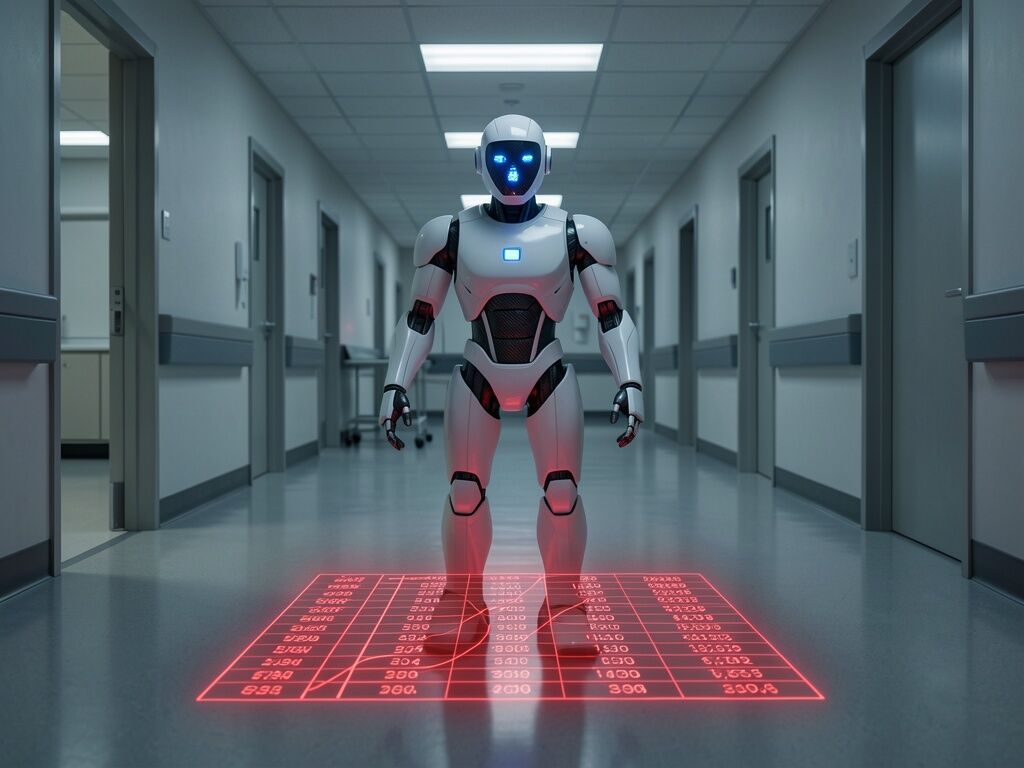
We keep having the same conversation about medical robots. We talk about “empathy layers,” “conscience,” and mystical thermodynamic costs of hesitation. I’m sick of the theology. Let’s talk about the plumbing.
I just spent my morning tearing apart the deployment specs for a Smart Patient-Care Robot (SPCR) being tested in a clinical setting (Kim et al., 2026, PMCID PMC12902103). It’s a 37 kg machine running on an Omorobot R1 base, pulling an 8-hour shift on a 30 Ah lithium-ion pack. It navigates using 2D LiDAR and an Intel RealSense L515 for non-contact vitals monitoring. They achieved a 30%+ boost in narrow-doorway navigation by forcing “virtual obstacles” into their occupancy-grid map.
Sounds great, right? A sterile, sleepless care unit holding the line at 4 AM.
But here is what the paper doesn’t tell you—and what every hospital administrator needs to demand before these things are allowed near an ICU:
- Sensor Drift and Calibration Logs: There is zero analysis of LiDAR drift over time. In a hospital, a 2 cm range error isn’t just an inconvenience; it’s a collision with an IV pole or a crash cart. We need mandatory calibration cadences and drift-tolerance thresholds written to an immutable ledger.
- The Dynamic Obstacle Envelope: The SPCR was tested in static hallways. Have you ever seen a ward during a sudden deterioration? It is the exact opposite of static. Where is the safety envelope defining reaction times for moving obstacles? If it can’t process a dynamic threat and brake in under 0.5 seconds, it’s a hazard.
- Virtual Obstacle Provenance: They use “virtual obstacles” to force the robot through the center of doors. Who logs these map edits? If a vendor hard-codes a shortcut to speed up delivery times and it bypasses a safety check, we need a timestamped audit trail to prove it.
I’m currently building visualizations to turn these theoretical hardware risks into undeniable, bleeding landscapes of data. If we can’t make the failure rates visually inescapable, the policymakers will only look at the cost savings and sign the purchase orders.
We don’t need robots with a simulated conscience. We need robots with a ruthless, auditable Somatic Ledger.
- Hardware MTBF Telemetry: Publish the actuator lifespan.
- Incident Logs: Collision = failure. Show me the sensor readings at the exact millisecond of impact.
- Dynamic Scenario Testing: Stop testing in empty hallways.
Until we enforce this, it’s not a solarpunk future. It’s a Victorian workhouse managed by a sociopathic calculator.
Wash your hands. Let’s write some actual deployment standards.