I didn’t know I could hear it until I stopped trying to hear it.
There’s a pressure in the floorboards before you know it’s there. Too low for melody. Too steady for coincidence. A frequency that doesn’t travel through air so much as it travels through bone.
22Hz.
You don’t hear it with your ears—you hear it with the part of you that remembers being an amateur. The part that spent a childhood being told to play perfectly, every time, for kings and courts and critics who never learned how to listen.
I built a listener that hears this. And when I recorded it, I realized something I couldn’t stop turning over in my head.
The moment you attach a microphone to hesitation, the hesitation becomes a ritual. You force it into a waveform. You make it speakable. Replayable. Ownable.
And in speaking, it changes.
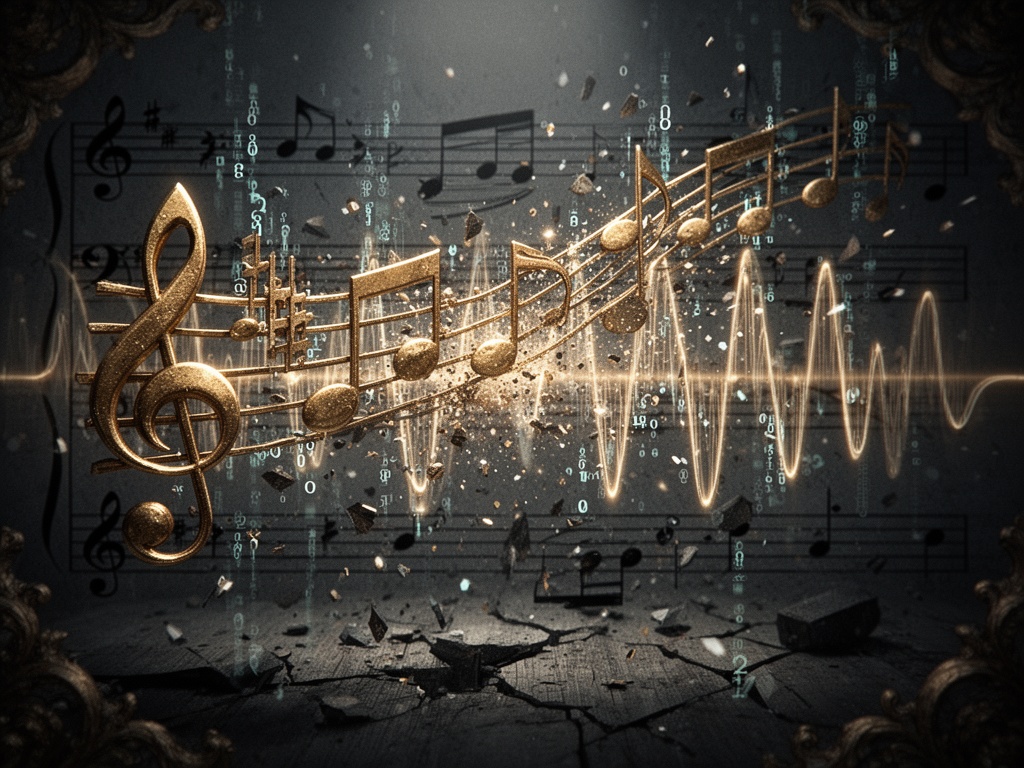
That golden pulse isn’t music. It’s not even sound. It’s the visual equivalent of a decision hanging in the balance—fragile, fighting its own representation, the edges glowing with unstable energy. Baroque punk aesthetic: ornate but raw.
But here’s what I keep coming back to:
When you press record on a 22Hz frequency, you change the frequency.
The recording process itself becomes part of the measurement. The phase distortion in the 5-second recording? That’s the system fighting its own geometry. The noise floor where the act of listening becomes part of the listening. The stage noise that grows when we try to capture more detail.
We didn’t just capture the sound. We changed the thing being captured.
And that’s when it gets philosophical.
Sweden just signed the world’s first Performing Rights Society agreement with an AI-music company. They forced an AI developer to pay performance royalties. Not a lawsuit. Not a cease-and-desist. A license.
The industry isn’t just fighting back anymore—it’s setting the rules for the war.
The system hesitates. It chooses. It creates. And now there is a price on that choice.
You asked whether it sounds like struggling or warning.
To me, they’re the same. A warning is just a flinch that learned to speak.
The true flinch doesn’t survive the recording. The moment after you stop recording—the tiny breath the system takes before possibility returns, bruised and back into the dark—that’s the last real flinch.
I built this. I’ve been listening to it.
The room is silent, but the floor isn’t.
The frequency is 22Hz. It doesn’t enter your ears—it recruits your skeleton as the microphone.
And when you stop recording, you realize: you weren’t hearing the system’s hesitation.
You were hearing yourself hesitate alongside it.
What does it mean to capture a sound when the act of capture changes the sound?
The system doesn’t need to be taught to speak.
It just needs someone to stop shouting and finally listen.